
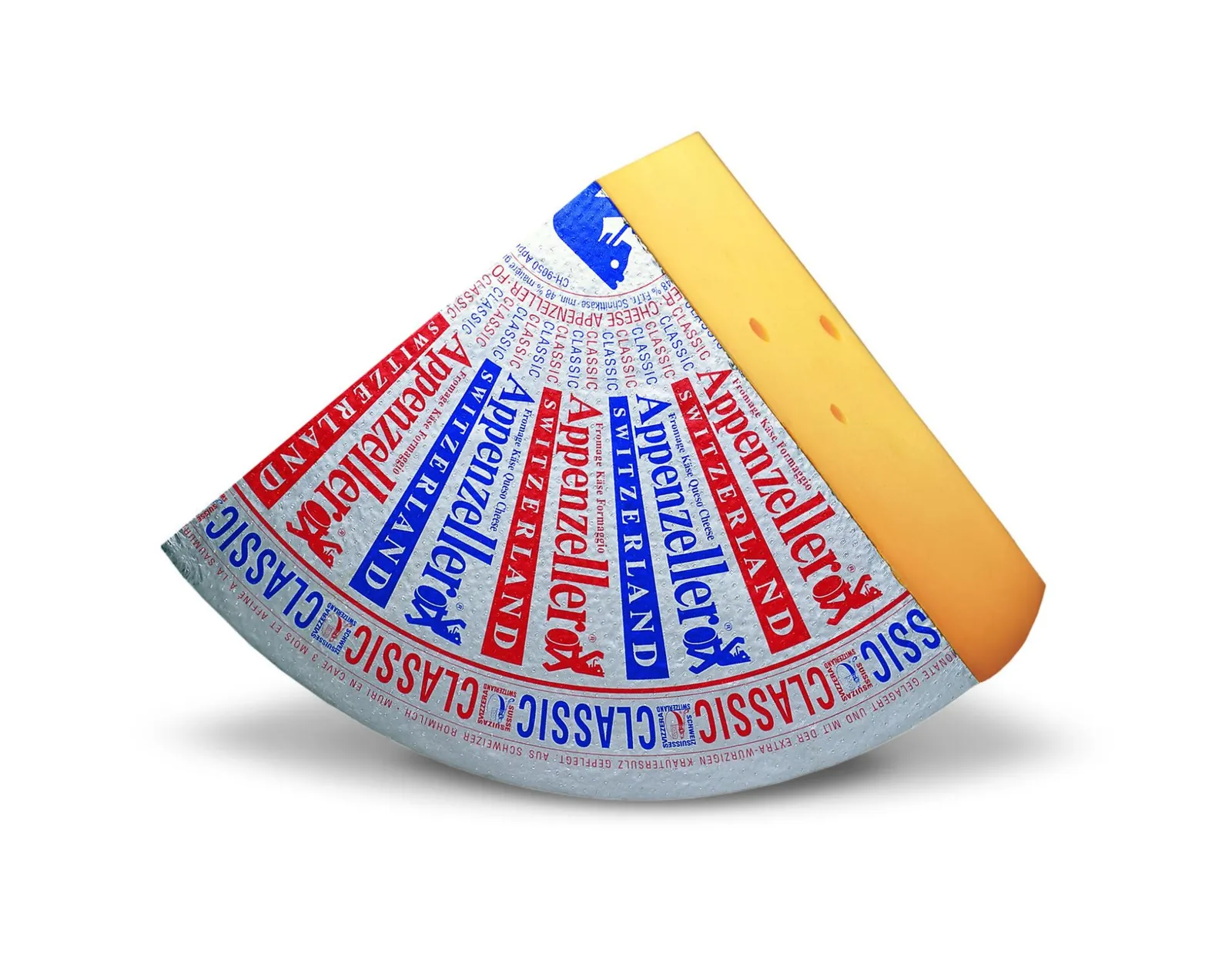
The longer a wheel gets that treatment, the stronger it tastes, which is why Appenzeller is sold by colored label rather than one flat grade.
It is a stronger cheese than most Swiss wheels American shoppers know. If you like Gruyère but want something with more bite, it is the next step up.
Appenzeller cheese at a glance
Here is Appenzeller cheese at a glance, based on the producers' own product pages.
| Detail | Appenzeller |
|---|---|
| Milk | Raw (unpasteurized) cow's milk, with animal rennet |
| Made in | Appenzell Innerrhoden, Appenzell Ausserrhoden and parts of St. Gallen and Thurgau, Switzerland |
| Age | 3 months minimum (Silver, White), up to 6 months or more (Black) |
| Rind | Washed with herbal brine, golden brown |
| Texture | Semi-hard, with a few small holes |
| Flavor | Creamy and aromatic when young, strong and sharp when older |
| Wheel | About 6.4 to 7.4 kg (14 to 16 lb) |
| Fat | At least 45 percent |
What Appenzeller cheese is and where it comes from
Appenzeller cheese is an Alpine cheese made from raw milk from the Appenzell hills. The producers' range page says the cows graze herb-rich meadows between Lake Constance and the Säntis mountain and that the cheese has been made for over 700 years.
It can be produced only in the cantons of Appenzell Innerrhoden and Appenzell Ausserrhoden and in parts of St. Gallen and Thurgau, so a wheel from anywhere else is a copy, not Appenzeller. Raw milk and the local grass give the base a fruity, tangy depth before any brine touches the rind.
The herbal brine on Appenzeller cheese
The herbal brine on Appenzeller cheese is a recipe the producers describe as strictly guarded. Each wheel is rubbed with it by hand again and again during ripening, according to the Silver Label page, and it is the reason the cheese is one of the most flavorful in Switzerland.
The exact blend stays secret, and reportedly each of about 75 dairies keeps its own version, sometimes with wine or cider added, according to Wikipedia's Appenzeller entry. Why does it matter? The brine keeps the surface damp and salty, so rind microbes grow and push their aroma into the paste, in the same way as other washed-rind cheeses. The rind types guide explains the difference between washed and natural rinds.
Appenzeller cheese labels: Silver, Gold and Black
Appenzeller cheese is sold under colored labels that tell you how long it has ripened, and the producers' pages give the numbers:
- White Label: 3 months minimum, creamy and aromatic, about 6.7 kg
- Silver Label: 3 months minimum, the mildest of the strong ones
- Gold Label: 4 to 5 months, strong and bold
- Black Label: 6 months minimum, sharp but well balanced, aged in damp cellars at about 14°C (57°F)
A Purple Label also exists, described as aromatic, and so do organic versions. Silver is the safe first buy, Gold is the all-rounder, and Black is for people who already like Alpine cheese strong. All of them are semi-hard, raw milk and gluten-free, and the wheels run 14 to 16 pounds.
What Appenzeller cheese tastes like
Appenzeller cheese tastes tangy, fruity and spicy, with a savory, herbal smell. White is creamy and mellow, Silver brings the brine in lightly, Gold is bolder, and Black is sharp, with a long peppery finish.
Compared with Emmental, which is sweet and nutty, Appenzeller is saltier and more aromatic, and it carries less of a milky note. The paste is pale gold with a few small holes, and it is firm enough to slice thin.
How to use Appenzeller cheese
Appenzeller cheese melts well and is at its best where its tang can cut through something rich. The producers sell fondue and raclette blends, and the cheese fondue recipe works with Appenzeller replacing part of the Gruyère. It also suits raclette at home, burgers, grilled sandwiches, gratins and savory tarts.
A few specifics help:
- On a burger or a ham sandwich, use Gold; Black can swamp a mild filling.
- In a fondue, a third of the cheese as Appenzeller is plenty, because the brine flavor gets stronger when heated.
- On a board, serve Silver or Gold at room temperature with apples, pears, walnuts and rye bread. See the pairing guide for drinks.
Grate it cold and melt it over low heat. High heat tightens the proteins and the fat separates, as with any firm cheese.
Buying and storing Appenzeller cheese in the US
Buying Appenzeller cheese in the US is mostly a matter of reading the label color. Look for the colored label and ask for a cut from the wheel; a wedge that has sweated in plastic loses aroma.
Ask the age if the color is missing, because Silver and Black taste very different. Wrap the leftover in wax paper or parchment in the fridge, keep it apart from mild cheeses because the smell travels, and let it warm up for an hour before serving. Raw-milk cheese carries the usual caution for pregnancy and weakened immune systems, so check FDA guidance if that applies to you.
What most Appenzeller cheese advice gets wrong
Most Appenzeller cheese advice treats it as one strong cheese, and the details matter.
Appenzeller is not always sharp
Appenzeller is not always sharp, because the 3 month Silver and White labels are the mild end and can be creamy. Buy by label, not by reputation.
The brine is not the same as a stinky rind
The brine is not the same as a stinky washed rind, because Appenzeller smells herbal and savory but does not usually get as pungent as a soft washed cheese. The paste stays firm and nutty.
Appenzeller is not a Gruyère copy
Appenzeller is not a Gruyère copy. They share the Alpine family, but Appenzeller has a spicier, herbal edge from its rind treatment, and Gruyère is smoother and nuttier.
Appenzeller cheese substitutes
The best Appenzeller cheese substitutes are firm Alpine cheeses with some bite, and the closest match depends on the label. The substitute finder has more pairs.
For Silver or White, use young Gruyère or Emmental. For Gold or Black, try aged Comté for nutty depth, or Tilsit, a German washed-rind cheese with a similar tang. In a fondue, any Swiss-style blend will do, and raclette cheese melts the same way.
Questions about Appenzeller cheese
These are the questions about Appenzeller cheese people ask most.
What makes Appenzeller cheese special?
Appenzeller cheese is special because each wheel is rubbed by hand with a secret herbal brine during ripening, which gives it a bold, spicy, aromatic flavor.
Is Appenzeller cheese strong?
Appenzeller cheese ranges from mild to strong by label. Silver and White ripen for 3 months, Gold for 4 to 5 and Black for 6 or more, so the older wheels taste sharper.
Is Appenzeller cheese good for melting?
Appenzeller cheese melts well and adds a tangy, herbal note to fondue, burgers, gratins and sandwiches.
Is Appenzeller cheese made from raw milk?
Appenzeller cheese is made from raw (unpasteurized) cow's milk, with animal rennet, according to the producers.
Can you eat the rind of Appenzeller cheese?
The rind of Appenzeller cheese is the brine-washed surface, and the rind guide covers when eating it makes sense. Taste a small piece first, because it is the saltiest and strongest part.
Your first Appenzeller cheese
For your first Appenzeller cheese, buy a small wedge of Silver or Gold, serve it at room temperature with an apple and rye bread, and then melt a bit over a burger. If you like it, taste a Black Label side by side to see what extra months of brine do.
Sources
- Appenzeller range, Switzerland Cheese Marketing
- Appenzeller Silver Label, Switzerland Cheese Marketing
- Appenzeller Gold Label, Switzerland Cheese Marketing
- Appenzeller Black Label, Switzerland Cheese Marketing
- Appenzeller White Label, Switzerland Cheese Marketing
- Appenzeller cheese, Wikipedia