
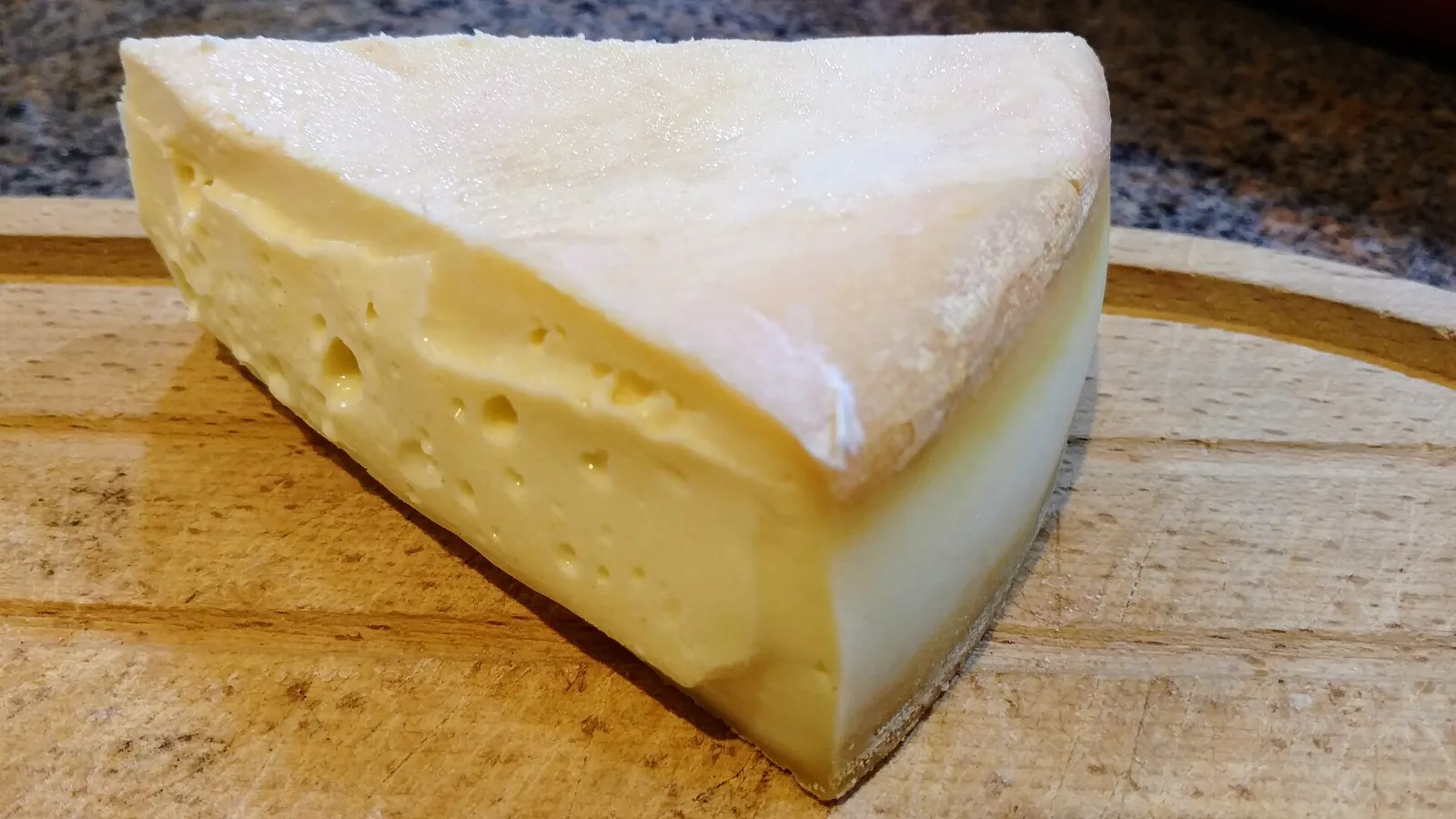
The rind is washed in perry made from Stinking Bishop pears, which feeds the bacteria behind the smell.
The smell is the famous part, and it is a bluff. The makers describe a pungent smell that belies a mild taste, and that gap between nose and mouth is the reason people who try it tend to come back.
Stinking Bishop cheese at a glance
Here is Stinking Bishop cheese at a glance, from the maker's profile and a reference summary.
| Detail | Stinking Bishop |
|---|---|
| Milk | Pasteurized cow's milk, mainly from Old Gloucester cattle |
| Made by | Charles Martell and Son, Dymock, Gloucestershire |
| Rind | Washed in perry; sticky, from white-yellow to orange |
| Age | Sources differ: about 6 to 8 weeks to about 4 months |
| Texture | Smooth, creamy, semi-soft |
| Fat | About 48 percent |
| Wheel | About 2 kg (4.4 lb), 20 cm (7.9 in) across |
| Flavor | Pungent aroma, mild savory, meaty and gently fruity taste |
Why it is called Stinking Bishop cheese
Stinking Bishop cheese is named for the Stinking Bishop pear, whose perry is used to wash the rind, not for its smell. Perry is the traditional pear cider of the region, and CooksInfo says the curds are washed with perry from these pears and the rind gets more perry washes as it ages. The smell lives up to the name anyway.
The cheese is made by Charles Martell and Son, and Martell revived the rare Old Gloucester breed, and it is still handmade at the family farm in Dymock. A profile in delicious. magazine says production is capped at just over half a metric ton a week, and that when more milk is needed it comes from a neighboring farm, Cotteswold Dairy.
Why Stinking Bishop smells so strong
Stinking Bishop smells strong because of its washed rind, and the perry washing both flavors the cheese and encourages the smell. Washing keeps the surface damp and slightly acidic, which suits the orange, sticky-rind bacteria that break down surface fat and protein into sulfur compounds. That chemistry is what you smell, and it stays mostly in the rind.
The guide to rind types explains how washed rinds differ from bloomy and natural ones. If this is your first one, the stinky cheese ranking puts it in context against Époisses and Taleggio.
What Stinking Bishop tastes like
Stinking Bishop tastes mild, savory and creamy under its rind, with a meaty depth, a faint fruitiness from the perry and, CooksInfo says, a tang like mild vinegar. A ripe wheel is soft enough to spoon. Most of the pungency sits in the rind and just under it, so if the smell puts you off, cut it away and you get a gentler, buttery paste.
The Wallace and Gromit connection helps explain its reputation: it featured in the 2005 film The Curse of the Were-Rabbit, and demand reportedly rose by 500 percent afterward, which pushed the dairy to expand.
Buying Stinking Bishop cheese in the US
Buying Stinking Bishop cheese in the US means finding an imported, boxed wheel at a cheese shop, so ask a monger to cut or hold one for you. Look for a wheel that is plump and sticky but not collapsing or bulging, and a smell that is meaty and funky, not sharp with ammonia. Check the date on the box and ask when the wheel arrived.
Because this is a soft, ripening cheese, buy it close to when you will eat it. Since it is made from pasteurized milk, it is not a raw-milk cheese; see the pasteurized vs. raw guide for what that does and does not mean.
How to serve Stinking Bishop cheese
Stinking Bishop cheese is best served at room temperature, when it is softest and most aromatic, spooned onto crusty bread, plain crackers or boiled potatoes. Take it out of the fridge an hour ahead. A little goes a long way, so one small wheel feeds a board of six to eight.
It also bakes well. Score the top, spoon a little perry or cider over it, and warm it in a hot oven until it is molten, then dip bread and apple slices. This is the same trick as baked Brie, with more punch. Cider with cheese covers the drinks, and perry, cider, a brown ale or a fruity white all work.
Stinking Bishop substitutes
The nearest substitute for Stinking Bishop is another washed-rind cheese with a sticky rind and a mild, savory paste, such as Taleggio, which is milder, or Époisses, which is stronger and runnier. For a mellower stand-in, a ripe Munster or a washed-rind soft cheese from a local creamery works. The substitute finder lists more.
Storing Stinking Bishop cheese
Store Stinking Bishop tightly wrapped in a sealed container in the fridge, because its smell travels, and eat it within days of ripeness. The storing cheese guide covers containers.
What most Stinking Bishop advice gets wrong
Most advice on Stinking Bishop repeats a few ideas that are only half right.
The name is about the pear
The name Stinking Bishop comes from the pear and the perry, not the odor. People who assume the smell named it miss the cider connection that pairs so well with the cheese.
The smell is not the taste
Stinking Bishop's smell is stronger than its taste, so smelling it and giving up is a mistake. Taste a small piece, rind off if you must.
Stinking Bishop cheese is not an ancient recipe
Stinking Bishop cheese is a modern cheese tied to the revival of Old Gloucester cattle, not a medieval one, and it is still handmade on a family farm.
Questions about Stinking Bishop cheese
These are the questions about Stinking Bishop cheese that come up most.
Is Stinking Bishop named for its smell?
Stinking Bishop is not named for its smell; it is named for the Stinking Bishop pear used to make the perry that washes the rind.
Does Stinking Bishop taste as strong as it smells?
Stinking Bishop does not taste as strong as it smells, because the pungency sits mostly in the rind and the paste is mild, creamy and savory.
Is Stinking Bishop pasteurized?
Stinking Bishop is made from pasteurized cow's milk, according to the reference summary.
How do you eat Stinking Bishop?
You eat Stinking Bishop at room temperature on bread or boiled potatoes, or baked in its box and dipped, with perry, cider or ale alongside.
Can you eat the rind of Stinking Bishop?
You can eat the rind of Stinking Bishop, and many people do, though trimming it gives a milder bite.
Your first Stinking Bishop cheese
For your first Stinking Bishop cheese, buy a small wheel close to when you will eat it, warm it for an hour, and serve it with bread, pears and a glass of cider. Taste the paste before you judge the smell.
Sources
- Charles Martell & Son Ltd, delicious. magazine
- Stinking Bishop, Wikipedia
- Stinking Bishop Cheese, CooksInfo