
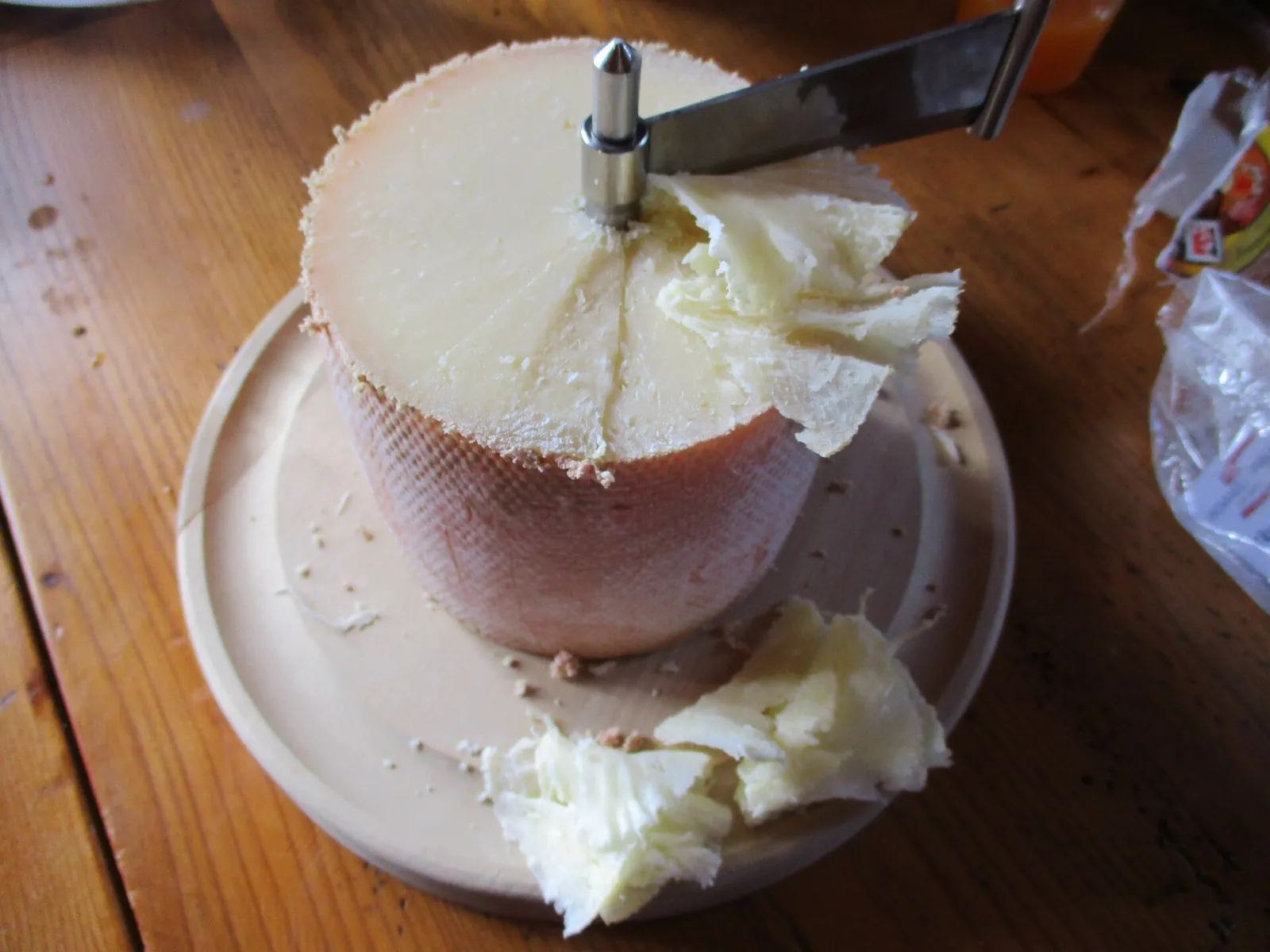
Its name means "monk's head," after the monks of Bellelay Abbey, and the shaved shape is the whole point of the cheese.
Thin curls of a firm cheese warm up the moment they hit your tongue, so the aroma opens up fast and the texture goes soft. Cut into a block, the same cheese tastes plainer and firmer.
Tête de Moine cheese at a glance
Here is Tête de Moine cheese at a glance, according to the Swiss AOP association.
| Detail | Tête de Moine AOP |
|---|---|
| Milk | Raw cow's milk, processed within 24 hours of milking |
| Made in | Mountain districts of the Jura and Bernese Jura, Switzerland |
| Protected name | AOP, registered May 8, 2001 |
| Age | At least 75 days, on spruce planks |
| Shape and size | Cylinder, 10 to 15 cm (4 to 6 in) across, 700 to 900 g (about 1.5 to 2 lb) |
| Texture | Semi-hard, delicate and supple |
| Flavor | Pure and aromatic, more pronounced with age |
Where Tête de Moine cheese comes from
Tête de Moine cheese was first recorded at Bellelay Abbey, where the monks' cheesemaking is written down as far back as 1192, according to the Swiss AOP-IGP association. The name "Tête de Moine" appeared in 1790, when the monks had been driven out and the farms around the abbey kept making the cheese.
The protected area is the mountain and summer-pasture zone of four districts in the canton of Jura and the Bernese Jura, and the name has been an AOP since May 8, 2001. The interprofession's site counts six dairies today and still points visitors to the Maison de la Tête de Moine in Bellelay. The guide to PDO and PGI labels explains what the AOP mark covers.
How Tête de Moine cheese is made
Tête de Moine cheese is made from raw milk, cooked in a copper vat within 24 hours of milking, according to the AOP association's product sheet. Cows eat grass in summer and hay in winter, and silage is banned all year.
The curd is pressed and molded, a casein mark goes on the fresh wheel, and it then sits in brine for at least 12 hours. Rubbed regularly with salt water, it ripens on spruce planks for at least 75 days. The wood and the rubbing build a thin rind and the aroma under it.
Why Tête de Moine cheese is shaved
Tête de Moine cheese is shaved because the thin curls change how it tastes. A girolle has a central spindle and a rotating blade. You cut off the top rind, set the cheese on the spindle and turn the blade, and it lifts off ruffled curls that are almost see-through.
Think about what that does. Each curl has far more surface area than a cut slice, so it warms to mouth temperature at once and gives off more aroma. The paste is supple, so it holds its frills instead of crumbling. That is guidance rather than a laboratory finding, but any cook who has tasted both forms will notice it.
The girolle itself is recent. A Jura precision mechanic invented it in the early 1980s (the AOP association's pages give both 1981 and 1982), and it has sold about 2.5 million units.
What Tête de Moine cheese tastes like
Tête de Moine cheese tastes pure and aromatic, with a nutty, fruity, slightly peppery depth that grows with age, and a texture that moves from firm to delicate as it is shaved. The producers describe the paste as delicate and supple, and the flavor as stronger the longer it ripens.
Shaved young, it is mild and almost buttery. Shaved from an older wheel, it is more savory with a faint bite, and the aroma lingers longer. The rind is part of the cheese but is cut off before shaving.
How to serve Tête de Moine cheese
Serve Tête de Moine cheese as fresh rosettes, shaved just before eating, at room temperature. Take the cylinder out of the fridge about an hour ahead. Slice off the rind on top, set it on the girolle and turn in slow, steady circles for a full rosette.
The producers' own suggestions are a snack or the centerpiece of a cheese board. Pile rosettes on rye bread, scatter them over a green salad or a beet salad, or drape them over cured meat. Shave only what the table will eat, because the cut face dries out; wrap the rest tightly and keep it in the fridge. The cheese board guide shows where a rosette plate fits. Plan on about 1 to 2 ounces a person as an appetizer, per the serving guide. For drinks, check the pairing guide; a dry white or a light Pinot Noir with dried fruit and walnuts works.
Buying Tête de Moine cheese in the US
Buying Tête de Moine cheese in the US usually means a whole small wheel or half wheel, sometimes sold with a girolle in a gift set. The producers also sell pre-shaved rosettes, whole wheels and half wheels, in organic and farm versions.
Look for the AOP name and a clear, even rind. Because it is raw milk, anyone pregnant or with a weakened immune system should check FDA guidance first. The wheels are small, so plan a cylinder for a small table. After you cut the rind, rewrap it tightly and use it within a couple of weeks.
What most Tête de Moine cheese advice gets wrong
Most Tête de Moine cheese advice starts with the tool, but the technique matters more.
You do not need a girolle to enjoy it
You do not need a girolle to enjoy Tête de Moine, since a sharp knife or a vegetable peeler makes thin slivers. The rosette shape is lost, and so is some of the aroma, but the cheese still tastes good.
Cold cheese makes tight, tough rosettes
Cold Tête de Moine cheese makes tight, tough rosettes. Let the cylinder warm up for an hour before shaving.
Shaving ahead dries it out
Shaving Tête de Moine ahead of time dries it out. The curls have a lot of surface, so make them within minutes of serving, and keep the rest of the cylinder wrapped.
Tête de Moine cheese substitutes
The best Tête de Moine cheese substitutes are firm, aromatic cheeses you can shave thin, and the substitute finder lists more options at cheese substitutes. Aged Gruyère or Comté shaved with a peeler is the closest in nutty depth, and Appenzeller brings a spicier edge. None gives a true rosette, so serve them as thin curls.
Questions about Tête de Moine cheese
These are the questions about Tête de Moine cheese that readers ask most.
What is a girolle?
A girolle is a tool with a central spindle and a rotating blade that shaves Tête de Moine cheese into ruffled rosettes. It dates from the early 1980s.
What does Tête de Moine mean?
Tête de Moine means "monk's head," from the monks of Bellelay Abbey, who made the cheese long before the name appeared in 1790.
Why is Tête de Moine shaved instead of sliced?
Tête de Moine is shaved because thin curls warm quickly and release more aroma than a slice, and the rosettes are the traditional way to eat it.
How long is Tête de Moine aged?
Tête de Moine is aged at least 75 days on spruce planks, according to the AOP rules, and some wheels ripen longer for a stronger flavor.
Is Tête de Moine made from raw milk?
Tête de Moine is made from raw cow's milk, processed within 24 hours of milking, which is a part of the AOP specification.
Your first Tête de Moine cheese
For your first Tête de Moine cheese, buy a small cylinder, give it an hour out of the fridge and shave it onto a plate at the table. Serve the rosettes with rye bread, walnuts and a few grapes, and see how it tastes next to a slice from the same wheel.
Sources
- Tête de Moine AOP, Swiss AOP-IGP Association
- Tête de Moine AOP product sheet, Swiss AOP-IGP Association and Interprofession Tête de Moine
- Tête de Moine AOP, Interprofession Tête de Moine