
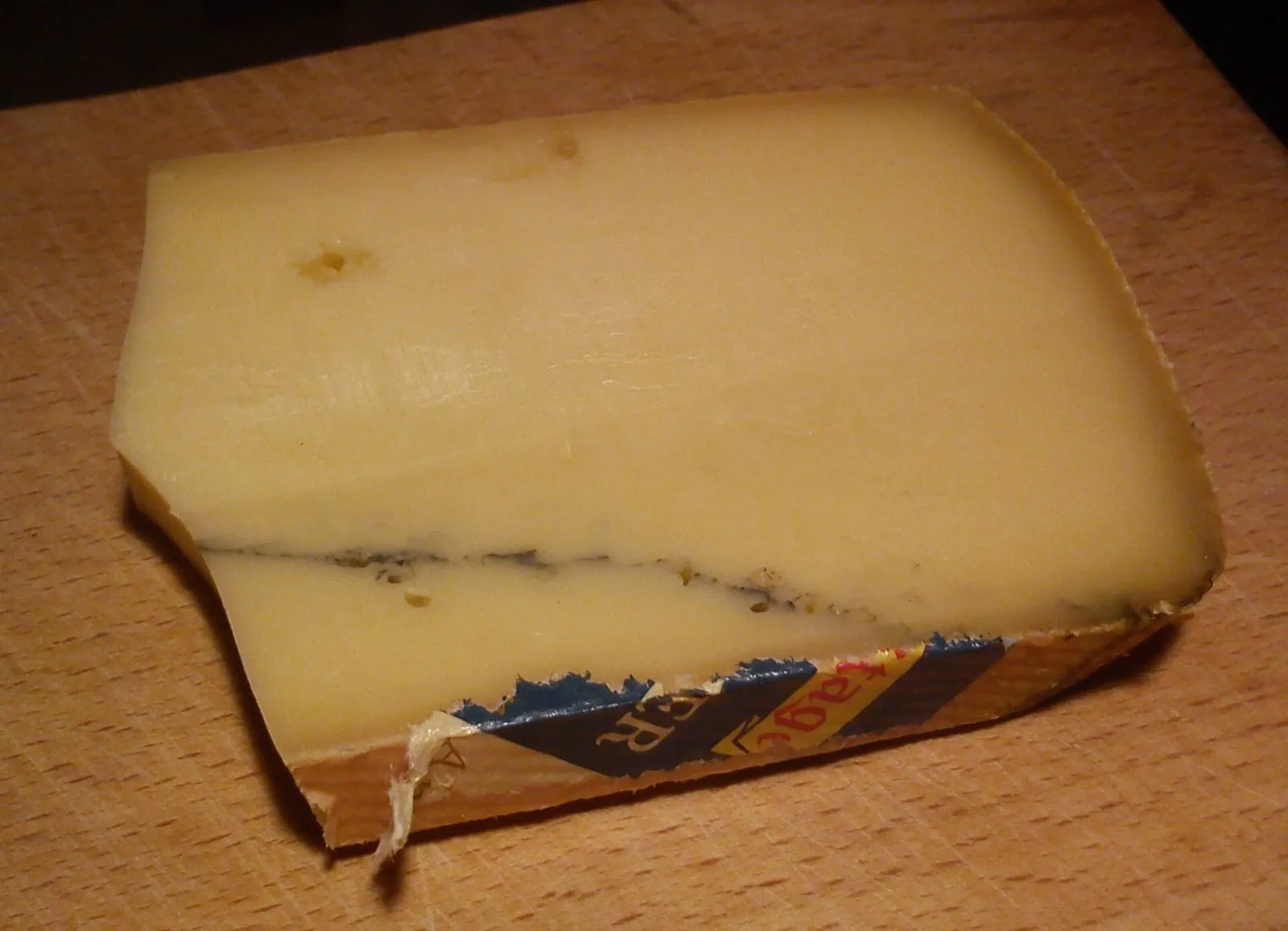
It is supple, mild and a little fruity, it melts well, and it is one of the easiest French cheeses to like.
The line is the whole story. It started as a way to protect curd overnight, and today it is written into the AOP rules: the black stripe has to run through the cheese as one sealed, continuous band from edge to edge.
Morbier cheese at a glance
Here is Morbier cheese at a glance, taken from its protected-name specification and the cheese syndicate's 2025 press kit.
| Detail | Morbier |
|---|---|
| Milk | Raw cow's milk, from Montbéliarde or Simmental Française cows |
| Made in | Franche-Comté, France; named for the village of Morbier in the Jura |
| Protected name | AOC in 2000, AOP (the European label) in 2002 |
| Wheel | Flat cylinder, 30 to 40 cm wide, 5 to 8 cm tall, 5 to 8 kg (about 11 to 18 lb) |
| Aging | At least 45 days, on spruce boards |
| Rind | Natural and rubbed, beige to orange with pink and brown tints |
| Paste | Ivory to pale yellow, smooth, sometimes a few currant-size holes |
| Fat | At least 45 g per 100 g of dry matter |
| Flavor | Lactic, caramel, vanilla and fruit; roasted and spicy notes with age |
The origin of Morbier cheese and what the AOP requires
The origin of Morbier cheese goes back to the end of the 18th century, when it was born in secret, according to the syndicate. Farmers in Franche-Comté sent their milk to the village fruitière to make Comté, and when harsh weather made the trip hard, they made their own cheese at the farm instead. It is a close cousin of Comté in method and landscape, though softer and much younger.
The syndicate says production has grown from 3,000 tonnes in the first year to more than 13,000 tonnes in 2023. The specification explains what holds the style together: raw milk, because the cheese needs a particular lactic flora to get its fine texture and delicate flavors; ripening on spruce boards; and no rind colorants. The guide to PDO and PGI labels covers what the seal promises in general.
The ash line in Morbier cheese
The ash line in Morbier cheese is a layer between two blocks of curd. In the story the syndicate tells, farmers covered the curd from the evening milking with ash scraped from the bottom of the cauldron, and the next morning they laid the curd from the second milking on top. The specification says several theories exist for the cheese's origin, and that the line was first made with cauldron soot.
Today the black comes from food-grade vegetable charcoal, brushed by hand onto one face of a curd block before the cheese is pressed, and the specification lets no other method make the line. It adds a look rather than a taste.
What Morbier cheese tastes like
Morbier cheese tastes frank and milky first, then caramel, vanilla and fruit, according to the specification, with roasted, spicy and vegetal notes as it ages. The paste is smooth, supple and melting, and does not cling to the mouth. The rind is natural and rubbed, so it carries a little farmyard character, but nothing like a strong washed rind such as Époisses.
The rind is edible, though many people trim it; the rind guide explains the call. The syndicate suggests letting the cheese sit at room temperature for at least 30 minutes before serving so the fruity and caramel notes open up.
How to cook with Morbier cheese
Morbier cheese melts very well, so it works in gratins, on pizza and over potatoes. The syndicate points to winter dishes: raclette, and the morbiflette, which is the Jura's tartiflette made with Morbier in place of Reblochon (the full dish is in the tartiflette recipe). For raclette at home, thin slices over hot potatoes and cornichons are enough.
For sandwiches, cut slices about 1/4 inch thick so the cheese melts through before the bread burns. On a board, pair it with apples, pears, walnuts, cured ham and dry cider; a white wine from the Jura works well too.
Morbier cheese substitutes
The best Morbier cheese substitutes are mild, supple cheeses that melt: Port Salut for the closest feel, Havarti for butteriness and fontina for a bit more depth. Gruyère gives a nuttier, firmer melt in gratins. None has the black line, so buy the real thing for a board and substitute for cooking.
How to buy Morbier cheese in the US
Buying Morbier cheese in the US starts with the label. Look for "Morbier AOP", which means raw milk and the protected rules. The FDA requires cheese made from unpasteurized milk to be cured at 35 °F or higher for at least 60 days (the semisoft cheese standard is one example), which is longer than the AOP's 45-day minimum. So an AOP wheel on a US counter has been aged past 60 days, and a pasteurized "Morbier" is a lookalike made elsewhere. Both are fine to eat; they just taste different.
Pick a wedge with a straight, even line and a supple, creamy paste. Wrap it in wax paper, keep it in the fridge and eat it within a week or two. The storing cheese guide covers wraps.
What most Morbier advice gets wrong
Most Morbier advice repeats a few ideas that need correcting.
The Morbier line is not ash flavor
The Morbier line is not an ash flavor, because it is vegetable charcoal applied in a thin layer. It changes how the cheese looks, not how it tastes, so do not cut around it.
Morbier cheese is not a stinky cheese
Morbier cheese is not a stinky cheese. The specification's flavor words are lactic, caramel, vanilla and fruit, which makes it a good first step toward stronger French cheeses.
Morbier cheese is better warm than cold
Morbier cheese is better warm than cold, because fridge-cold paste mutes the fruit and caramel. Take it out half an hour before serving.
Questions about Morbier cheese
These are the questions about Morbier cheese that come up most.
Why does Morbier cheese have a black line?
Morbier cheese has a black line because farmers once covered the evening curd to protect it overnight and added morning curd on top. Today the line is vegetable charcoal and part of the AOP rules.
What does Morbier cheese taste like?
Morbier cheese tastes milky and mild, with caramel, vanilla and fruit notes and a smooth, melting texture.
Is Morbier cheese made from raw milk?
Morbier cheese under the AOP is made from raw cow's milk. People who avoid raw-milk cheese, including during pregnancy, should check the pregnancy guide and the label, since pasteurized lookalikes exist.
Can you eat the rind on Morbier cheese?
You can eat the rind on Morbier cheese, because it is natural and rubbed. Trim it if you prefer a softer bite.
What is a good substitute for Morbier cheese?
A good substitute for Morbier cheese is Port Salut, Havarti or fontina, all of which are mild, supple and melt smoothly.
Your first Morbier cheese
For your first Morbier cheese, buy a small wedge labeled Morbier AOP, let it warm up for half an hour, and eat it with a crisp apple and good bread. If you like it, melt a few slices over boiled potatoes for a quick morbiflette.
Sources
- Demande de modification du cahier des charges de l'AOP Morbier, approuvée le 21 novembre 2024, INAO (Institut national de l'origine et de la qualité)
- AOP Morbier, dossier de presse 2025, Syndicat de défense du Morbier
- 21 CFR 133.187, Semisoft cheeses, Electronic Code of Federal Regulations