
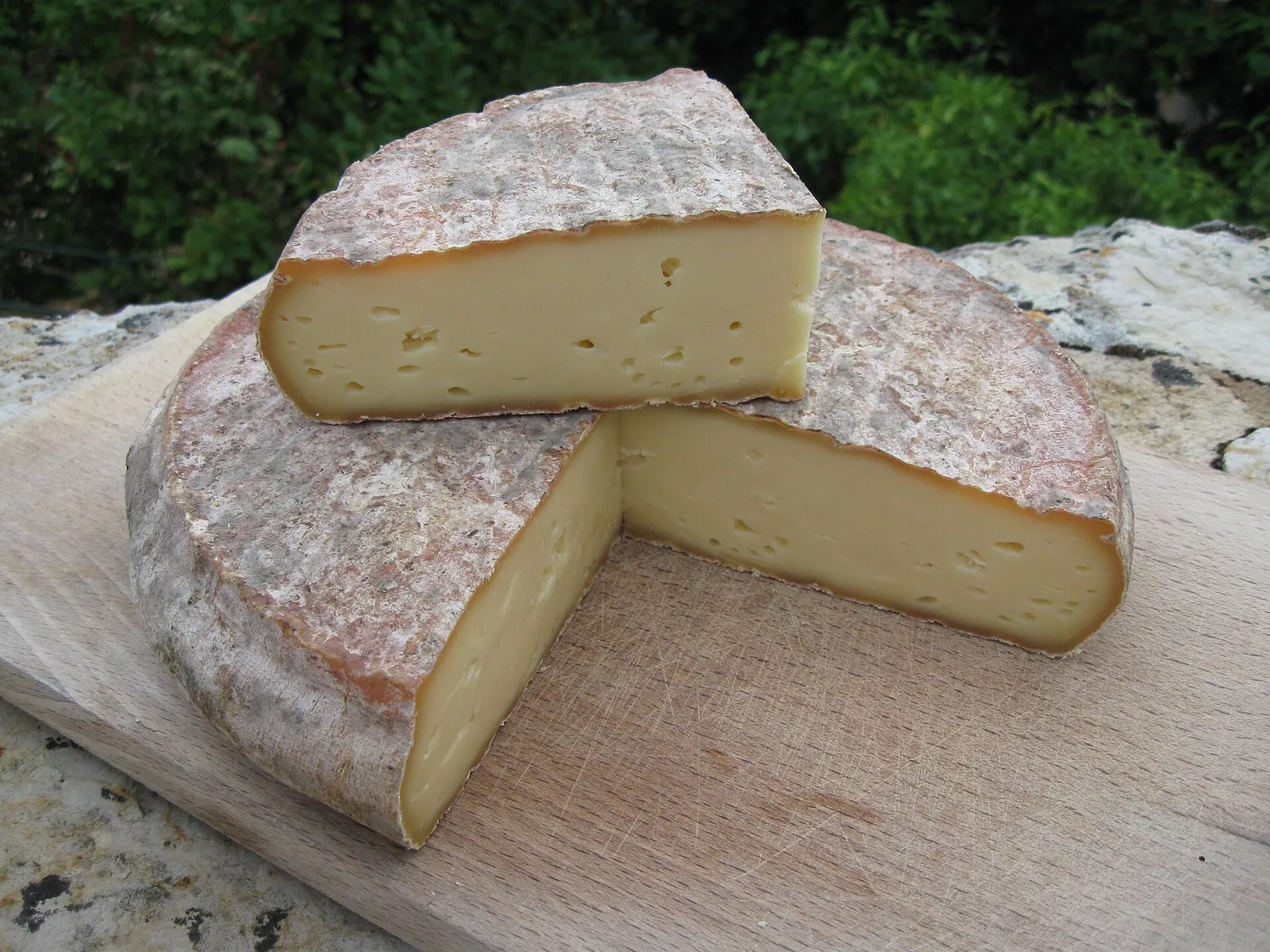
It comes in two versions, farmhouse and dairy, and the version you buy changes how it tastes.
Most of what makes it special happens in the cellar. The wheels are washed and turned for the first two weeks, which builds the rind that gives the cheese its earthy smell.
Saint-Nectaire cheese at a glance
Here is Saint-Nectaire cheese at a glance, based on the European Union's AOP registration file and the Sancy tourist office's cheese page.
| Detail | Saint-Nectaire |
|---|---|
| Milk | Cow's milk: raw for fermier, pasteurized for laitier |
| Made in | The Monts-Dore of the Auvergne, across Cantal and Puy-de-Dôme, France |
| Protected name | Appellation of origin from a 1955 court ruling; EU protected name (AOP) |
| Wheel | Flat disc of about 1.7 kg (3.75 lb), about 12 to 14 liters of milk each |
| Aging | At least 28 days (the 1992 file said 3 weeks) |
| Rind | Fermier: gray. Laitier: yellow-orange |
| Label | Fermier: oval casein plaque. Laitier: square |
| Flavor | A slight mushroom smell and a hazelnut flavor; fermier is stronger |
Where Saint-Nectaire cheese comes from
Saint-Nectaire cheese has been made in the Auvergne for a long time and appears in cooking from the 17th century under its present name. The EU file says a Marshal of France made it famous at the table of Louis XIV, and it is cited in books of 1786 and 1787. Production grew in the 19th and 20th centuries on small mountain farms with few cows, where it was the farm wives' cheese.
The name gained legal protection when a court in Issoire recognized it as an appellation of origin in 1955, and a decree followed on December 29, 1986. The guide to PDO and PGI labels explains what the EU seal means today. The region's altitude and mountain pasture, the file says, give the cheese its mushroom scent and hazelnut taste.
How Saint-Nectaire cheese is made
Saint-Nectaire cheese starts with warm milk set with rennet. The curd is broken, gathered, put in a mold and pressed, then salted, wrapped in a cloth, put back in the mold and pressed again. After drying, the wheels age in cool cellars. The Sancy office says they are washed and turned regularly during the first 15 days, which builds the rind, and the minimum age is 28 days.
Fermier vs laitier: Saint-Nectaire cheese in two versions
Fermier and laitier Saint-Nectaire cheese differ in who makes them and what milk they use. Fermier is farmhouse cheese made from raw whole milk from a single farm; it has a gray rind, an oval casein plaque and a stronger flavor. Laitier is made in a dairy from pasteurized milk collected from several farms in the zone; it has a yellow-orange rind, a square plaque and a milder taste that the Sancy office says children like.
The label also has to say "Fermier" or "Laitier", according to the EU file, so the plaque is the fastest way to know what you hold. Neither is the "real" one: fermier has more depth, laitier is more consistent and easier to find.
What Saint-Nectaire cheese tastes like
Saint-Nectaire cheese tastes of hazelnut and mushrooms with a milky, slightly tangy backbone. The paste is supple, smooth and ivory to pale yellow, and the rind adds an earthy, cellar-like note. A fermier wheel leans more toward grass and mushroom; a laitier wheel is rounder and gentler.
How to serve and cook with Saint-Nectaire cheese
Serve Saint-Nectaire cheese at room temperature, taking it out of the fridge at least an hour ahead, as the Sancy office advises. It goes well with rye or walnut bread and an Auvergne red wine. Pears, apples and cured ham suit it on a board too.
It also melts well. Slice it over boiled potatoes, into a gratin or onto a baguette under the broiler for a plain mountain supper. If you like this style of dish, the Morbier page covers a similar melter, and the tartiflette recipe uses an Alpine cousin.
Saint-Nectaire cheese substitutes
The best Saint-Nectaire cheese substitutes are earthy, supple semi-firm cheeses: Tomme de Savoie is the closest in rustic rind and mild earthiness, fontina melts the same way, and Taleggio gives more funk. For a plainer, milder swap, Port Salut works in cooking.
How to buy Saint-Nectaire cheese in the US
Buying Saint-Nectaire cheese in the US means checking the plaque. The FDA requires cheese made from unpasteurized milk to be cured at 35 °F or higher for at least 60 days (the semisoft cheese standard is one example). Saint-Nectaire's minimum aging is 28 days, so a fermier wheel has to be aged well past its usual age to reach a US counter raw. Many US wheels are therefore the pasteurized laitier version, with the square plaque. If it matters to you, ask the cheesemonger, and read the pasteurized vs raw guide; the pregnancy guide covers raw milk.
Store it wrapped in the original paper, in the vegetable drawer, as the Sancy office advises; the storing cheese guide has more.
What most Saint-Nectaire cheese advice gets wrong
Most Saint-Nectaire advice makes it sound like one cheese, when the label tells you which one you have.
The Saint-Nectaire plaque tells you the version
The Saint-Nectaire plaque tells you the version: oval for fermier, square for laitier. Rind color is a second clue, gray for fermier and yellow-orange for laitier.
Saint-Nectaire cheese rind is natural
The Saint-Nectaire cheese rind is natural and is part of the flavor, though the texture is firm and some people trim it. The rind guide helps you decide.
Saint-Nectaire cheese is not better cold
Saint-Nectaire cheese is not better cold, because chilling flattens the hazelnut and mushroom notes. One hour out of the fridge is enough.
Questions about Saint-Nectaire cheese
These are the questions about Saint-Nectaire cheese that come up most.
What does Saint-Nectaire cheese taste like?
Saint-Nectaire cheese tastes of hazelnut with a slight mushroom note and a creamy, mildly tangy paste.
What is the difference between fermier and laitier Saint-Nectaire cheese?
Fermier Saint-Nectaire cheese is made on one farm from raw milk and has an oval plaque; laitier is made in a dairy from pasteurized milk and has a square plaque.
Can you eat the rind of Saint-Nectaire cheese?
You can eat the rind of Saint-Nectaire cheese, since it is a natural rind; trim it if you prefer.
Is Saint-Nectaire cheese pasteurized?
Saint-Nectaire cheese is pasteurized only in the laitier version; the fermier version is raw milk.
What can you use instead of Saint-Nectaire cheese?
Instead of Saint-Nectaire cheese, use Tomme de Savoie, fontina or Taleggio.
Your first Saint-Nectaire cheese
For your first Saint-Nectaire cheese, buy a small wedge, check the plaque, let it warm for an hour and eat it with rye bread, walnuts and a glass of light red.
Sources
- Saint-Nectaire, demande d'enregistrement d'AOP (Règlement CEE 2081/92), European Commission, eAmbrosia
- Fromage AOP Saint-Nectaire, Sancy tourist office
- 21 CFR 133.187, Semisoft cheeses, Electronic Code of Federal Regulations