
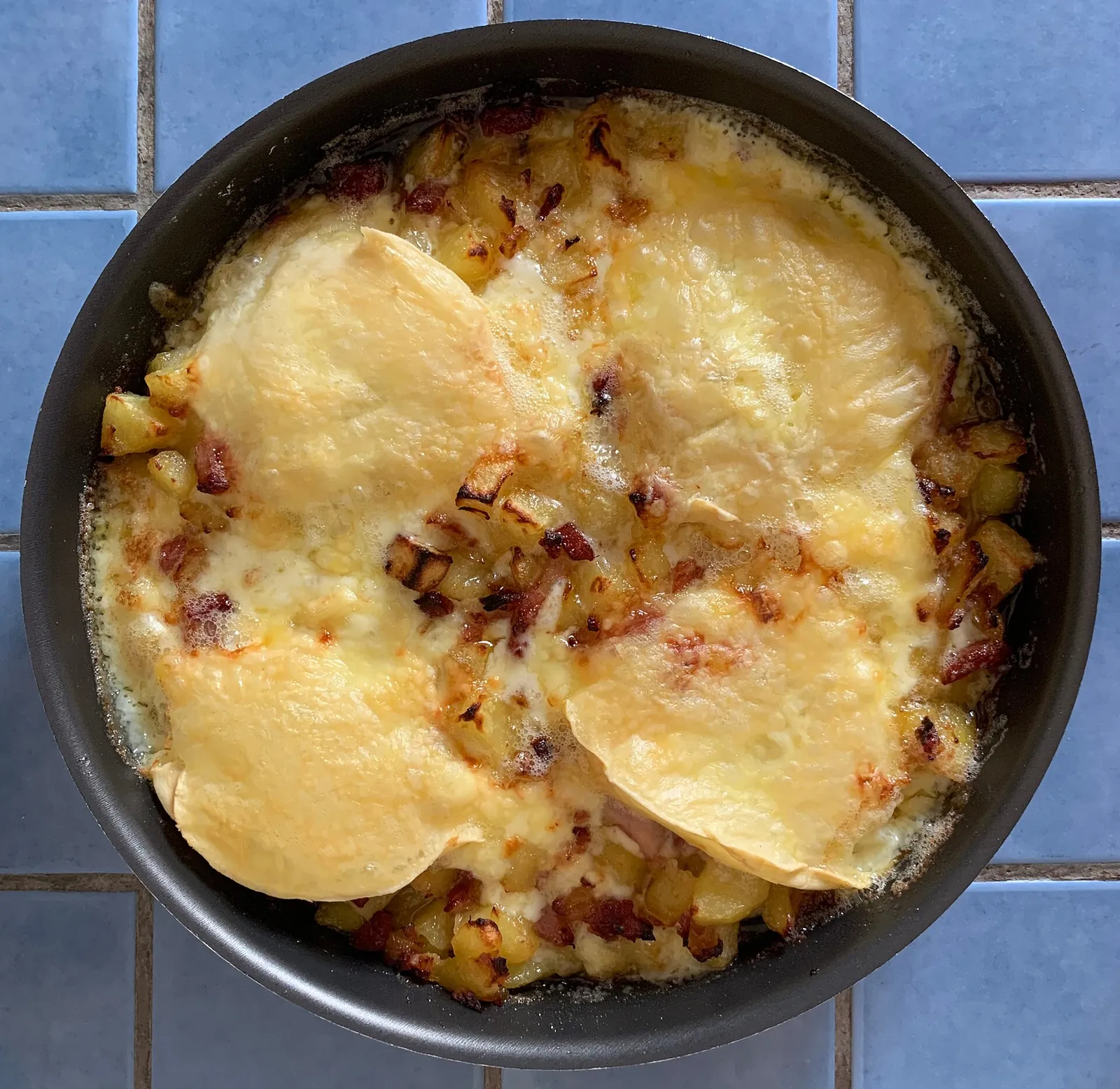
The cheese melts into the potatoes as it bakes, which is the point of the dish.
The catch for US cooks is the cheese. Genuine Reblochon AOP is a raw-milk cheese and generally not sold here, so the recipe below works with a substitute, and the sections after it explain which ones melt best and why.
Tartiflette recipe with US amounts
This tartiflette recipe serves four to six as a main course and takes about 1 hour 15 minutes, most of it hands off. Use a real Reblochon if you can get one; otherwise use Taleggio or another substitute from the section further down.
Ingredients:
- 2 lb (900 g) waxy potatoes, such as Yukon Gold
- 6 oz (170 g) thick-cut bacon or pancetta, cut into 1/2 inch pieces
- 1 large yellow onion (about 10 oz or 280 g), thinly sliced
- 1 clove garlic, minced (optional)
- 1/2 cup (120 ml) dry white wine
- 1 whole Reblochon of about 1 lb (450 g), or 12 to 14 oz (340 to 400 g) Taleggio
- Butter for the dish, black pepper; salt only if needed, since the bacon and cheese are salty
Steps:
- Heat the oven to 400 °F (200 °C) and butter a 2 to 2.5 quart (about 2 L) baking dish.
- Boil the potatoes whole, skins on, in salted water for 20 to 25 minutes, until a knife slides in with just a little resistance. Drain, cool for 10 minutes, peel and slice 1/4 inch (6 mm) thick.
- Cook the bacon in a dry skillet over medium heat for 6 to 8 minutes, until browned. Lift it out and pour off all but about 1 tablespoon of fat.
- Cook the onion in that fat for 8 to 10 minutes, until golden. Add the garlic for the last minute, pour in the wine and cook for 2 to 3 minutes, until almost dry. Stir the bacon back in.
- Layer half the potatoes in the dish, spread half the onion mixture on top, then repeat.
- Cut the Reblochon in half horizontally to make two thin rounds. Lay them cut side down on the potatoes, rind up so it crisps. If you are using Taleggio, cut it into 1/2 inch slabs and cover the top.
- Bake for 25 to 30 minutes, until the cheese has melted, bubbles at the edges and browns in spots. Rest for 5 minutes and serve with a green salad and a crisp white wine from Savoie.
You can assemble the potatoes and onions a day ahead; add the cheese just before baking so it melts fresh.
What tartiflette is
Tartiflette is a gratin of potatoes, onions, bacon and Reblochon, and it is younger than it tastes. The cheese's own protected-name specification says the Reblochon syndicate created the recipe in the 1980s, and it has since become a mountain staple. Its cousin from the Jura, the morbiflette, swaps in Morbier.
Reblochon cheese at a glance
Here is Reblochon cheese at a glance, from the national specification (2010 version) and the Reblochon syndicate's history sheet.
| Detail | Reblochon de Savoie |
|---|---|
| Milk | Raw whole cow's milk, never standardized, from Abondance, Montbéliarde or Tarine cows |
| Made in | Haute-Savoie and the Val d'Arly in Savoie, France |
| Protected name | AOC decree of August 7, 1958; EU recognition as AOP on June 12, 1996 |
| Wheel | About 14 cm wide, 3.5 cm tall, 450 to 550 g (about 1 lb); a smaller format about 9 cm wide also exists |
| Aging | At least 18 days |
| Fat | At least 45 g per 100 g of dry matter |
| Labels | Red casein plaque for dairy-made, green for farmhouse |
How Reblochon cheese got its name
Reblochon cheese got its name from a bit of medieval cheating. The specification says that in the 13th century a farmer renting a mountain pasture owed the owner a share based on the day's milk. On the day the owner came to measure it, the farmer held back, then finished milking after he left. That second milk, from the "reblâche", was rich in fat and made small, creamy cheeses. The Savoyard word for this trick, rablasa, is the likely source of the name. The cheese stayed half-hidden until the 18th century, when fixed rents replaced the milk share, and Louis XIV and his court liked it.
Why Reblochon cheese is hard to find in the US
Reblochon cheese is hard to find in the US because the AOP requires raw milk and only 18 days of aging. The FDA requires cheese made from unpasteurized milk to be cured at 35 °F or higher for at least 60 days; both the soft ripened cheese standard and the semisoft cheese standard say so. A cheese meant to be eaten in weeks cannot meet that without becoming a different cheese. If you see a "Reblochon" in the US, read the label: it is likely pasteurized and made outside the AOP.
The cheese is part of the family covered in the Alpine cheeses guide. If you avoid raw milk, see the pregnancy guide.
Best Reblochon substitutes for tartiflette
The best Reblochon substitute for tartiflette is Taleggio, a soft washed-rind cheese that melts creamily and has the same savory, slightly farmy edge. Use 12 to 14 oz (340 to 400 g), cut into slabs. Second choice is raclette cheese, sliced to cover the dish: it melts well but is milder. Fontina is a third option with a nuttier flavor; add a spoonful of the strongest washed-rind cheese you like to bring back the aroma. A ripe Brie works in a pinch, though without the washed-rind savor.
Tartiflette mistakes that cost you flavor
Tartiflette mistakes that cost you flavor are mostly small details that most advice skips.
Tartiflette potatoes must be waxy
Tartiflette potatoes must be waxy, because floury potatoes turn to mush under the cheese. Yukon Gold or red potatoes hold their slices.
Tartiflette cheese goes cut side down
Tartiflette cheese goes cut side down, because the soft face then melts into the potatoes while the rind browns on top. Laying it rind side down smothers the dish with an oily slick.
Tartiflette needs the bacon fat drained
Tartiflette needs the bacon fat drained to about 1 tablespoon. Leaving all of it makes the dish greasy; leaving none loses the flavor.
Questions about tartiflette
These are the questions about tartiflette that come up most.
What is tartiflette?
Tartiflette is a Savoyard gratin of potatoes, onions and bacon topped with a whole Reblochon and baked until molten.
Can you make tartiflette without Reblochon?
You can make tartiflette without Reblochon by using Taleggio, raclette cheese or fontina in the same amount.
Is Reblochon cheese the same as Taleggio?
Reblochon cheese is not the same as Taleggio: Reblochon is French, from raw cow's milk, while Taleggio is an Italian washed-rind cheese, though they melt in a similar way.
Can you eat the rind of Reblochon cheese?
You can eat the rind of Reblochon cheese, which is thin and washed, and it adds flavor to a tartiflette.
What do you serve with tartiflette?
Serve tartiflette with a green salad, cornichons and a crisp white wine from Savoie.
Your first tartiflette recipe
For your first tartiflette recipe, buy 12 to 14 ounces of Taleggio, a pound of Yukon Gold potatoes per two people and good thick bacon, and bake it as above. Taste it, then look for a true Reblochon if you travel to Savoie.
Sources
- Cahier des charges de l'appellation d'origine Reblochon ou Reblochon de Savoie, procédure nationale d'opposition, version du 10 décembre 2010, INAO
- Histoire, chiffres, missions de la filière Reblochon, Syndicat interprofessionnel du Reblochon
- 21 CFR 133.182, Soft ripened cheeses, Electronic Code of Federal Regulations
- 21 CFR 133.187, Semisoft cheeses, Electronic Code of Federal Regulations
- The Reblochon PDO: specifications, Syndicat Interprofessionnel du Reblochon