
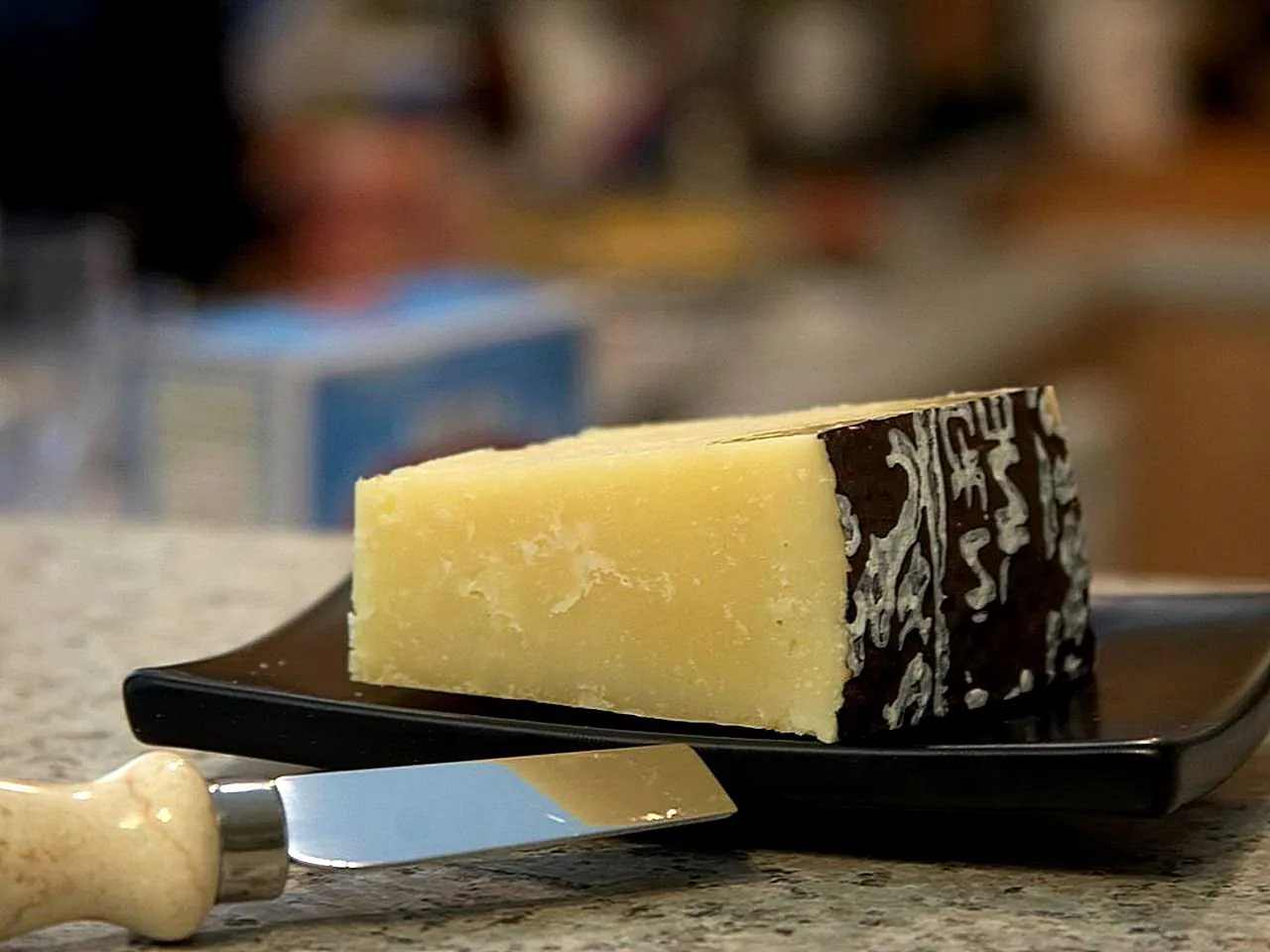
Its sharp, tangy bite and heavy salting mean a small amount seasons a whole pot of pasta, which is why Rome built four classic dishes around it. The EU single document cites Columella, Virgil, Varro and Pliny the Elder as Latin writers who described its ancestor. For the milk-by-milk differences from cow's-milk cheese, see Parmesan vs Pecorino Romano.
Pecorino Romano at a glance
This Pecorino Romano at a glance table draws on the EU's 2026 single document, the consortium and USDA.
| Pecorino Romano | |
|---|---|
| Milk | Fresh whole sheep's milk, raw or lightly heat-treated (thermized) |
| Made in | All of Sardinia and Lazio, plus the province of Grosseto in Tuscany; mostly made in Sardinia |
| Protected name | PDO in the EU since 1996 |
| Rennet | Lamb rennet paste from animals raised and slaughtered in the area |
| Minimum age | 5 months (table), 8 months (grating), 18 months for Riserva |
| Season | Made from October to July |
| Wheel | 10 to 14 inches (25 to 35 cm) across, 44 to 77 pounds (20 to 35 kg) |
| Flavor | Aromatic and mildly pungent as a table cheese; pungent and intense when well aged |
| Per ounce (USDA, Romano) | 110 calories, 9.0 g protein, 406 mg sodium |
What the Pecorino Romano PDO rules require
The Pecorino Romano PDO rules, revised in 2026, are set out in the EU's published single document, and they start with the sheep.
Only fresh whole sheep's milk from farms in the area may be used, and at least half the dry matter in the ewes' annual feed must come from inside it. Production runs from October to July. The milk may be gently heated and seeded with native lactic cultures, then set at 100 to 104°F (38 to 40°C) with lamb rennet paste from animals raised and slaughtered in the area. That paste does more than clot the milk: in a study of a goat cheese, lamb rennet paste raised the short-chain fatty acids and gave a slightly more piquant taste, a likely contributor to Pecorino Romano's tang.
The curd is cut to the size of a wheat grain, cooked at 113 to 122°F (45 to 50°C), salted dry, in brine or both, and aged in cellars kept at 43 to 54°F (6 to 12°C). The rind is thin and ivory or straw-colored, though it may carry a food-grade neutral, black or brown coating. The side of each wheel is stamped with a diamond holding a stylized sheep's head, the producer's code and the month and year, and the words Lazio, Sardegna or Grosseto appear only if every step took place there.
Pecorino Romano aging, salt and the new Riserva
Pecorino Romano aging starts at 5 months for table cheese and 8 months for the grating type, and salt is the other thing that defines it.
The specification sets no salt ceiling for the standard cheese. A 2024 study of 103 Pecorino Romano samples from Sardinia, published in Molecules, puts typical salt at 3 to 7 percent, against rarely more than 2 percent for Pecorino Sardo, a younger and smaller Sardinian cheese. USDA's Romano row works out to 406 mg of sodium per ounce, about 22 percent more than hard Parmesan's 333 mg; the low-sodium cheese guide covers lighter options.
An amendment communicated to the EU in August 2026 and published on September 2 adds a Riserva type. It must be at least 18 months old, made only from December to March, and no more than 4 percent salt, which makes it the one version with a salt cap.
How to buy Pecorino Romano in the US
To buy Pecorino Romano in the US, look for the diamond sheep's-head mark and the words Pecorino Romano, because a Romano label does not say by itself which milk is inside.
The FDA's standard for Romano (21 CFR 133.183) allows cow's, sheep's or goat's milk, and the name has to say which, as in "Romano cheese made from sheep's milk," which may be preceded by Pecorino. The Italian specification requires the official mark on every pre-packed, portioned or grated pack. Ask whether a wedge is the 5-month table type or the 8-month grating type, and trim the rind before grating, since it may be coated or treated with preservatives.
How to use Pecorino Romano
Use Pecorino Romano as a seasoning cheese, grated at the end, and cut the other salt in the dish.
Rome's four classics all lean on it: cacio e pepe, gricia, amatriciana and carbonara. Grate it fine on a rasp-style grater so it dissolves into hot pasta. In cacio e pepe the cheese and a splash of starchy pasta water make the whole sauce, so take the pan off the heat and let the water cool for a few seconds before the cheese goes in, or it will clump. A 5-month table wedge is mild enough to eat in slivers with pears or honey, while an 8-month-plus grating wedge is the one for the pasta pot.
Pecorino Romano substitutes
The best Pecorino Romano substitutes are the other hard grating cheeses, and each needs a small adjustment.
| Swap | How to use it | What changes |
|---|---|---|
| Parmigiano-Reggiano or Grana Padano | Same amount, plus a pinch of salt and extra pepper | Milder and nuttier, less tang |
| Pecorino Sardo, aged | A little more than the recipe calls for | Another sheep's-milk cheese, with far less salt |
| Aged Manchego | Same amount | Sheep's milk, but milder and nuttier |
The substitute finder lists more.
What most Pecorino Romano advice gets wrong
Most Pecorino Romano advice treats the name as one thing, and three details change what ends up in your pan.
Pecorino and Pecorino Romano are not the same
Pecorino and Pecorino Romano are not the same, because pecorino only means sheep's-milk cheese. Pecorino Sardo is another Sardinian sheep's-milk cheese, but the same study measured about a third of Romano's sodium in it, so it will not season a pasta the same way.
Plain Romano can be cow's milk
Plain Romano can be cow's milk under the US standard, so read the full name and the ingredient list for sheep's milk. If the ingredients say only milk, it is cow's milk, because the standard requires any other milk to be named; USDA's Romano entry names no milk at all, so treat its numbers as a guide and not a lab result for the Italian PDO.
Salt the pasta water lightly
Salt the pasta water lightly, because Pecorino Romano already carries 406 mg of sodium per ounce in USDA's data. Taste the sauce before you add any more.
Questions about Pecorino Romano
These questions about Pecorino Romano come up most at the stove.
Is Pecorino Romano the same as Parmesan?
Pecorino Romano is not the same as Parmesan: it is made from sheep's milk instead of cow's milk, and it is saltier and sharper.
Why is Pecorino Romano so salty?
Pecorino Romano is so salty because the wheels are heavily salted, dry, in brine or both, and the rules set no salt limit for the standard cheese; the 2024 study puts typical salt at 3 to 7 percent.
Can you eat the rind of Pecorino Romano?
You can eat the rind of Pecorino Romano only with care: some wheels are wrapped to keep the rind edible, but the rules also allow coatings and preservatives on it, so trim it before you grate unless the maker says it is edible.
Is Pecorino Romano vegetarian?
Pecorino Romano is not vegetarian, because the rules require lamb rennet paste to set the milk.
Does Pecorino Romano have lactose?
Pecorino Romano has almost no lactose: a 2020 review lists it below 0.01 gram per 100 grams, though it still contains milk protein.
Is Pecorino Romano safe during pregnancy?
Pecorino Romano's milk may be raw or only gently heated (thermized), and the FDA's pregnancy guidance says to avoid cheeses made with unpasteurized milk, so ask your doctor before eating it.
Which Pecorino Romano to buy first
Buy a small wedge marked Pecorino Romano with the sheep's-head diamond, grate it fine for your next cacio e pepe, and taste a sliver beside Parmigiano-Reggiano to learn the salt gap for yourself.
Sources
- Communication of an approved standard amendment, 'Pecorino Romano' PDO (OJ C/2026/4125, 2 September 2026) and Commission Regulation (EC) No 1030/2009, Official Journal of the European Union
- Disciplinari DOP e IGP, 1.3 Formaggi (Pecorino Romano product specification), Italian Ministry of Agriculture (MASAF)
- Consorzio per la Tutela del Formaggio Pecorino Romano: Characteristics and Processing
- Peer-reviewed studies: Elemental Fingerprinting of Pecorino Romano and Pecorino Sardo PDO (Mara et al., 2024), Molecules via PubMed Central, and Influence of lamb rennet paste on the lipolytic and sensory profile of Murcia al Vino cheese (Ferrandini et al., 2012), Journal of Dairy Science via PubMed
- 21 CFR 133.183, Romano cheese, Electronic Code of Federal Regulations
- USDA FoodData Central (SR Legacy): Cheese, romano (FDC 171249) and Cheese, parmesan, hard (FDC 170848)
- Nutritional management of lactose intolerance: the importance of diet and food labelling (Facioni et al., 2020), Journal of Translational Medicine via PubMed Central
- Listeria (Food Safety for Moms-to-Be), U.S. Food and Drug Administration