
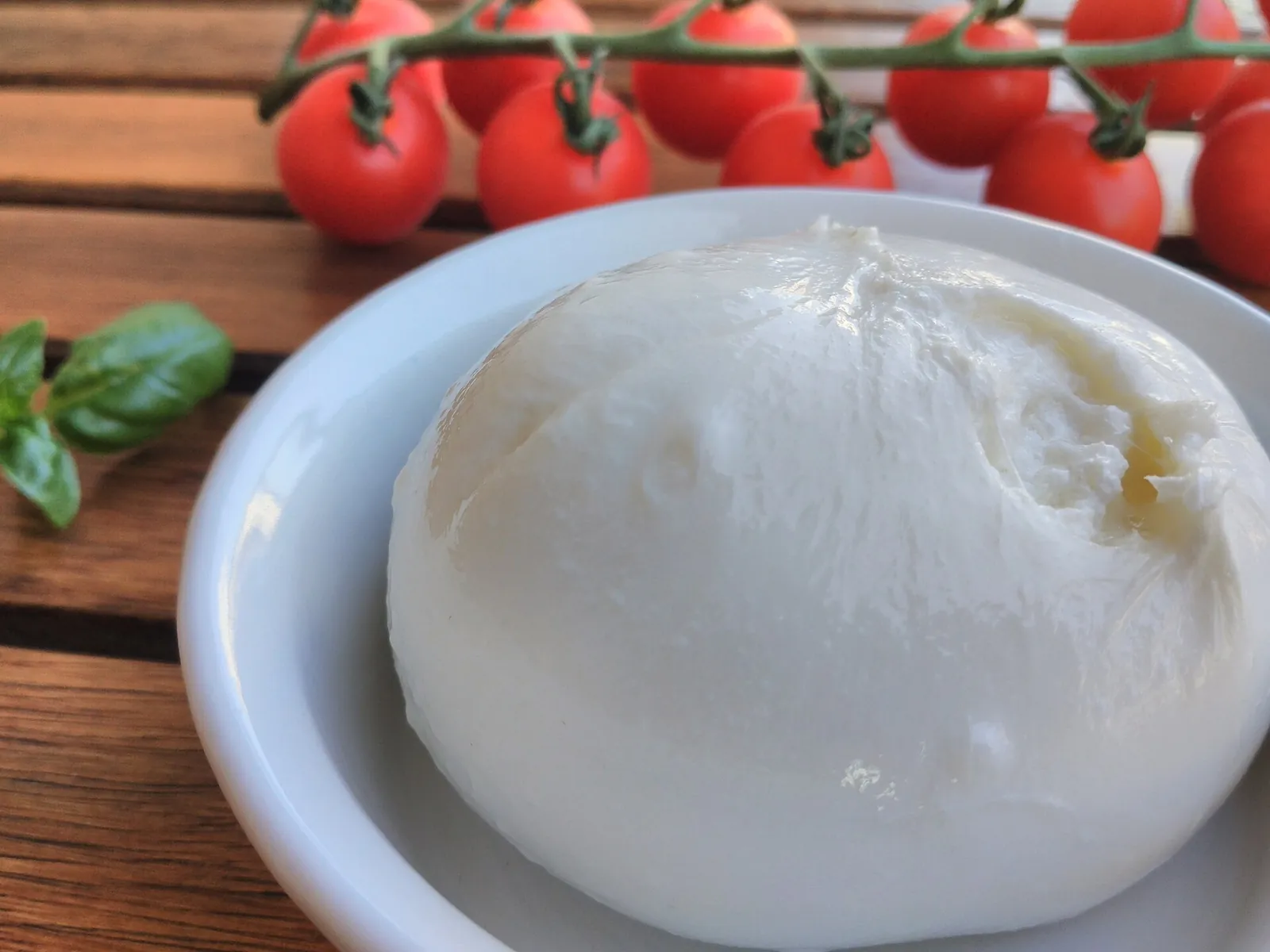
The outside is a thin pouch of stretched curd, the same springy curd as fresh mozzarella. The inside is stracciatella: ribbons of that curd torn by hand and soaked in cream. Cut it open and the filling slumps out, milky and buttery, while the shell holds its shape.
That contrast is the whole point, and it fades fast. EU rules require the protected Burrata di Andria to be packed at the dairy that made it because it spoils quickly, and it is at its best within a day of being made.
Burrata at a glance
This burrata at a glance table follows the EU rules for the protected Burrata di Andria PGI, with notes for US shoppers where they differ.
| Burrata | |
|---|---|
| Milk | Cow's milk; raw or pasteurized under the PGI rules, pasteurized in US stores |
| Origin | Andria, in Puglia (Apulia), southern Italy, early 20th century |
| Protected name | Burrata di Andria PGI, registered by the EU in 2016; may be made anywhere in Puglia |
| Rind | None: a smooth, milk-white shell of stretched curd about 2 mm thick |
| Texture | Springy shell around a soft, spongy, cream-soaked filling |
| Size | 100 g to 1 kg (3.5 ounces to 2.2 pounds) for the PGI |
| Moisture | 50 to 70 percent (PGI rule) |
| Flavor | Milky, buttery and fresh, with a light tang |
| Age | None; handmade burrata keeps 3 to 5 days, machine-made up to about 20 |
What burrata is
Burrata is a stretched-curd cheese built as a closed pouch. EU rules define it as a cow's milk cheese made by adding cream to stretched curd: an outer layer made entirely of pasta filata (stretched curd) around a filling of cream and hand-shredded curd. The name comes from burro, Italian for butter, according to the Treccani dictionary.
The filling, stracciatella, takes its name from the Italian verb for "to rip," for the way the curd is torn into ragged strips, and delis also sell stracciatella on its own in tubs.
Burrata among Italian cheeses
Among Italian cheeses, burrata belongs to the pasta filata family with mozzarella, provolone, scamorza and caciocavallo, all made by kneading curd in hot water until it stretches. It is a young member, about a century old, modeled on an older one: manteca, a casing of aged stretched curd used to store butter. The guide to Italian cheeses by region places it among its neighbors.
Burrata di Andria PGI
Burrata di Andria is burrata's protected name, registered as a PGI (protected geographical indication) in the EU's eAmbrosia register in December 2016. The PDO and PGI guide explains what a PGI does and does not promise.
The Burrata di Andria origin story
The Burrata di Andria origin story, as the EU file tells it, starts with a snowstorm. By oral tradition, heavy snow in the early 20th century kept a cheesemaker named Lorenzo Bianchino from getting milk from a farm estate near Andria into town. With milk to use up and cream rising on it, he borrowed the manteca method, sealing scraps of stretched curd and cream inside a pouch of the same curd, a story the consortium's history page also tells. The EU file cites a 1931 Touring Club guide as one of the first written references, and notes that the Shah of Iran became a faithful fan.
Burrata di Andria rules
Burrata di Andria rules, set out in the current EU single document, are short and specific.
- Milk: cow's milk only, raw or pasteurized.
- Size: 100 g to 1 kg (3.5 ounces to 2.2 pounds).
- Shell: milk-white, about 2 mm thick, gathered at the top into a bunched knot. Since a 2024 amendment the knot may be minimal, so makers can skip the plastic raffia tie.
- Filling: curd shredded solely by hand, then soaked in cream.
- Moisture: 50 to 70 percent.
- Place: anywhere in Puglia, not only Andria, and it must be packed at the dairy where it was made.
- Storage: 4°C, give or take 2 degrees (about 36 to 43°F).
On the label, look for the words Burrata di Andria followed by Protected Geographical Indication or PGI (IGP on Italian packs).
How burrata is made
How burrata is made comes down to one batch of stretched curd, split two ways.
- The curd is stretched with boiling water and may be salted.
- Part of it is torn by hand into ragged ribbons, cooled in water into a spongy mass and mixed with cream: the stracciatella.
- The rest is shaped into small sacks and filled with the stracciatella.
- The cheesemaker closes each sack, shapes the neck, and seals it with boiling water or ties it.
- The finished cheese firms up in cold water, for 20 to 30 minutes in traditional practice.
Factory burrata takes a shortcut. In a 2023 University of Bari trial at a dairy in Andria, curd was stretched in 83°C (181°F) water into a mozzarella ball, then a "blowing machine" inflated the warm ball into a pouch and filled it with stracciatella made from UHT cream and fresh mozzarella strands in equal weights. Even the PGI allows packaged UHT cream in the filling, alongside cream skimmed from fresh milk or whey.
How to buy burrata in the US
Buying burrata in the US means reading the date first, because burrata is sold by the day, not the month.
Burrata in US stores is made with pasteurized milk. Federal rules require packaged dairy foods sold across state lines to be pasteurized, except certain cured cheeses (21 CFR 1240.61), and burrata is never cured. Some Burrata di Andria producers ship to the US weekly, the EU file notes.
The date also hints at how it was made. In a study of Burrata di Andria, researchers put handmade burrata's shelf life at 3 to 5 days and machine-formed burrata's at up to 20, and advised eating it within 24 hours of production. Buy it the day you will serve it, or the day before, and skip any tub that has puffed up.
A 4-ounce burrata serves two to four people as a starter at the usual 1 to 2 ounces of cheese per person; an 8-ounce one covers four to eight.
How to serve burrata
Serve burrata whole, raw and a little warmer than the refrigerator, so the cream inside loosens. Take it out 30 to 45 minutes ahead, or do as Puglia does: tradition there calls for a brief warm-water bath, for a creamier center and fuller flavor, according to the same study. A bowl of warm tap water for 10 to 15 minutes, with the cheese still sealed, does the job.
Set it in a shallow bowl, cut it open at the table so the cream lands in the dish, and finish with olive oil, flaky salt, black pepper and bread to drag through it.
Burrata on pizza and pasta
Burrata on pizza and pasta goes on after the heat, because an oven turns the shell rubbery and the cream greasy. Tear it over a pizza as it leaves the oven, or over hot pasta just before serving.
Burrata pairings
Burrata pairings work by contrast, setting something sharp, salty, bitter or crisp against all that cream.
- Fruit and vegetables: summer tomatoes with basil, grilled or raw peaches, figs, roasted peppers, bitter greens such as arugula or radicchio.
- Salt: prosciutto, anchovies, olives, capers.
- Crunch: toasted breadcrumbs, pistachios, hazelnuts, grilled bread.
- Drinks: a dry sparkling wine such as Prosecco, a crisp white such as Vermentino or Fiano, or a rosato from Puglia made from Negroamaro. Beer drinkers can pour a pilsner.
How to store burrata
Store burrata in its own container in the coldest part of the refrigerator, and treat the date as a deadline. Once you cut it, finish it that day, or stir covered leftovers into hot pasta the next day. Do not freeze it: thawed, the shell turns spongy and the cream separates. Throw it out if it smells sour or yeasty, the liquid turns cloudy and yellow, or the package swells.
Burrata substitutes
The best burrata substitutes copy either the cream or the shell.
- Stracciatella in a tub is the filling without the pouch, and the closest match on toast, pasta or pizza.
- Fresh mozzarella, especially buffalo mozzarella, gives you the milky shell; fior di latte vs. buffalo mozzarella explains how the two differ.
- Whole-milk ricotta loosened with a spoonful of heavy cream stands in for the filling in a pinch.
- **Stracchino**, a soft, spreadable Italian cheese, works on bread and white pizza.
Burrata mistakes that cost you flavor
Most burrata mistakes come from treating it like a cheese that keeps.
Serving it cold. Fridge-cold cream is stiff and tastes of little; give it time on the counter or a warm-water bath.
Trusting a long date. A use-by three weeks out reflects machine filling and modern packaging, not freshness, and even that cheese is best soon after it is made.
Reading "Andria" as an address. The protected name covers burrata made anywhere in Puglia, and plain "burrata" can be made anywhere at all, including in the US.
Buying one big ball. A cut burrata does not keep, so for four people two 4-ounce balls beat one 8-ounce ball: the second stays sealed until you need it.
Questions about burrata
These questions about burrata come up most at the cheese counter.
How do Italians eat burrata?
Italians eat burrata fresh, ideally within a day of when it was made, with bread, tomatoes or cured meats, or torn over pasta.
What's so special about burrata?
What's special about burrata is its build: a firm shell of stretched curd around a loose filling of hand-torn curd and cream, two textures in one cheese that last only days.
Are you supposed to eat the skin of burrata?
Yes, you are supposed to eat the skin of burrata. It is not a rind but stretched curd, the same cheese as fresh mozzarella; only plastic ties and wrappers come off.
How unhealthy is burrata?
Burrata is rich, but by weight it is less fatty than its reputation. Lab tests of 21 Burrata di Andria cheeses found about 18 grams of fat and 10 grams of protein per 100 grams, with 70 percent water, so a whole 4-ounce ball carries about 20 grams of fat. Burrata vs. mozzarella has the full comparison.
Is burrata safe during pregnancy?
Burrata made with pasteurized milk is the safer choice during pregnancy, and that is what US stores sell. The CDC advises pregnant people to avoid any cheese made from raw milk unless it is heated to 165°F, and lists pasteurized mozzarella among safer cheeses; Burrata di Andria may be made from raw milk in Italy. See cheese during pregnancy and ask your doctor.
Buying your first burrata
For your first burrata, buy a 4-ounce ball with the latest date in the case, on the day you plan to eat it. Let it warm, set it in a shallow bowl with ripe tomatoes, olive oil, flaky salt and grilled bread, and cut it open at the table. Next time, find a Burrata di Andria PGI or a handmade local burrata and taste the difference.
Sources
- Burrata di Andria (PGI), EUGI00000015902, European Commission eAmbrosia register
- Single document, Burrata di Andria PGI, standard amendment C/2024/1948, Official Journal of the European Union (EUR-Lex)
- History of Burrata di Andria, Consorzio Burrata di Andria IGP
- "Burrata di Andria" PGI Cheese: Physicochemical and Microbiological Features (Di Cerbo et al., 2020), Foods via PubMed Central
- Application of Commercial Biopreservation Starter in Combination with MAP for Shelf-Life Extension of Burrata Cheese (Natrella, Gambacorta and Faccia, 2023), Foods via PubMed Central
- Burrata, Vocabolario Treccani
- 21 CFR 1240.61, Mandatory pasteurization for all milk and milk products in final package form, Electronic Code of Federal Regulations (FDA)
- Preventing Listeria infection, Centers for Disease Control and Prevention