
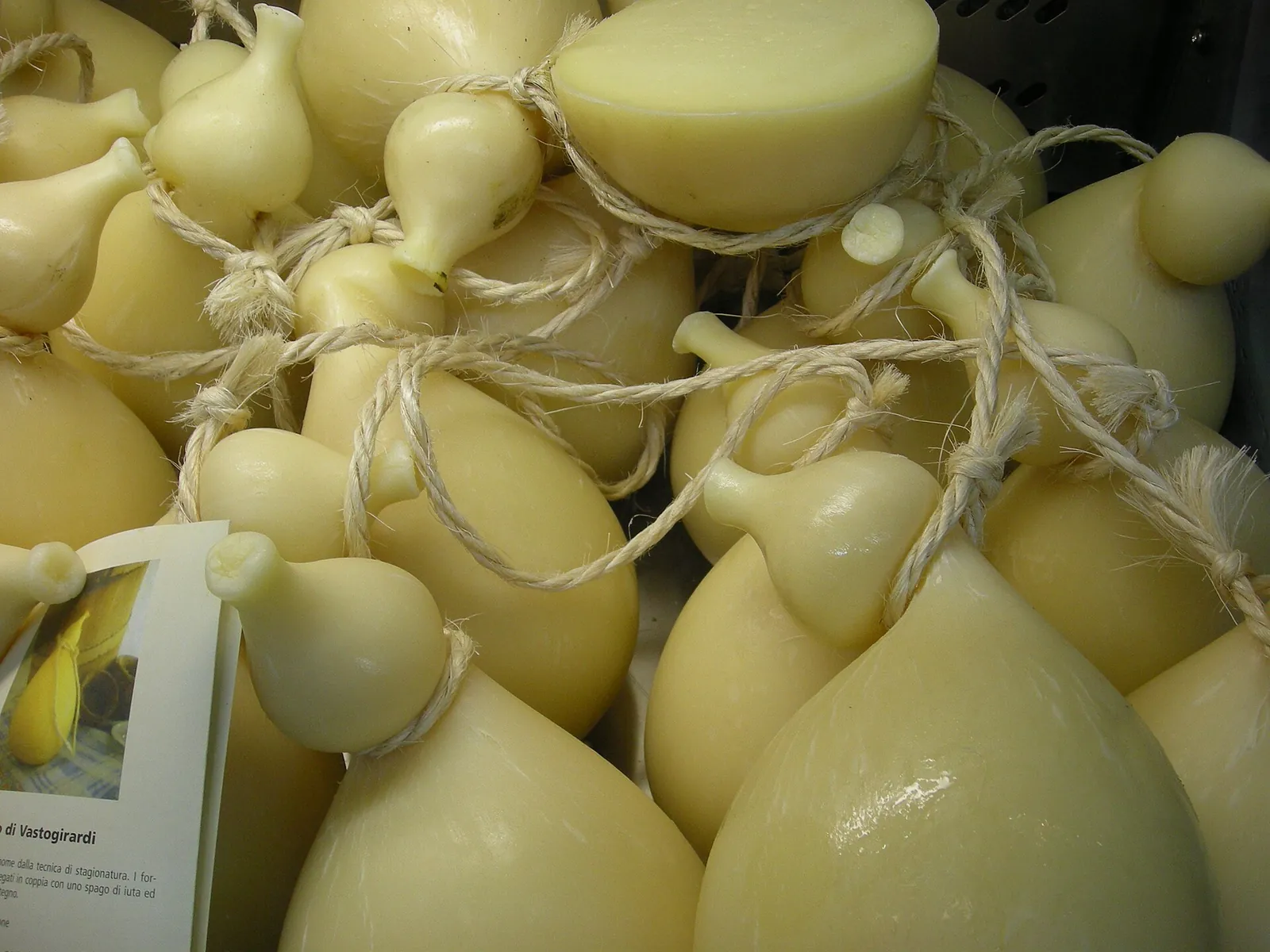
Young, it is mild, milky and supple. After several months it turns firm, salty and sharp.
Stretched curd, pasta filata in Italian, is a method rather than a single cheese. The curd is soured until it can be pulled like taffy in hot water, then shaped by hand. Mozzarella uses the same trick and is eaten within days; caciocavallo is built to last, salted in brine and hung for a month or a year.
Caciocavallo at a glance
This caciocavallo at a glance table uses the rules for Caciocavallo Silano, the protected version, since generic caciocavallo has no fixed recipe.
| Caciocavallo Silano | |
|---|---|
| Milk | Cow's milk only, raw or thermized (heated to at most 136°F, 58°C, for 30 seconds) |
| Where | Parts of Calabria, Campania, Molise, Puglia and Basilicata |
| Style | Stretched curd (pasta filata), brined, hung in pairs |
| Shape | Oval with a small head, or a truncated cone without one in Calabria |
| Weight | 2.2 to 5.5 lb (1 to 2.5 kg) |
| Age | 30 days minimum; "Extra" at 4 months, "Gran Riserva" at 9 months |
| Rind | Thin, smooth, straw yellow, with grooves from the cord |
| Flavor | Sweet and delicate young; savory and piquant aged |
| Rennet | Calf or kid rennet paste |
| Protected name | Italian protection 1993, EU PDO 1996 |
What caciocavallo is and where the name comes from
Caciocavallo is a semi-hard stretched curd cheese made all along the southern Apennines, and its name means roughly "cheese on horseback." Cacio is an Italian word for cheese, and the Caciocavallo Silano consortium says the cavallo part most likely comes from the habit, as old as the cheese, of tying the cheeses in pairs and hanging them to age astride a beam. Despite the name, no horse milk is involved; the protected version is cow's milk only.
The pairs explain the shape. Each cheese is cinched with cord near the top, and that pressure makes the "neck" between the round body and the small head, according to ONAF, Italy's national organization of cheese tasters. The shape even made it into an old southern saying: to "end up like a caciocavallo" meant to be hanged.
How caciocavallo is made
Caciocavallo is made by souring the curd until it stretches, then spinning and shaping it by hand. The Caciocavallo Silano specification spells out each step:
- Cow's milk from no more than four consecutive milkings is set at 97 to 100°F (36 to 38°C) with calf or kid rennet paste.
- The curd is broken into pieces about the size of a hazelnut and left to sour, usually 4 to 10 hours.
- The cheesemaker tests it by dipping small pieces in nearly boiling water: when they pull into elastic, shiny, unbroken strands, the curd is ready.
- The curd is stretched in hot water into a thick rope, folded and pressed by hand into a smooth ball, sealed at the top with a quick dip in boiling water and shaped, with or without a head.
- The cheeses are cooled in water, salted in brine for at least 6 hours, then tied in pairs and hung over wooden or steel poles for at least 30 days.
The sour wait is the whole secret. Acid from the lactic bacteria changes the curd's protein network so that heat makes it soft and pliable, and kneading lines the proteins up into long fibers, which is why caciocavallo, like string cheese, pulls apart in strands. The consortium adds a historical reason for the method: working milk fast this way kept it from souring in the southern heat.
Caciocavallo Silano and other caciocavalli
Caciocavallo Silano is the protected caciocavallo you are most likely to see, named for the Sila plateau of Calabria and now made in parts of five regions. Its specification requires a thin, straw-colored rind, a compact paste with only a few tiny holes, at least 38 percent fat in the dry matter and at least 30 days of aging. Wheels aged 4 months may be labeled Extra, and 9 months Gran Riserva.
Other caciocavallo styles
Other caciocavallo styles fill out the family. Sicily's Ragusano, protected in the EU, is a rectangular block that is also hung by cord and may be sold smoked as "affumicato." La Cucina Italiana points to Caciocavallo Podolico del Gargano, a Slow Food Presidium made from the milk of Podolica cows, which give little milk and only at certain times of year, and aged a long time in natural caves.
What caciocavallo tastes like at each age
Caciocavallo tastes sweet, milky and delicate when young and turns piquant with age, as the specification describes. The consortium sums up the range: about 30 days old in spring, sweet and gentle; about 12 months old in winter, sharper and fuller.
| Age | Texture | Flavor | Best use |
|---|---|---|---|
| 1 to 3 months | Supple, elastic, white to pale straw | Milky and sweet | Hanging over embers, sandwiches, melting |
| 4 to 8 months (Extra from 4) | Firmer, compact | Savory and saltier | Grilling in slices, boards |
| 9 months and up (Gran Riserva) | Hard, flaky | Sharp and piquant | Shaving, grating over pasta |
The sharpness has a source: the Silano specification credits the kid rennet paste most makers use for the distinctive flavor that develops as the cheese ages.
How to eat caciocavallo: grilled, impiccato and more
Caciocavallo is eaten grilled, sliced on the table or hung over a fire as impiccato in southern Italy. ONAF suggests serving it with bread, vegetables or salads and with Calabrian cured meats such as soppressata and capocollo.
Grilled caciocavallo
Grilled caciocavallo works because a firm, aged wheel holds its shape: ONAF notes that the real Caciocavallo Silano, set on a griddle or grill, browns on the outside and softens slightly inside instead of running. Cut slices about 1/2 inch thick, lay them in a hot cast-iron pan and turn once, after a minute or two per side, when the bottom is deep golden.
Caciocavallo impiccato
Caciocavallo impiccato, "hanged caciocavallo," is a young cheese hung by its cord over embers so the outside melts and can be scraped onto toasted bread. La Cucina Italiana's guide calls for a young, less salty cheese, hung on a chain from a tripod about 4 inches (10 cm) above the fire so it never touches the grill; scrape off the melted layer with a spatula or the back of a knife and lower the cheese as it shrinks. Use one no older than about three months for a milky taste, or up to six months for a saltier one.
In the kitchen and at the table
In the kitchen, young caciocavallo melts into baked pasta and eggplant parmigiana, and an aged one can be grated like a sharp seasoning cheese. For wine, ONAF pairs young caciocavallo with full southern whites such as Fiano di Avellino or Greco di Tufo, and aged wheels with reds such as Aglianico del Vulture, Taurasi or Primitivo di Manduria. Honey, pears and fruit jams also work on a board.
How to buy caciocavallo in the US
Buying caciocavallo in the US starts with the label. Real Caciocavallo Silano carries the DOP name and logo, and each cheese is heat-branded with the consortium's mark and the producer's ID number. The rules ban add-on words such as tipo ("style") or gusto ("flavor"), so a "caciocavallo tipo Silano" is not the protected cheese. Generic caciocavallo is often fine for cooking; ask how old it is, since age matters more than anything else on the label.
Raw milk changes the timing. Caciocavallo Silano may be made from raw or only lightly heated milk, and US rules require cheese made from unpasteurized milk to be cured at least 60 days at 35°F or warmer, as in the FDA's provolone standard, so a raw milk import must be at least two months old. The CDC advises people who are pregnant, adults 65 and older and anyone with a weakened immune system to avoid raw milk cheese unless it is heated to 165°F (74°C) or until steaming hot; see cheese during pregnancy. At home, keep it wrapped in wax paper or cheese paper in the fridge.
Caciocavallo substitutes
The best caciocavallo substitute is provolone, its closest relative: provolone dolce for young caciocavallo and provolone piccante for aged. For a smoky version, use scamorza, and for pure melting, low-moisture mozzarella from the mozzarella family.
What most caciocavallo guides get wrong
Most caciocavallo guides repeat the romance and skip the rules, and the details change what you buy.
Impiccato is not an ancient shepherds' custom. The story of shepherds melting cheese over campfires is everywhere, but La Cucina Italiana traced the hanging technique to a group in Irpinia, Campania, who began doing it at the start of the 2000s and brought it to the chestnut festival in Montella; nearby festivals copied it. Its verdict: hanged caciocavallo is "the child of the new millennium."
Smoked caciocavallo is not Caciocavallo Silano. Smoked caciocavallo is a real traditional cheese, smoked over burning straw or with liquid smoke and sold with a brown rind, and Sicily's Ragusano allows a smoked version. The Silano specification never mentions smoking and bans extra descriptors beyond Extra and Gran Riserva. For more smoked choices, see the best smoked cheeses.
The word caciocavallo alone promises little. Outside the protected names, it can be weeks or years old, and the US standard for caciocavallo siciliano even allows sheep's or goat's milk, with at least 90 days of curing, no more than 40 percent moisture and at least 42 percent milkfat in the solids. Read the milk and the age on the label.
Questions about caciocavallo
These quick answers cover the questions about caciocavallo that come up most.
What is caciocavallo called in English?
Caciocavallo has no separate English name, so it is sold as caciocavallo; the name translates roughly as "cheese on horseback."
Is caciocavallo made from horse milk?
Caciocavallo is not made from horse milk; the protected Caciocavallo Silano is made only from cow's milk, and the "horse" refers to hanging the cheese astride a pole.
What are the southern Italian stretched curd cheeses?
The southern Italian stretched curd cheeses include caciocavallo, mozzarella, scamorza and provolone, all made by stretching soured curd in hot water.
Is caciocavallo the same as provolone?
Caciocavallo is not the same as provolone, though both are stretched curd cheeses; caciocavallo has its own gourd shape with a head and its own protected version, Caciocavallo Silano.
Does caciocavallo melt?
Caciocavallo melts well when young, which is why it is the cheese for impiccato; aged caciocavallo softens and browns on a griddle without running.
How long is caciocavallo aged?
Caciocavallo Silano is aged at least 30 days, may be called Extra at 4 months and Gran Riserva at 9 months, and some wheels go a year or more.
Your first caciocavallo
For your first caciocavallo, buy a young one by the piece and an aged wedge if you can find both. Eat the young one with bread and pears, sear slices of the aged one in a hot pan, and you will taste the whole range of this southern Italian stretched curd cheese in one evening.
Sources
- Disciplinare di produzione della DOP Caciocavallo Silano, Italian Ministry of the Environment (copy of the official specification)
- Il Caciocavallo, Consorzio di Tutela Formaggio Caciocavallo Silano DOP
- Caciocavallo Silano (scheda tecnica), ONAF (Organizzazione Nazionale Assaggiatori Formaggi)
- Caciocavallo vaccino (semplice e affumicato), ONAF (Organizzazione Nazionale Assaggiatori Formaggi)
- Caciocavallo Impiccato (hanged), Grilled Cheese of Southern Italy, La Cucina Italiana
- 21 CFR 133.111, Caciocavallo siciliano cheese, Electronic Code of Federal Regulations
- 21 CFR 133.181, Provolone cheese, Electronic Code of Federal Regulations
- Preventing Listeria Infection, Centers for Disease Control and Prevention