
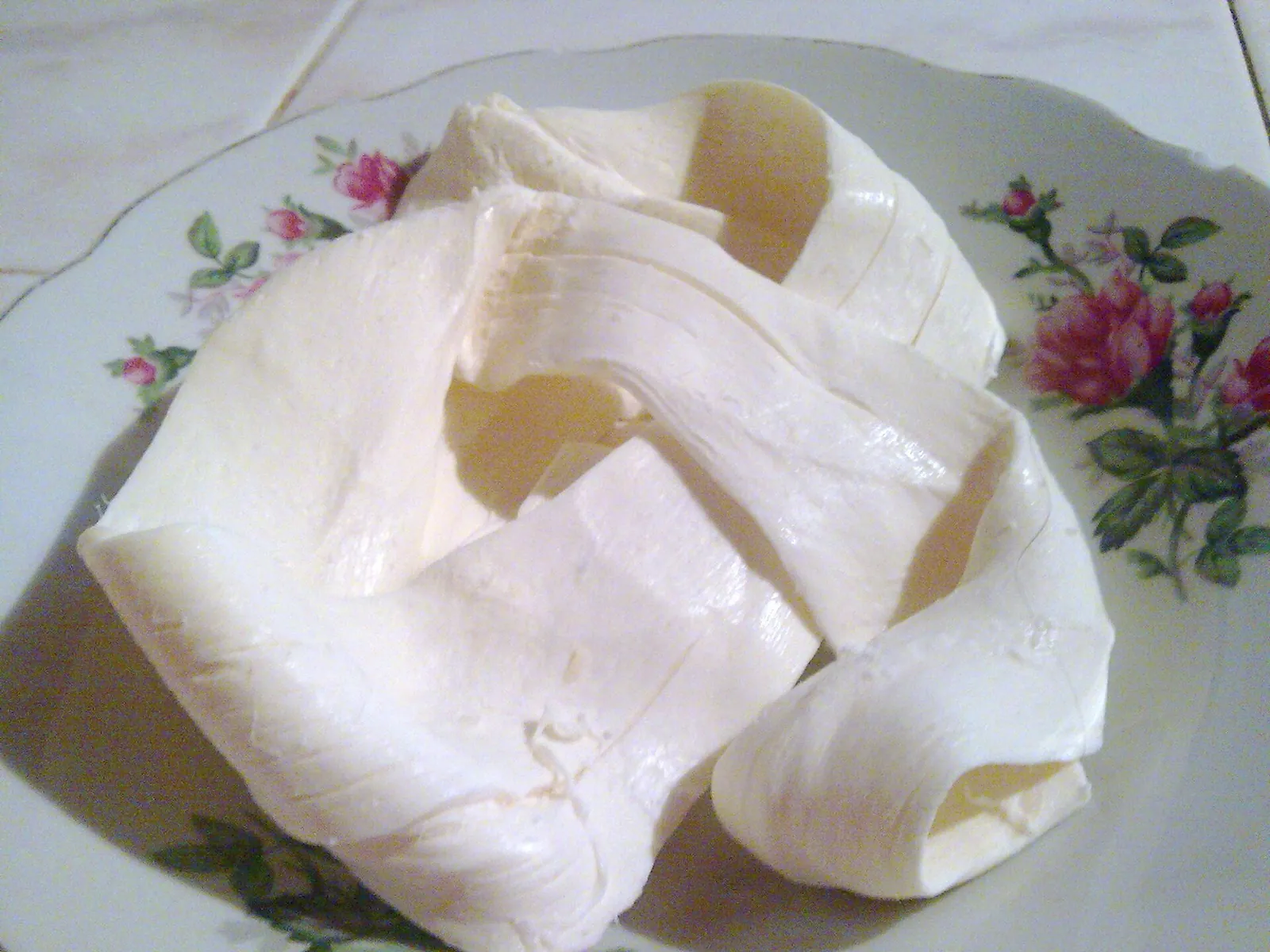
It is called quesillo in Mexico, it peels apart like string cheese, and it melts into the long, smooth strings that make a quesadilla.
The stretch comes from the method. The curd is soured in its whey until it turns elastic, then kneaded in hot water until it can be pulled, the pasta filata technique behind mozzarella. A cheese that skips those steps, such as queso fresco, crumbles instead of stretching.
Oaxaca cheese at a glance
This table shows Oaxaca cheese at a glance, drawn from a 2003 review of Hispanic cheeses, a 2022 study of the traditional method and USDA nutrient data.
| Oaxaca cheese | |
|---|---|
| Milk | Cow's; raw in the traditional cheese, pasteurized in commercial ones |
| Origin | The state of Oaxaca, Mexico, its probable place of origin |
| Other names | Quesillo, queso Oaxaca |
| Type | Pasta filata (stretched curd), soured, kneaded in hot water and wound |
| Age | None; sold fresh |
| Texture | Soft, elastic, stringy; peels in strands |
| Flavor | Mild, milky and buttery |
| Moisture and pH | About 40 to 46% moisture; pH 5.0 to 5.5 |
| Melt | Smooth, with long strings |
| Per ounce (USDA) | No Oaxaca entry; asadero, a stretched Mexican melter, has 101 calories, 7.1 g fat, 6.4 g protein and 172 mg sodium |
How Oaxaca cheese is made
Oaxaca cheese is made by setting warm milk with rennet, souring the curd in its whey, and then stretching it in hot water. A 2022 study of the artisanal method warmed milk to 90 to 93°F (32 to 34°C), set it with rennet, cut the curd and poured off most of the whey. The curd then rested for 30 to 45 minutes until it turned acidic enough to stretch. A 2003 review by USDA's Diane Van Hekken and Cal Poly's Nana Farkye puts the finished cheese at pH 5.0 to 5.5.
The soured curd was cut into small cubes and kneaded by hand in hot water at about 158°F (70°C), within the 158 to 176°F (70 to 80°C) the paper gives as the traditional range, until it formed a cylinder that could be pulled into a thin ribbon. Traditional quesillo is made from raw milk with no starter culture, while commercial versions use pasteurized milk and often add one. The 1953 USDA cheese handbook describes the same logic for pasta filata cheeses: ferment the curd, heat it until it turns plastic, then draw it into ropes.
Why Oaxaca cheese is wound into a ball
Oaxaca cheese is wound into a ball because the stretching step leaves it as one long ribbon. The ribbon goes into cold water to firm up, 39°F (4°C) for about 5 minutes in the 2022 study. It is then rubbed with dry salt, about 2 percent of its weight there, and wound into a ball. The 2003 review calls the shape a ball of twine, and Dairy Farmers of Wisconsin compares it to a ball of yarn.
To use it, find the loose end and unwind the ball, then tear the ribbon into strips, much as you would string cheese. The string cheese guide explains why stretched curd peels this way.
What Oaxaca cheese tastes like
Oaxaca cheese tastes mild, milky and buttery, with a soft, squeaky chew. Wisconsin cheesemakers compare the flavor to a young Monterey Jack, but more buttery and with far more melt. A sensory study of Oaxaca cheeses listed descriptors such as moist, salty, fibrous and squeaky, and the 2022 paper adds acidic, fermented notes.
How to use Oaxaca cheese
How to use Oaxaca cheese comes down to its melt: put it where you want long, smooth strings.
- Quesadillas: about 2 ounces (1/2 cup torn strands) is enough for an 8-inch tortilla. Cook over medium heat until the cheese is melted and the tortilla is crisp. The quesadilla guide compares other cheeses.
- Queso fundido and dips: melt it in a hot skillet or oven dish with chorizo or roasted chiles.
- Other Mexican dishes: Wisconsin cheesemakers also suggest tostadas, empanadas, refried beans and stuffed squash blossoms.
- Anywhere you use mozzarella: pizza and baked pasta take it well.
The melting cheese ranking lists Oaxaca and asadero as its stringy-stretch picks, and the guide to Mexican cheeses covers the rest of the family.
Oaxaca cheese substitutes
The best Oaxaca cheese substitute is a block of low-moisture mozzarella, which is made the same way. The federal standard for low-moisture mozzarella has the curd kneaded and stretched in hot water, then firmed in cold water, with 45 to 52 percent moisture. Skip fresh mozzarella packed in water, since its standard allows 52 to 60 percent and it can leave a quesadilla soggy.
| Substitute | How it compares |
|---|---|
| Low-moisture mozzarella, block | Stretches like Oaxaca because it is made the same way; 45 to 52% moisture by standard, and USDA measures 48.4 g water per 100 g in the whole-milk type |
| Asadero or Chihuahua | Mexican melters; asadero is stretched, and Chihuahua is a cheddar-type cheese |
| Monterey Jack | Similar mild, buttery flavor; melts smoothly but does not string |
| String cheese | The same peel-apart texture; fine torn into a quesadilla |
The mozzarella guide explains the types, and the substitute finder lists more swaps.
Buying and storing Oaxaca cheese
Buying Oaxaca cheese means looking for a ball or coil labeled Oaxaca or quesillo in the refrigerated case. Check that the label says pasteurized: the CDC advises people who are pregnant, 65 or older or immunocompromised to avoid cheese made with unpasteurized milk, and artisanal quesillo is often raw-milk. In a study of vacuum-packed Oaxaca stored at 46°F (8°C), pH, hardness, elasticity and whiteness fell over 24 days and off-flavors appeared, so use it fresh.
What most Oaxaca cheese advice gets wrong
Most Oaxaca cheese advice calls it Mexican mozzarella and stops there, which skips three details.
Reduced-fat Oaxaca stretches less. A Journal of Dairy Science study found that lowering the fat made melted Oaxaca flow and release oil more easily but stretch less. Buy the full-fat ball for long strings.
Aging adds melt and costs flavor. In the 24-day storage study, meltability rose as the cheese aged while off-flavors appeared, so melting hides some age, but fresh Oaxaca still tastes best.
It is not mozzarella with a new name. Both are stretched, but Oaxaca is pulled into a ribbon and wound rather than molded, is traditionally made from raw milk with no starter culture, and runs 40 to 46 percent moisture in the 2003 review, at or below low-moisture mozzarella's 45 to 52.
Questions about Oaxaca cheese
These questions about Oaxaca cheese come up most at the market and the stove.
How do you pronounce Oaxaca cheese?
Oaxaca cheese is pronounced "wa-ha-ka," according to Dairy Farmers of Wisconsin, with the x sounding like an h.
Is Oaxaca cheese the same as mozzarella?
Oaxaca cheese is not the same as mozzarella, though both are stretched-curd cheeses. Oaxaca is wound from one long ribbon and tastes like a young Monterey Jack, and the two can usually trade places on a pizza or in a quesadilla.
Is Oaxaca cheese the same as queso fresco?
Oaxaca cheese is quite different from queso fresco: Oaxaca is stretched, stringy and melts, while queso fresco is crumbly and does not. The queso fresco guide covers the fresh cheese.
What is quesillo?
Quesillo is the traditional Mexican name for Oaxaca cheese, according to a 2022 study of the cheese. The study describes an artisanal fresh cheese sold as balls or strands of different sizes and weights.
What cheese is best for quesadillas?
The best cheese for quesadillas is Oaxaca, which Wisconsin cheesemakers call the mozzarella of Mexico for its stringy, easy melt. Asadero, Chihuahua, Monterey Jack and mozzarella also work.
Choosing Oaxaca cheese
Choosing Oaxaca cheese starts with the label: a full-fat ball or coil, made with pasteurized milk, bought close to its date. Unwind it, tear it into strips and lay them across a tortilla. For a first test, make one quesadilla with Oaxaca and one with block mozzarella, and compare the strings and the flavor.
Sources
- Hispanic Cheeses: The Quest for Queso (Van Hekken and Farkye, January 2003), Food Technology, Institute of Food Technologists
- Properties of Oaxaca Cheese Elaborated with Ultrasound-Treated Raw Milk: Physicochemical and Microbiological Parameters (Huerta-Jimenez and others, 2022), Foods via PubMed Central
- Journal of Dairy Science via PubMed: Changes in quality of nonaged pasta filata Mexican cheese during refrigerated vacuum storage (Fuentes and others, 2015), Composition, yield, and functionality of reduced-fat Oaxaca cheese (Caro and others, 2011) and Sensory profile development of Oaxaca cheese and relationship with physicochemical parameters (Sandoval-Copado and others, 2016)
- Cheese Varieties and Descriptions (Agriculture Handbook No. 54, 1953), U.S. Department of Agriculture
- 21 CFR 133.156, Low-moisture mozzarella and scamorza cheese and 133.155, Mozzarella cheese and scamorza cheese, eCFR (FDA standards of identity)
- Dairy Farmers of Wisconsin: Oaxaca Cheese and Mexican Cheese for Quesadillas
- Preventing Listeria Infection, Centers for Disease Control and Prevention
- USDA FoodData Central (SR Legacy): queso asadero and mozzarella, whole milk, low moisture, U.S. Department of Agriculture