
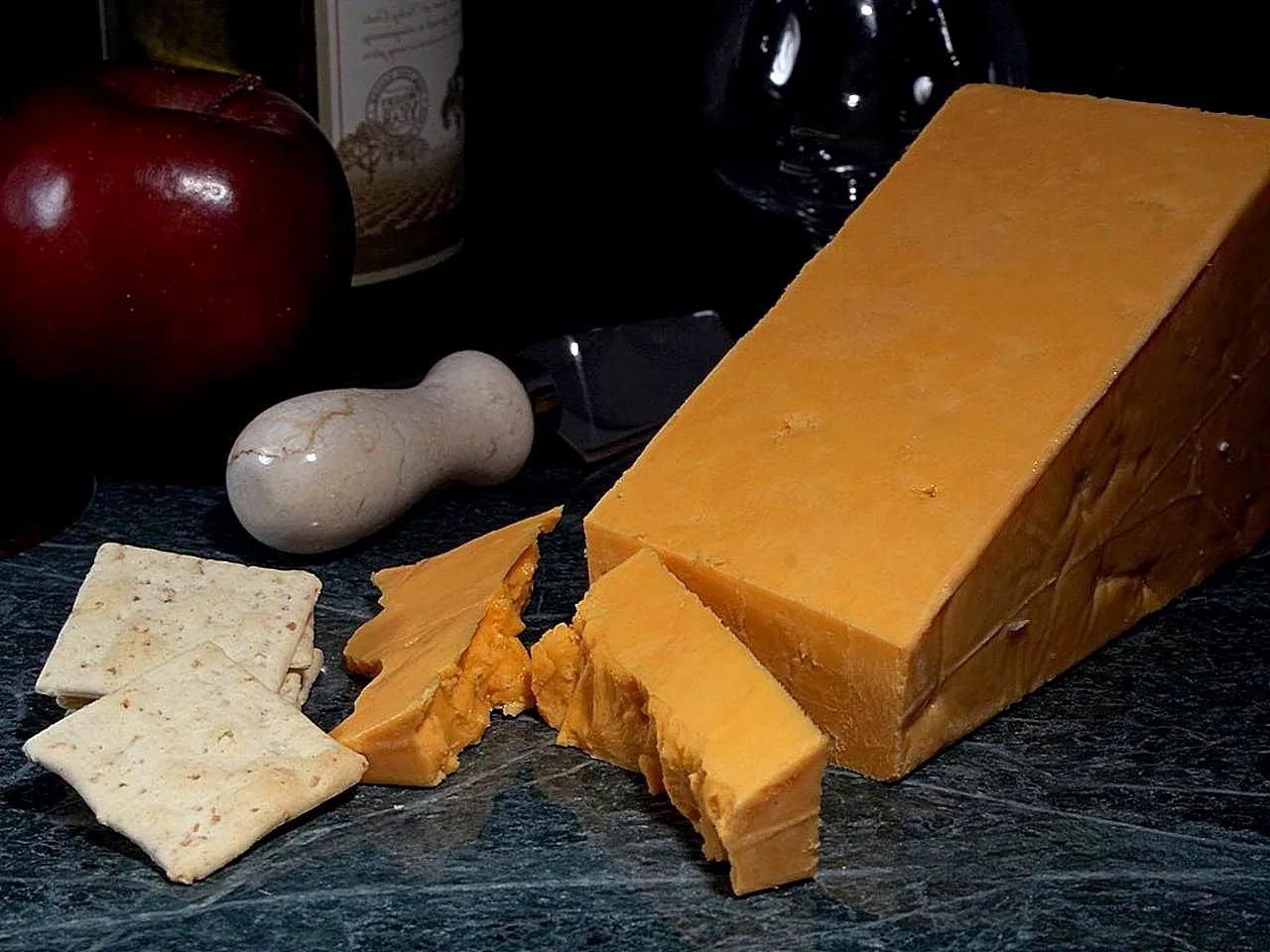
It tastes mellow, lightly sweet and nutty, and it grates and melts well enough to work as an everyday cooking cheese.
Despite the name, there is nothing red in it; the color is the signature, and it is also the thing most often misunderstood.
Red Leicester cheese at a glance
Here is Red Leicester cheese at a glance, built from the facts below.
| Detail | Red Leicester |
|---|---|
| Milk | Cow's milk (farmhouse versions are raw; many others are pasteurized) |
| Made in | Leicestershire, England, and now elsewhere in Britain |
| Color | Russet orange, from annatto |
| Rind | Reddish orange, often with powdery mold on cloth-bound wheels |
| Texture | Firm, flaky, crumbly; block versions are moister |
| Age sold | About 3 to 12 months |
| Flavor | Mellow, lightly sweet, nutty, with caramel notes as it ages |
Where Red Leicester cheese comes from
Red Leicester cheese traces back to the 17th century in England's East Midlands, according to Slow Food UK's Ark of Taste entry. The cheese market in Leicester became so important that it gave the cheese its name, even though little of it was made inside the city.
It was long just "Leicester." The "Red" became a necessary label in the 1940s, when wartime rationing produced an uncolored "White Leicester," as Wikipedia records. Leicestershire is also the home of Stilton, and the two cheeses show how one county can make very different styles.
Farmhouse makers still use raw milk and traditional wheels, bound in cloth while they mature, and the slow-matured wheels are the ones sold at around 3 to 12 months old.
Why Red Leicester cheese is orange
Red Leicester cheese is orange because makers add annatto, an extract of the seeds of Bixa orellana that the FDA lets color foods generally, to the milk. It colors the cheese without noticeably changing the taste, and the same dye turns orange cheddar orange.
Annatto has been used since the 18th century; before that, the coloring was carrot or beetroot juice. Slow Food says the color was a signal of high cream content and quality in the old Leicester market. Uncolored versions still exist, so a pale Leicester is not a mistake.
Red Leicester cheese flavor and texture
Red Leicester cheese flavor is mellow and lightly sweet with a nutty edge, and a traditional wheel is fairly firm, dry and flaky. Slow Food describes a delicately sweet taste with a hint of caramel that grows with age. Block-pressed supermarket versions are moister, creamier and milder.
Age changes it. Young wheels are very mild, and after about 6 months it develops enough tang to count as old, per Wikipedia. Compared with cheddar, Red Leicester is more open and crumbly, and it never reaches cheddar's sharp bite.
How to use Red Leicester cheese
Red Leicester cheese is a good all-purpose cheese, and its color is a bonus on a plate. On a board, it pairs with chutney, pickles, apples and crusty bread. It melts into a cheese toastie or Welsh rarebit with a warm orange tint and a mellow flavor, and it grates over gratins and baked dishes.
Grate it fresh for sauces and add it off the heat, then stir; a firm, crumbly cheese turns grainy if boiled. The cheese sauce guide shows the method.
For drinks, the pairing guide lists Cabernet Sauvignon, Merlot and Malbec, bitter, brown ale and IPA, and apple, pear and grape on the side.
Red Leicester cheese substitutes
The best Red Leicester cheese substitutes are mild, orange, firm cheeses. A young Double Gloucester is closest in color and mellowness, though it is smoother and more buttery, and a mild orange cheddar gives a similar melt with a bit more tang.
Colby is the simplest US swap for melting and for a toastie. For a board, the substitute finder lists more matches, and a young Lancashire gives a more crumbly bite without the color.
Buying and storing Red Leicester cheese
When buying Red Leicester cheese, check whether you want a moist block or a farmhouse cloth-bound wheel, since the labels can look alike. The wheel will taste more complex, and the block will melt more smoothly.
Store it wrapped in wax paper in the fridge and use it within a couple of weeks, slicing or grating it fresh. Raw-milk wheels are fine for most people, but anyone pregnant or immunocompromised should check the label and follow FDA and CDC advice. The storing cheese guide covers wraps in more detail.
What most Red Leicester cheese advice gets wrong
Most Red Leicester cheese advice repeats a few shortcuts that are worth correcting.
Red Leicester is not red or hot
Red Leicester is not red, spicy or sharp just because of its color. Annatto is a dye, so the orange says nothing about age or strength; judge the cheese by its label and by tasting it.
Mold on a Red Leicester rind is common
Mold on a Red Leicester rind is common on cloth-bound farmhouse wheels, where powdery mold on the rind is normal. Mold on a cut face of a block is different, so cut it away with a generous margin and rewrap in fresh paper.
Red Leicester is not a cheddar copy
Red Leicester is not a cheddar copy, because it tastes sweeter, breaks more easily, and keeps a rounder flavor rather than turning sharp. Use it where you want gentleness.
Questions about Red Leicester cheese
These are the questions about Red Leicester cheese that come up most often.
Why is Red Leicester cheese orange?
Red Leicester cheese is orange because annatto, a plant dye, is added to the milk; it gives color but little flavor.
Is Red Leicester cheese the same as cheddar?
Red Leicester cheese is not the same as cheddar, because it is flakier and sweeter, while cheddar is denser and sharper with age.
Is Red Leicester cheese good for melting?
Red Leicester cheese is good for melting, giving toasties, gratins and sauces a warm color and a mellow flavor.
How old is Red Leicester cheese when sold?
Red Leicester cheese is sold at about 3 to 12 months old, and it develops a tangier flavor after around 6 months.
What is a good Red Leicester cheese substitute?
A good Red Leicester cheese substitute is young Double Gloucester, mild orange cheddar or Colby.
Your first Red Leicester cheese
For your first Red Leicester cheese, buy a small wedge, taste it plain, then grate the rest over a toastie. If you like it, compare it with Double Gloucester next time.
Sources
- Artisan Red Leicester Cheese, Slow Food UK, Ark of Taste
- Red Leicester, Wikipedia
- 21 CFR 73.30, Annatto extract, Legal Information Institute, Cornell Law School