
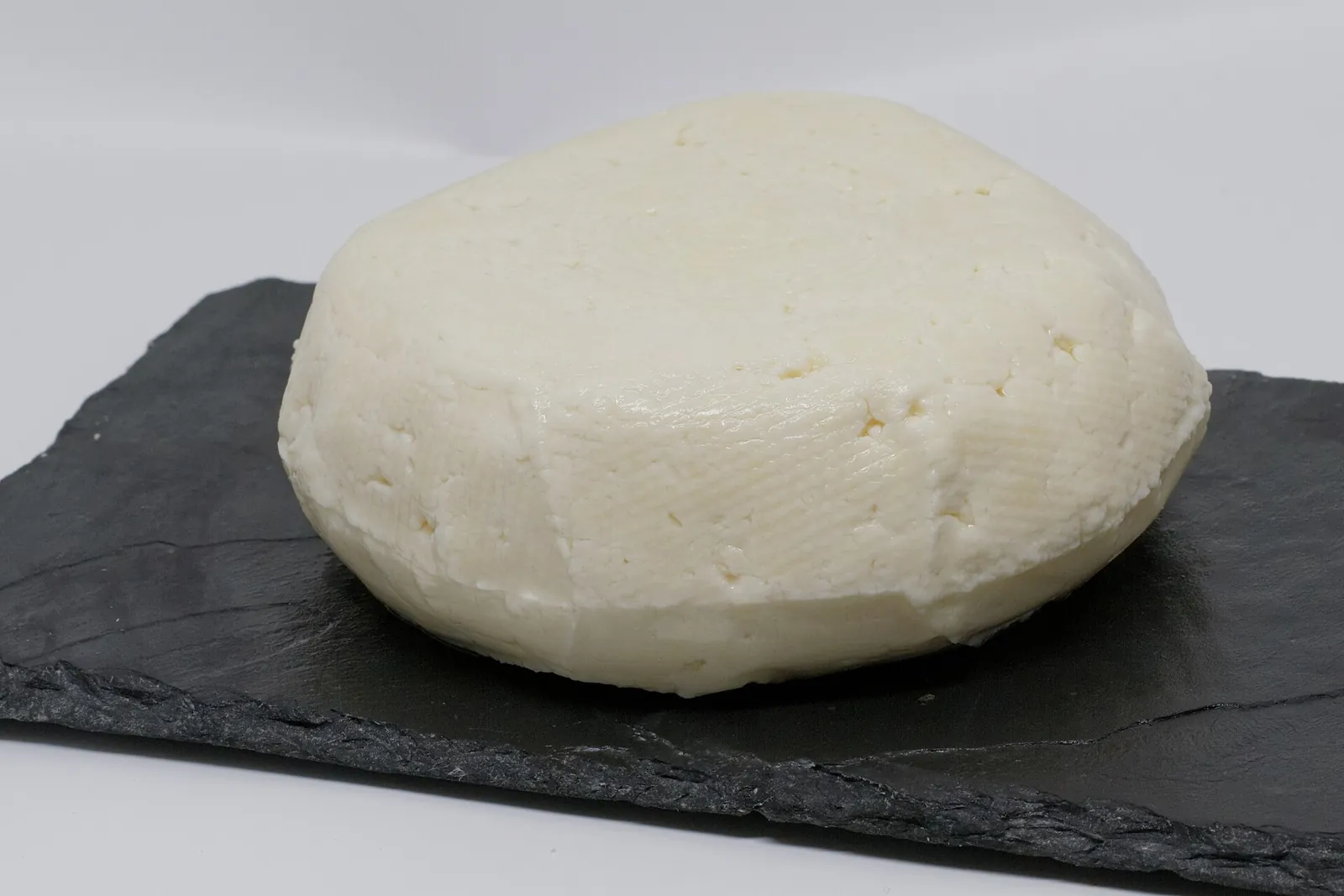
It is named for the panela, or basket, in which the curd drains, and the weave leaves its pattern on the surface.
What sets panela apart is how it is set: with rennet, in large cubes, and drained in molds rather than milled and crumbled. That gives a firm, moist, sliceable cheese that stands up to a grill pan.
Panela cheese at a glance
Here is panela cheese at a glance, drawn from a review of Hispanic cheeses by USDA and Cal Poly dairy scientists and a cheese technologist at the Wisconsin Center for Dairy Research.
| Detail | Panela cheese |
|---|---|
| Milk | Whole milk, usually cow's |
| Set with | Rennet; no starter culture in the traditional method |
| Moisture | 53 to 58 percent |
| Fat | 19 to 25 percent |
| pH | 5.6 to 6.4 |
| Texture | Firm, moist, sliceable and a little crumbly |
| Flavor | Very mild, milky, lightly salty |
| Heat | Softens, browns, does not melt |
| Age | Fresh, eaten within days or weeks |
How panela cheese is made
Panela cheese is made from whole milk warmed to 86 to 104°F (30 to 40°C), with calcium chloride and rennet added. The curd is cut into large cubes about 1 inch (2.5 cm) on a side and cooked gently while stirred, then about half the whey is drained and the curd is salted, either directly or with a concentrated salt solution. The wet curd goes into basket-weave molds and drains overnight, according to the Van Hekken and Farkye review.
Dean Sommer of the Wisconsin Center for Dairy Research describes panela, like queso fresco, as made without a starter culture. Large cubes and no milling are why the finished cheese holds together.
Why panela cheese does not melt
Panela cheese does not melt because its pH stays high, between 5.6 and 6.4, and it holds a lot of moisture, 53 to 58 percent. Cheeses that melt, such as Chihuahua cheese, are more acidic, at about pH 5.0 to 5.3. In panela the protein stays tightly bound, so heat softens the cheese and browns the surface but the curd never relaxes into a liquid.
Sommer says panela will soften but not melt and flow when heat is applied. That behavior is the reason to pick it over a melting cheese for the grill.
Panela cheese flavor and texture
Panela cheese tastes very mild, somewhat bland, with sweet, milky and salty notes, in Sommer's words, and USDA researchers call it "mild, sweet and crumbly" in a 2002 Agricultural Research magazine report. Its texture is firm and moist; it slices into clean slabs and cubes, and it crumbles a little at the edges.
A trade description likens its flavor to a dry pressed ricotta. Because it is so mild, it takes on whatever you put with it: salsa, lime, chile, olive oil.
How to use panela cheese
Panela cheese works both raw and cooked. Cubed or sliced, it goes into salads and onto sandwiches and tortas, with tomatoes, avocado, nopales or fruit. Crumbled, it tops beans, enchiladas and antojitos, though queso fresco crumbles more easily.
To cook it, pat a thick slab dry, brush it with oil and sear it in a hot skillet or on a grill for 1 to 2 minutes per side, until golden. Serve it with salsa, lime and herbs, or tuck it into tacos. It can also marinate in oil, chile and herbs. Treat it as a vegetarian protein for a plate.
How to buy panela cheese in the US
Buying panela cheese in the US means looking in the refrigerated case at Latin markets and larger supermarkets, where it is sold as a round or wedge labeled queso panela. Pick a smooth, white, moist round with the basket pattern on the surface and check the date, because it is a fresh cheese with a short life.
Look for "pasteurized" on the label. Fresh, high-moisture cheeses are the ones the FDA and CDC warn pregnant people about when they are made from raw milk; the queso fresco guide covers that advice. Keep panela refrigerated, wrap cut pieces and use it within about a week, following the storing cheese guide.
What most panela advice gets wrong
Most panela advice treats it as a low-fat queso fresco or a melting cheese, and it is neither.
Panela cheese is not queso fresco
Panela cheese is not queso fresco, though both are fresh, white and rennet-set. Queso fresco curd is milled fine, which makes it crumbly, while panela curd stays in large pieces and is drained in baskets, so panela slices. The queso fresco guide compares both with the third white Mexican cheese, queso blanco.
Panela cheese is not a melting cheese
Panela cheese is not a melting cheese, so a panela quesadilla will warm and soften but never stretch. Pair it with Oaxaca cheese when you want pull, or use panela for the fresh, milky layer on top.
Panela cheese is not especially low in fat
Panela cheese is not especially low in fat, since the review puts it at 19 to 25 percent fat by weight, which overlaps the 21 to 30 percent range for Chihuahua cheese. It feels light because it is also 53 to 58 percent water, not because it is lean.
Panela cheese substitutes
Panela cheese substitutes depend on what you are doing. For grilling or frying, halloumi and paneer hold their shape in the same way, though halloumi is saltier and squeakier. For salads and toppings, queso fresco is the nearest match, and queso blanco also works. The substitute finder lists more options.
Questions about panela cheese
These are the questions about panela cheese that come up most.
Does panela cheese melt?
Panela cheese does not melt. It softens and browns when heated but keeps its shape, so it is good for grilling and frying.
Why is panela cheese called basket cheese?
Panela cheese is called basket cheese because the curd drains overnight in basket-weave molds, which leave a pattern on the surface.
What does panela cheese taste like?
Panela cheese tastes very mild, milky and lightly salty, with a firm, moist, slightly crumbly texture.
Is panela cheese the same as queso fresco?
Panela cheese is not the same as queso fresco. Both are fresh and rennet-set, but queso fresco is milled and crumbly, while panela is drained in large pieces in molds and slices cleanly.
Can you substitute halloumi for panela cheese?
Halloumi can replace panela cheese for grilling and frying, because both keep their shape in heat. Halloumi is saltier, so skip added salt.
Your first panela cheese
For your first panela cheese, buy a pasteurized round, slice it into slabs about half an inch (1.3 cm) thick, sear them in a hot oiled pan and serve them with salsa and lime. Use it up within a week.
Sources
- Hispanic Cheeses: The Quest for Queso, Van Hekken and Farkye, Food Technology, Institute of Food Technologists
- Versatility of Hispanic cheeses could boost market, FoodNavigator-USA, quoting Dean Sommer, Wisconsin Center for Dairy Research
- Hispanic cheeses research, Agricultural Research magazine, USDA ARS
- Versatile and Authentic Hispanic-style Cheeses, Cafe Meeting Place