
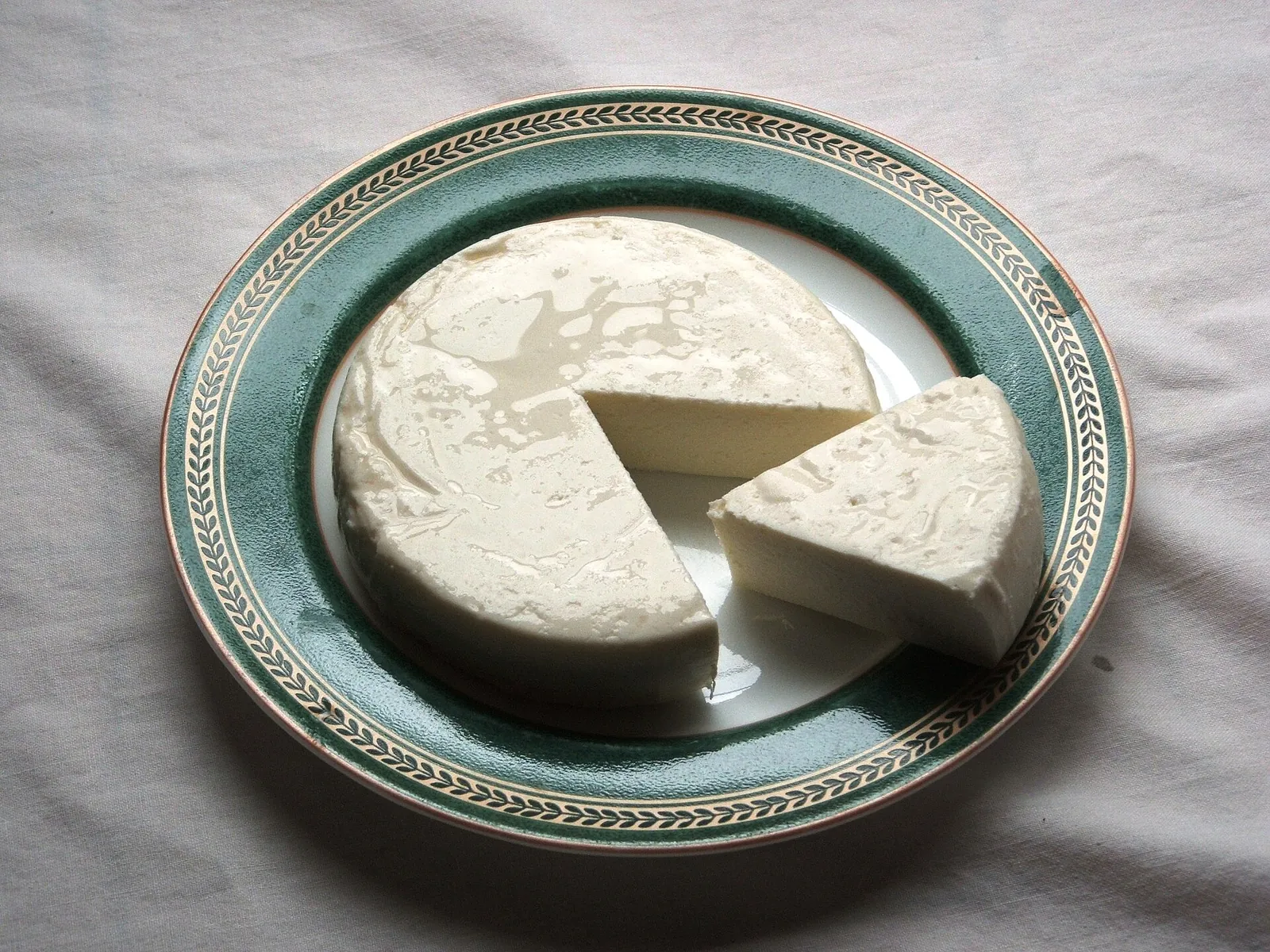
It tastes mild, milky and slightly salty, and it softens in heat without melting, which is why it belongs on top of a dish rather than inside it.
The pH explains the melt. Queso fresco stays at 6.1 or higher, well above the roughly 5.2 where cheese curd starts to melt, according to a 2003 review by Diane Van Hekken of USDA and Nana Farkye of Cal Poly, so the curd holds together instead of flowing. It also carries a safety caveat: the FDA tells people at higher risk of listeriosis to avoid queso fresco-type cheeses altogether, pasteurized or not.
Queso fresco at a glance
This table shows queso fresco at a glance, drawn from USDA research, FDA guidance and USDA nutrient data.
| Queso fresco | |
|---|---|
| Milk | Cow's, whole or part skim; most US retail cheese is pasteurized |
| Origin | Mexico; made across Latin America and in the US |
| Protected name | None; the US has no standard of identity for it |
| Set with | Rennet, not acid; a starter culture is optional |
| Age | None; sold and eaten fresh |
| Texture | Soft, moist, crumbly |
| Flavor | Mild, milky, slightly salty |
| Moisture and pH | About 46 to 57% moisture; pH 6.1 or higher |
| Heat | Softens, does not melt |
| Per ounce (USDA) | 85 calories, 6.8 g fat, 5.1 g protein, 213 mg sodium |
How queso fresco is made
Queso fresco is made by warming milk, setting it with rennet, then cutting, cooking, draining and milling the curd. In their 2003 review of Hispanic cheeses, Van Hekken and Farkye describe whole or part-skim milk warmed to 86 to 90°F (30 to 32°C), rennet added, the curd cut and cooked to the firmness the maker wants, and the whey drained. The curd is then finely milled, which is what makes the cheese crumble, dry-salted and packed into molds.
A starter culture is optional. Soft Mexican cheeses were traditionally made without one, because the bacteria in raw milk supplied the acid, and makers who pasteurize often add a culture for flavor. USDA's own test batches, described in the Journal of Dairy Science, are starter-free and rennet-set. The US has no standard of identity for queso fresco, so the exact recipe is up to the maker.
Queso fresco vs queso blanco and panela
Queso fresco, queso blanco and panela are all white, soft Mexican-style cheeses, and they differ in how the curd is set and handled, according to the same review.
| Queso fresco | Queso blanco | Panela | |
|---|---|---|---|
| Set with | Rennet | Acid and heat: milk heated to 185°F (85°C) or higher, organic acid added to reach pH about 5.3 | Rennet |
| Curd | Finely milled | Not finely milled | Cut into large cubes, drained in baskets |
| Texture | Crumbly, moist | Firmer, tougher | Sliceable and crumbly |
| Moisture | 46 to 57% | 51 to 53% | 53 to 58% |
| pH | 6.1 or higher | 5.6 or lower | 5.6 to 6.4 |
Panela is the basket-molded sibling, covered in the panela guide, and cotija is the aged, saltier cousin, compared in queso fresco vs. cotija.
Why queso fresco does not melt
Queso fresco does not melt because it never gets acidic enough. The pH figures above are the reason, and USDA researchers describe the result as a weak-bodied cheese that crumbled and did not melt on heating. At 51 percent water in USDA data it is wet but not meltable, and the melting cheese ranking places it with the cheeses that hold their shape. In a hot pan it browns and softens. For long, gooey strings, use Oaxaca cheese.
How to use queso fresco
How to use queso fresco comes down to timing: add it at the end, or let it hold its shape in the pan.
- Toppings: crumble it just before serving over tacos, tostadas, enchiladas, beans, soups, salads and grilled corn.
- Fillings: it holds its shape inside chiles rellenos and other cooked dishes, and the 2003 review calls soft Hispanic cheeses ideal for fillings that must not flow.
- Pan-fried: pat a thick slice dry and brown it in a hot nonstick pan. The FDA lists pan-frying among the common ways to eat queso fresco-type cheeses, and firmer panela holds slabs best.
- Quesadillas: mix it with a melter such as Oaxaca so the filling stays gooey.
Taste before you salt. USDA lists 213 mg of sodium per ounce, about half of cotija's 397 mg. See Mexican cheeses and how to use them for more dishes.
Queso fresco safety: raw milk and Listeria
Queso fresco safety is mostly a Listeria question, because the bacterium grows in moist, low-acid cheese even in a refrigerator. The FDA recommends that people who are pregnant, 65 or older or have weakened immune systems avoid all queso fresco-type cheeses, since outbreaks have repeatedly been linked to them and even pasteurized cheese can be recontaminated in an unsanitary plant. It says listeriosis risk in pregnancy is about 10 times the general population's, and about 24 times for Hispanic pregnant women. The CDC says to avoid unheated queso fresco-type cheeses, pasteurized or not, but lists them as safer when heated to 165°F (74°C) or until steaming hot.
Two outbreaks show both failure routes. In 2000 and 2001, illicitly made, unlabeled Mexican-style cheese from contaminated raw milk sickened 13 people in Winston-Salem, North Carolina, 11 of them pregnant, with 5 stillbirths, 3 premature deliveries and 3 infected newborns, a study in Clinical Infectious Diseases found. In 2024, queso fresco and cotija from a commercial California maker were linked to 26 illnesses in 11 states between 2014 and 2023, with 23 hospitalizations and 2 deaths, and the FDA matched the outbreak strain to a sample from the plant.
Federal cheese standards, such as the cheddar standard, allow raw milk only if the cheese is cured at 35°F or warmer for at least 60 days. Queso fresco is eaten fresh, so US makers pasteurize, but the FDA warns that raw-milk versions turn up, which is why unlabeled cheese is the one to skip. If you are at higher risk, skip queso fresco or cook it to 165°F inside a dish, as the FDA suggests. Anyone buying it can follow the FDA's shopping advice: sealed packages that name the maker, show a date and say pasteurized, kept at 40°F (4°C) or below.
Queso fresco substitutes
The best queso fresco substitutes match its crumble, and Wisconsin cheesemakers suggest queso blanco, feta or ricotta salata. Feta is saltier, so rinse it and use a little less. Panela works when you want slabs to fry, and cotija gives a drier, saltier crumble in smaller amounts. The substitute finder lists more swaps.
What most queso fresco advice gets wrong
Most queso fresco advice repeats a few shortcuts, and three of them mislead.
Queso fresco is not an acid cheese. Some cheese guides describe it as curdled with vinegar, but USDA dairy scientists describe it as rennet-set, and the acid-and-heat cheese is queso blanco. Check the ingredient list: enzymes or rennet usually point to queso fresco, and vinegar or citric acid to queso blanco.
The label does not settle it. With no US standard of identity, "queso fresco" can mean slightly different cheeses, and the FDA's guidance covers a whole group it calls "queso fresco-type," including queso blanco and requesón.
The crumble is by design. Makers mill the curd to break up the protein matrix, and USDA research found milling makes the cheese softer and more fragile, with more whey seeping out in storage.
Questions about queso fresco
These questions about queso fresco come up most at the store and the stove.
What does queso fresco taste like?
Queso fresco tastes mild, milky and slightly salty, with a soft, moist crumble. Wisconsin cheesemakers add a bright, slightly tangy edge.
Is queso fresco safe during pregnancy?
Queso fresco is on the FDA's avoid list during pregnancy, even when it is pasteurized, because outbreaks have repeatedly been linked to queso fresco-type cheeses. The CDC says unheated queso fresco-type cheeses should be avoided, and that they are safer when heated to 165°F or until steaming hot. See cheese during pregnancy for the full list.
Is queso fresco the same as cotija?
Queso fresco is not the same as cotija: queso fresco is fresh, moist and mild, while cotija is aged, dry and much saltier. The cotija guide covers the aged cheese.
Can you fry queso fresco?
You can fry queso fresco, and the FDA lists pan-frying among its common uses. Pat slabs dry and brown them in a hot nonstick pan, since the cheese softens and browns rather than melting.
How long does queso fresco last?
Queso fresco has a short shelf life, so keep it at or below 40°F and eat it by the date on the package. The FDA advises at-risk eaters not to keep leftovers after opening.
Choosing queso fresco
Choosing queso fresco starts with the label: a sealed round or block that names the maker, shows a date and says pasteurized. Crumble it over something hot at the last minute and use Oaxaca where you want melt. If anyone at the table is pregnant, 65 or older or immunocompromised, skip it or cook it to 165°F inside the dish.
Sources
- Hispanic Cheeses: The Quest for Queso (Van Hekken and Farkye, January 2003), Food Technology, Institute of Food Technologists
- Van Hekken and others, Journal of Dairy Science: Impact of curd milling on the chemical, functional, and rheological properties of starter-free Queso Fresco (2012) and Effect of hydrostatic high-pressure processing on starter-free Queso Fresco (2013), USDA Agricultural Research Service via PubMed
- Queso Fresco-type Cheeses Consumer Guidance, U.S. Food and Drug Administration (content current as of January 16, 2025)
- Preventing Listeria Infection, Centers for Disease Control and Prevention (reviewed January 31, 2025)
- Outbreak Investigation of Listeria monocytogenes: Queso Fresco and Cotija Cheese (February 2024), U.S. Food and Drug Administration
- Outbreak of listeriosis among Mexican immigrants as a result of consumption of illicitly produced Mexican-style cheese (MacDonald and others, 2005), Clinical Infectious Diseases via PubMed
- 21 CFR Part 133, Cheeses and related cheese products (see 133.113 for the 60-day curing rule), eCFR (FDA standards of identity)
- Dairy Farmers of Wisconsin: Queso Fresco and How To Swap Cheeses in a Recipe
- USDA FoodData Central (SR Legacy): queso fresco and queso cotija, U.S. Department of Agriculture