
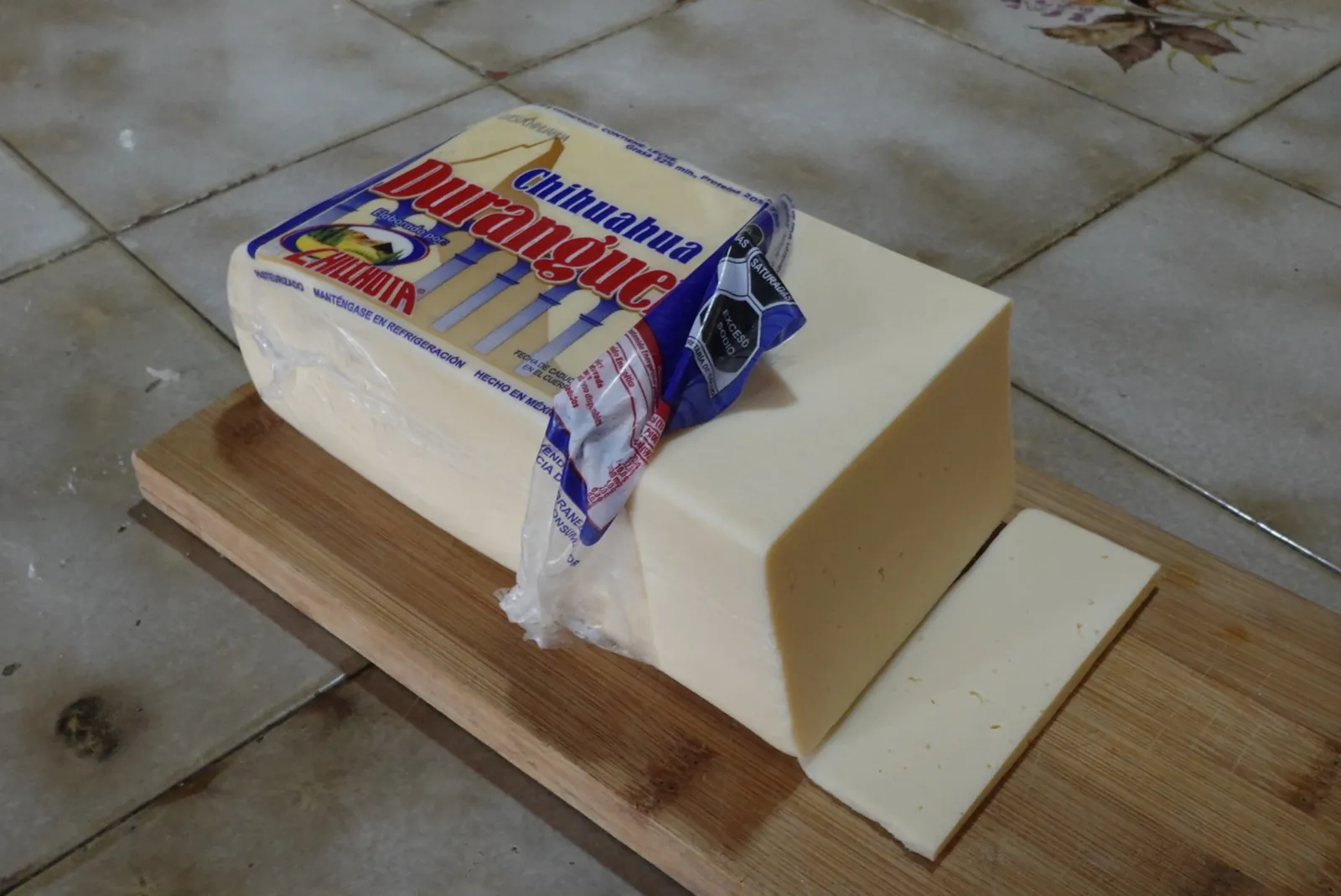
In Mexico it is often sold as queso menonita, the Mennonite cheese, and the two names mean the same thing.
The idea behind it is simple: it is a cheddar-style cheese, but a young, moist one. The curd is stacked like cheddar and then pressed and eaten within weeks, so you get cheddar's smooth melt without a sharp bite.
Chihuahua cheese at a glance
Here is Chihuahua cheese at a glance, taken from a USDA-linked review of Hispanic cheeses, USDA nutrient data and trade and consortium descriptions.
| Detail | Chihuahua cheese |
|---|---|
| Other names | Queso menonita, Mennonite cheese, queso quesadilla (a close relative) |
| Milk | Cow's milk; some versions blend in goat's milk |
| Origin | Chihuahua, northern Mexico, from Mennonite settlers |
| Style | High-moisture white cheddar or Colby type |
| Moisture | 41 to 45 percent |
| Age | Usually eaten within a month or two of making |
| Texture | Semisoft and supple, sometimes with small irregular holes |
| Flavor | Mild, buttery, slightly tangy; sharper with age |
| Per ounce (USDA) | 106 kcal, 8.4 g fat, 6.1 g protein, about 175 mg sodium |
Why Chihuahua cheese is called queso menonita
Chihuahua cheese is called queso menonita because Mennonite settlers began making it after they moved to northern Mexico. Mexican President Álvaro Obregón invited the Mennonites in 1921, and the first Old Colony, Manitoba Colony, Swift Current Colony and Hague-Osler communities settled around what became Cuauhtémoc, according to Culture magazine. Around 1929, Peter G. Friesen apprenticed with an American cheesemaker and came back to open the first quesería; by 1935 cheesemaking had reached Mennonite communities in Durango.
Outside Chihuahua state the same cheese is usually just called queso Chihuahua. The name on the package tells you the region more than the recipe.
How Chihuahua cheese is made
Chihuahua cheese is made the way cheddar is, with a shorter life. Whole milk is warmed to about 86 to 99°F (30 to 37°C) and set with rennet. The curd is cooked to 99 to 113°F (37 to 45°C), the whey is drained, and the curd slabs are stacked and turned (cheddared) until they reach the texture the maker wants, then milled, salted, packed into hoops, pressed and dried for 1 to 5 days, per the Van Hekken and Farkye review of Hispanic cheeses.
Traditional Mennonite makers press the curd overnight and ripen the cheese under paraffin wax, usually for about 15 days, and Culture magazine notes the range runs from 48 hours to three months. The bricks or rounds (ruedas) carry the maker's stamp.
Chihuahua cheese flavor and melt
Chihuahua cheese tastes mild and buttery with a slight tang, closer to Monterey Jack when young and to a medium cheddar when older, according to Wisconsin Cheese. The texture is supple and sliceable at room temperature.
It melts well because of its acidity and moisture. The review puts its pH at 5.0 to 5.3, which is acidic enough for the curd to relax into a smooth, stretchy layer, while soft fresh cheeses such as queso fresco sit at a pH of 6.1 or higher and only soften. The melt is creamy and a little stretchy rather than stringy; for long strands, Oaxaca cheese is the better pick.
How to buy Chihuahua cheese in the US
Buying Chihuahua cheese in the US is easy at Latin markets, and many supermarkets stock it in blocks, braids or shreds under the names queso Chihuahua, queso menonita or "Chihuahua style." Real queso menonita from Mexican makers shows up in well-stocked Mexican groceries, while some US-made versions are produced in Wisconsin; V&V Supremo, founded in 1964, is the best-known maker.
Read the ingredient list. Culture magazine warns that some "Chihuahua-style" products use milk derivatives rather than only milk, and the cheese should list milk, cultures, salt and enzymes. A pale yellow to white block with a few small holes is typical.
How to use Chihuahua cheese
Chihuahua cheese is best used where you want a clean, creamy melt: quesadillas, chiles rellenos, rajas con queso and queso fundido, the skillet of melted cheese often topped with chorizo. It also works on enchiladas, nachos, burgers, in mac and cheese and in baked casseroles. The guide to quesadillas compares it with Oaxaca and other melters, and the best melting cheeses shows where it falls among them.
Shred it from a block just before cooking. Mild spice, tomatoes, beans, chorizo and corn tortillas suit it, because its buttery flavor balances heat without competing. For queso fundido, bake or broil until the edges blister, about 8 to 10 minutes at 400°F (200°C).
What most Chihuahua cheese advice gets wrong
Most Chihuahua cheese advice mixes it up with other Mexican cheeses or skips the one safety point that matters.
Chihuahua cheese is not Oaxaca cheese
Chihuahua cheese is not Oaxaca cheese, even though both go into quesadillas. Oaxaca is a stretched, pasta filata cheese wound into a ball that pulls into strings, while Chihuahua is a pressed cheddar-type that melts smooth and creamy. Use both together if you want pull and flavor.
Chihuahua cheese is not a fresh cheese
Chihuahua cheese is not a crumbly fresh cheese, so do not use it as a topping the way you would queso fresco or cotija. It is pressed and dried, so it slices and shreds, and it will melt on a hot dish instead of sitting on top in crumbs.
Chihuahua cheese from raw milk needs a label check
Chihuahua cheese can be made from raw or pasteurized milk, and a USDA study of commercial queso Chihuahua found both in the market. That 2008 study did not detect pathogens in any sample, but its authors found aerobic plate counts above the recommended limit for the variety. Check the label for pasteurized milk if anyone eating it is pregnant or has a weakened immune system, and read the pasteurized vs. raw-milk cheese guide for the rules.
Chihuahua cheese substitutes
Chihuahua cheese substitutes are easy because it is a mild melter: Monterey Jack, mild cheddar and Muenster all work, according to Wisconsin Cheese. Monterey Jack is the closest match in flavor and melt; a young white cheddar adds a little more tang. If you need a stretch, use Oaxaca or low-moisture mozzarella. For a cold topping, none of these works; use queso fresco.
Questions about Chihuahua cheese
These are the questions about Chihuahua cheese that come up most.
Why is Chihuahua cheese called queso menonita?
Chihuahua cheese is called queso menonita because Mennonite settlers in the Mexican state of Chihuahua started making it in the 1920s. Elsewhere in Mexico it is sold as queso Chihuahua.
What does Chihuahua cheese taste like?
Chihuahua cheese tastes mild, buttery and slightly tangy. Young blocks lean toward Monterey Jack, and older ones get closer to a medium cheddar.
Does Chihuahua cheese melt?
Chihuahua cheese melts very well into a smooth, creamy layer, thanks to its pH of 5.0 to 5.3 and its moisture of 41 to 45 percent. It does not pull into long strings like Oaxaca.
Is Chihuahua cheese the same as Monterey Jack?
Chihuahua cheese is not the same as Monterey Jack, though they are close. Chihuahua is a cheddar-style cheese from Mexico with a slight tang; Monterey Jack is its mildest American stand-in.
How should you store Chihuahua cheese?
Chihuahua cheese keeps best wrapped in the fridge, and a couple of weeks is a good limit for an opened block. The storing cheese guide covers wraps.
Your first Chihuahua cheese
For your first Chihuahua cheese, buy a block labeled queso Chihuahua or queso menonita with a short ingredient list, shred it yourself and melt it into a quesadilla or a skillet of queso fundido. If you cannot find it, Monterey Jack will do the job.
Sources
- Hispanic Cheeses: The Quest for Queso, Van Hekken and Farkye, Food Technology, Institute of Food Technologists
- Mexico's Most Popular Cheese You've Likely Never Heard Of, Culture: The Word on Cheese
- Queso Chihuahua Cheese, Wisconsin Cheese
- Cheese, mexican, queso chihuahua, USDA FoodData Central
- Queso Chihuahua: manufacturing procedures, composition, protein profiles, and microbiology, Tunick et al., International Journal of Dairy Technology, 2008