
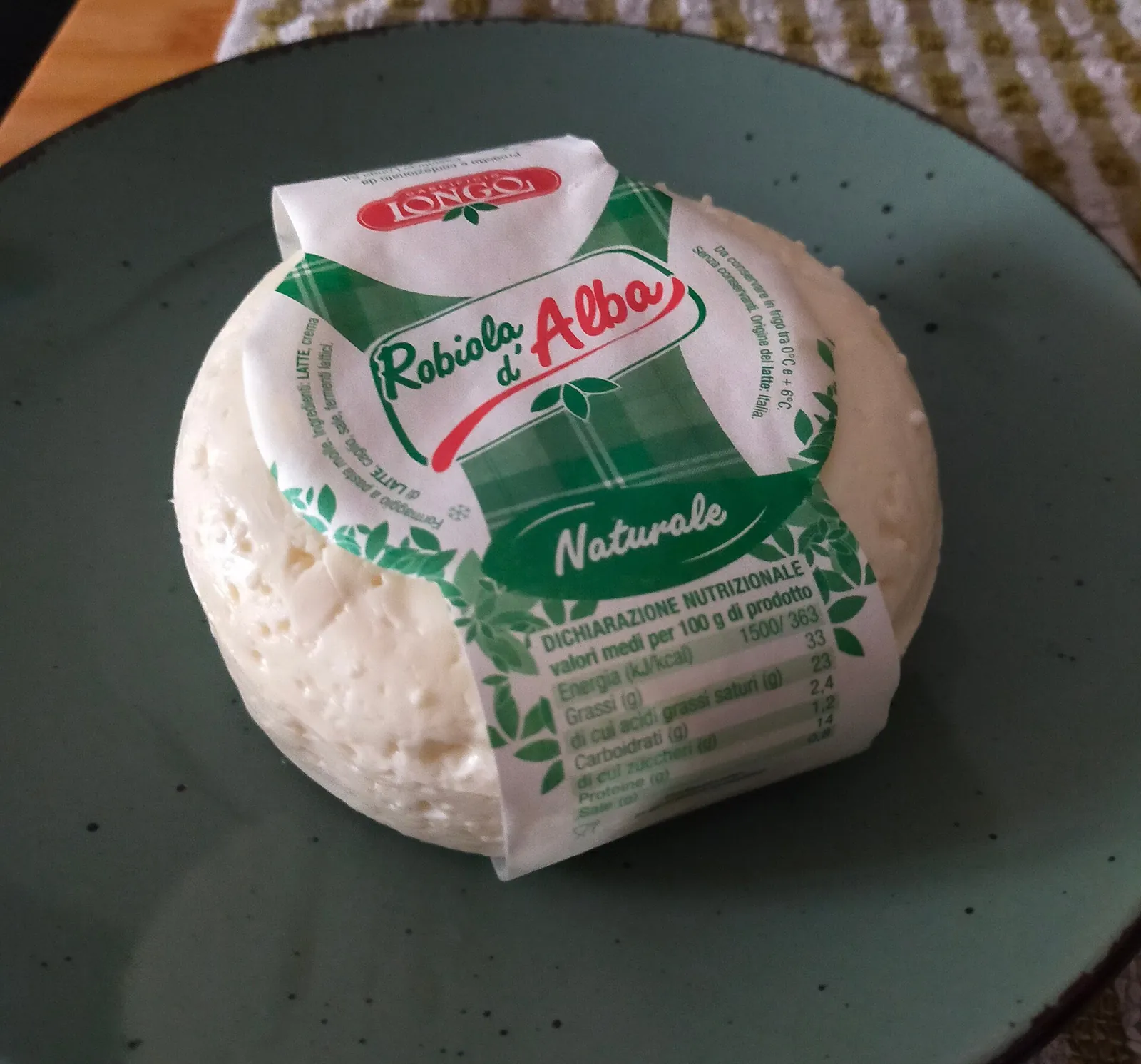
Some robiolas are fresh, white and spreadable, some wear a thin bloomy rind like a small brie, and one, Robiola di Roccaverano, has a protected name and comes from a specific part of Piedmont.
What they share is softness, creaminess and a gentle lactic tang. The differences come from the milk (cow, goat, sheep or a blend) and from how long the cheese has been ripened, which can be as little as no time at all.
Robiola cheese at a glance
Here is robiola cheese at a glance, with the range of types it covers.
| Detail | Robiola |
|---|---|
| Origin | Piedmont (Cuneo, Asti and Alessandria provinces) and Lombardy; also an Aosta Valley specialty |
| Milk | Cow, goat, sheep, or blends |
| Family | Soft-ripened cheeses of the stracchino family |
| Protected name | Robiola di Roccaverano (PDO); the rest of the family is unprotected |
| Ripening | None to about 20 days |
| Rind | None (fresh and Roccaverano) to thin bloomy rind |
| Texture | Soft, creamy, spreadable |
| Flavor | Mild, milky, gently tangy |
Types of robiola cheese
Types of robiola cheese fall into three groups: fresh, bloomy-rind, and the protected Roccaverano. Wikipedia's robiola entry describes robiola as a soft-ripened cheese of the stracchino family from the Langhe, made in Piedmont and Lombardy with varying proportions of cow's, goat's and sheep's milk.
- Fresh robiola: white, moist and spreadable, with a mild, milky flavor and very little ripening. Sold in tubs or small rolls.
- Bloomy-rind robiola, such as Robiola Bosina: a thin white rind and a richer, creamier paste, closer to a small brie. Robiola Lombardia has a thin milky-white to pink rind in small rolls, according to the same entry.
- La Tur: a mixed-style round with a cake-like rind over a tangy layer of cream, and a good example of how far the family stretches.
- Robiola di Roccaverano: the PDO version, with no rind and a slightly straw-yellow color, described as sweet and yielding.
Ripening across the family runs from none to about 20 days, which explains why robiola is soft in every form.
Robiola di Roccaverano, the protected robiola
Robiola di Roccaverano is the protected robiola, a PDO cheese recognized in 1996 and made in 19 municipalities in the provinces of Asti and Alessandria, in the eastern Langhe of Piedmont. Italian Wikipedia says the rules now allow 100 percent goat's milk as of 2023, where the cheese was historically a blend. It has no rind, is cylindrical and averages 250 to 350 g, and tastes sweet when young and more savory with longer ripening; it can be eaten from the fourth day after the curd is set.
If you want to know what the protection means, the PDO and PGI guide explains the label. The rest of the robiola family has no such protection, so "robiola" on a shop label can mean any of the types above, and you should check the milk and the rind.
Robiola cheese and Galbani
Robiola cheese and Galbani are linked through the history of a more famous Italian cheese. According to Galbani's company history, Egidio Galbani and his father Davide opened their dairy in Ballabio in 1882 and their first cheese was a fresh, uncooked robiola. Galbani later created the mild, semi-soft Bel Paese, which is a very different cheese: firmer, sliceable and made to melt.
What robiola cheese tastes like
Robiola cheese tastes soft, milky and gently tangy, with a clean finish. Fresh versions are mild and almost sweet, with a lactic freshness like good yogurt without the sourness. Bloomy-rind versions are richer and more buttery, with mushroomy notes from the rind. Goat's milk robiola is tangier and, when aged, sharper and more pungent.
Across the family, robiola is delicate and creamy rather than bold. The milk shapes it: cow's milk gives roundness and richness, goat's milk adds tang, and sheep's milk adds sweetness and fat. For a point of comparison, robiola sits between a fresh cheese and a bloomy rind, softer than most Italian table cheeses and milder than a washed-rind Taleggio.
How to serve robiola cheese
Serve robiola cheese at cool room temperature, and use the type you bought for what it does best.
- Fresh robiola: spread on crusty bread, crostini or toast with honey, fruit and nuts.
- On pizza: dollop it on after baking so it stays creamy rather than splitting.
- In pasta and risotto: stir it in at the end, off the heat, for richness and a little tang.
- In fillings: fold it into ravioli, savory tarts or stuffed vegetables, in place of other soft fresh cheeses.
- Bloomy-rind robiola: put it on a board at room temperature, like a small brie; take it out of the fridge about 30 minutes ahead, then cut through the rind rather than scraping it off.
Eat the rind of a bloomy robiola, since it is part of the cheese. For serving amounts on a board, the board builder plans about 2 oz of cheese per person for an appetizer.
What to drink and eat with robiola cheese
Robiola cheese pairs with crisp whites, sparkling wine and light reds from Piedmont and Lombardy. Moscato d'Asti, Dolcetto and Barbera are all good matches, and a saison, wheat beer or pale ale works for beer drinkers. Honey, figs, pears and grapes bring a little sweetness to its tang. See the pairing guide for more.
Robiola cheese substitutes
Robiola cheese substitutes depend on which type the recipe wants.
- For fresh robiola: Stracchino (also called crescenza) is the closest, then fresh goat cheese or a mild cream cheese.
- For bloomy-rind robiola: a young brie or a small Camembert.
- For Roccaverano: a fresh chèvre is the nearest goat's milk swap, though less delicate.
- For a spread or filling: mascarpone is richer and sweeter; mix it with a squeeze of lemon to add tang.
The substitute finder can narrow it down by recipe.
What most robiola advice gets wrong
Most robiola advice talks about it as one cheese, which hides the one fact that matters: the types behave nothing alike.
Robiola is not one cheese
Robiola is not one cheese, so a recipe that calls for it without saying which type is guessing. A fresh tub and a bloomy-rind round are not interchangeable in a pasta sauce: the rind in a ripened one will not melt smooth.
Robiola is only protected in one form
Robiola is only protected in one form, Robiola di Roccaverano, so most "robiola" in the US is not the PDO cheese. Check the label for Roccaverano if you want the real thing, and expect to find the others without a protected name.
Fresh robiola does not keep
Fresh robiola does not keep, because high moisture and no rind make it perishable. Buy it close to the day you plan to use it.
How to store robiola cheese
Store robiola cheese in the fridge and use fresh versions within a few days to a week, since soft, moist cheese spoils quickly. Keep bloomy-rind robiola in its paper or in a loosely closed container so the rind can breathe. The storing cheese guide explains wrapping soft cheeses.
Anyone pregnant should follow FDA guidance on soft and raw-milk cheeses and check the label for pasteurization.
Questions about robiola cheese
These are the questions about robiola cheese people ask most.
What is robiola cheese?
Robiola cheese is a family of soft Italian cheeses from Piedmont and Lombardy, made from cow's, goat's or sheep's milk or blends, ranging from fresh and mild to bloomy-rind.
What does robiola cheese taste like?
Robiola cheese tastes mild, creamy and gently tangy. Bloomy-rind versions are richer and more buttery, and aged goat's milk versions are sharper.
How do you use robiola cheese?
Robiola cheese is used spread on bread, dolloped on pizza after baking, stirred into pasta or risotto, or served on a board with honey and fruit.
Is robiola the same as Robiola di Roccaverano?
Robiola is not the same as Robiola di Roccaverano: the Roccaverano name is protected and refers to one goat's milk cheese from the Langhe, while robiola alone covers the whole family.
Can you eat the rind on robiola cheese?
You can eat the rind on robiola cheese when it is a bloomy rind, since it is part of the cheese. Fresh and Roccaverano versions have no rind.
What are good substitutes for robiola cheese?
Substitutes for robiola cheese are stracchino or fresh goat cheese for fresh types, and a young brie for bloomy-rind types.
Your first robiola cheese
For your first robiola cheese, buy a small fresh round, spread it on warm bread with honey and a pear, and taste it at cool room temperature. Next time try a bloomy-rind robiola for a richer version, and if you find a Robiola di Roccaverano, buy it to taste the protected one.
Sources
- Robiola, Wikipedia
- Authentic flavor for generations: Galbani history, Lactalis Culinary (Galbani)
- Robiola di Roccaverano, Wikipedia (Italian)