
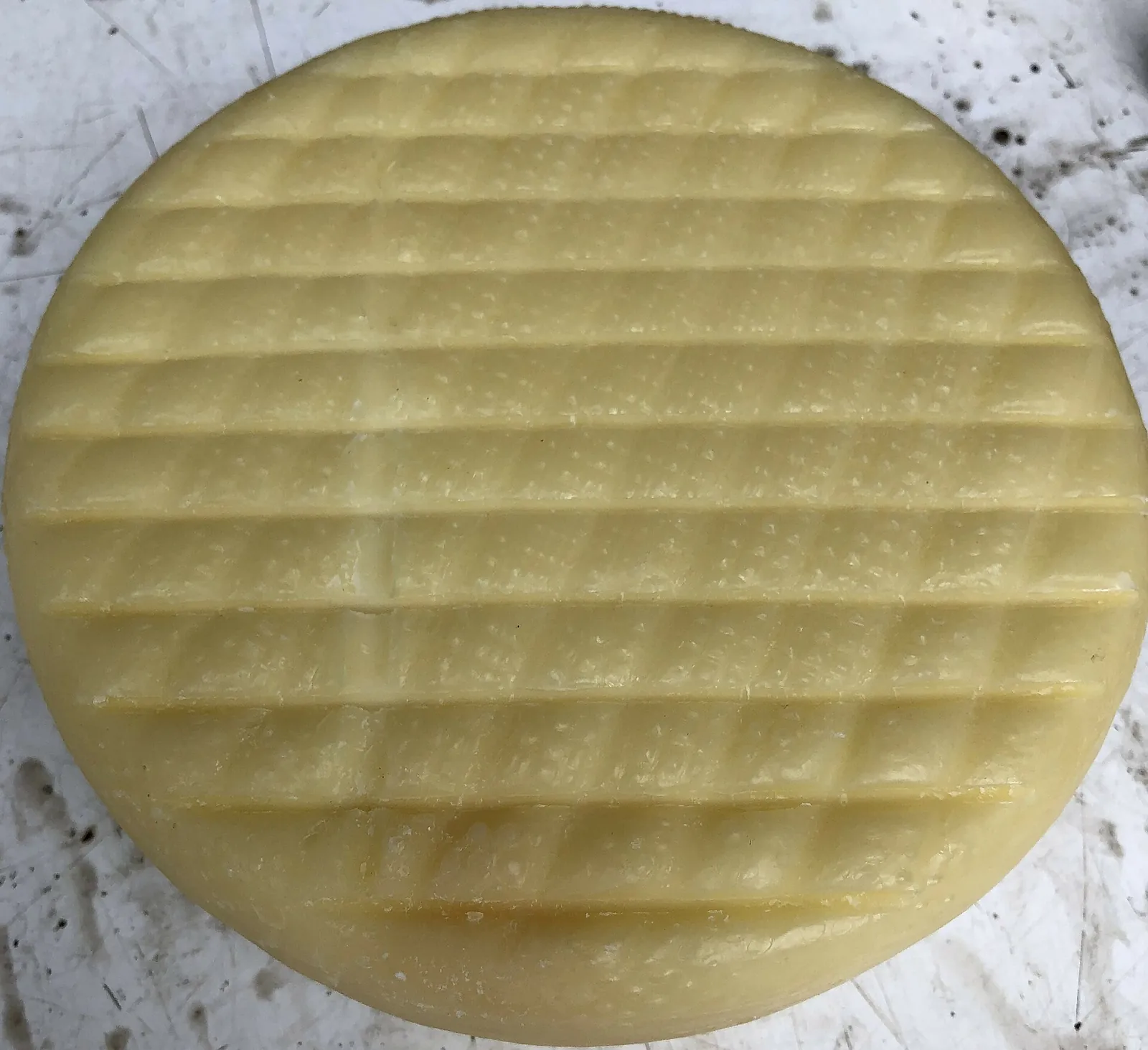
The name tells you the size and the intent, an everyday round that is soft, mild and eaten within weeks, but it does not tell you the milk, the flavor or the maker.
So two caciottas can taste quite different. One is a mild cow's milk cheese that melts into a sandwich, another is a richer sheep's milk round with a nutty edge, and a third is studded with truffle. Reading the label for the milk is the shortcut.
Caciotta cheese at a glance
Here is caciotta cheese at a glance, with the details that stay true across most versions.
| Detail | Caciotta |
|---|---|
| What it is | A style of small Italian table cheese, with more than a dozen variations |
| Milk | Cow, sheep, goat, water buffalo, or blends |
| Shape | Small cylinders, up to about 1 kg (2.2 lb) |
| Protected name | The style itself has none; Casciotta d'Urbino is a PDO |
| Ripening | Brief, from a couple of weeks to about a month |
| Rind | Thin and soft, yellow |
| Texture | Soft to semi-soft, supple |
| Flavor | Mild, milky, gently tangy |
What the name caciotta cheese covers
The name caciotta covers a loose family of small Italian cheeses rather than one defined product. According to Wikipedia's caciotta entry, the word derives from a Tuscan term, and the cheese is made from the milk of cows, sheep, goats or water buffalo, in cylinders of up to about 1 kg with a soft yellow rind around a white or yellowish body. The same entry counts more than a dozen variations and notes that ripening is brief and that both artisan and industrial dairies make it.
That is why the style has no single recipe or legal definition. A dairy in Tuscany, Umbria, the Marche or Lazio can sell a small young round as caciotta, and the maker decides on milk, size and any flavoring. The guide to PDO and PGI labels explains why a generic style like this carries no protection, and why a name like Casciotta d'Urbino does.
Types of caciotta cheese
Types of caciotta cheese are best sorted by milk first and added flavor second.
- Cow's milk caciotta: the softest and mildest, and the one most often found in US shops. Closest to the creamy semi-soft cheeses in the best mild cheeses guide.
- Sheep's milk caciotta (caciotta di pecora): richer, a little nuttier and more savory than cow's milk versions.
- Goat or mixed milk: tangier, with a lighter, more lactic flavor.
- Flavored caciotta: plain paste mixed with truffle, herbs, chili or peppercorns, or sometimes wrapped in leaves. Truffle is the version most exporters ship.
- Casciotta d'Urbino PDO: the protected one, covered in the next section.
Casciotta d'Urbino, the protected caciotta
Casciotta d'Urbino is the protected caciotta, a PDO cheese from the Marche region. Per Wikipedia's entry, it is made from 70 to 80 percent sheep's milk and 20 to 30 percent cow's milk in the province of Pesaro and Urbino, with a typical weight of 800 g to 1.2 kg and a typical ripening of two weeks to a month. It was protected on June 12, 1996, and the texture is described as semi-soft and crumbly.
The spelling with an s is a local variant: the same entry says it arose from a civil servant's mispronunciation of caciotta, though others trace it to the local dialect. Either way, it is the one version where the name guarantees a recipe, so if a label says Casciotta d'Urbino, expect the sheep-and-cow blend and the Marche origin.
What caciotta cheese tastes like
Caciotta cheese tastes mild, milky and slightly tangy, with a fresh, delicate finish. The paste is soft to semi-soft, pale and smooth, and some rounds have small holes. Cow's milk versions lean buttery and gentle, while sheep's milk versions come across richer and nuttier, and goat's milk ones sharper.
Because caciotta is young, it has little of the sharpness or crystals of an aged cheese. The flavor is closer to a good fresh milk than to Pecorino Romano, which is made from sheep's milk too but aged hard and salty. A flavored round tastes mostly of its additive, so truffle caciotta reads as earthy and savory before it reads as cheese.
How to use caciotta cheese
Use caciotta cheese the way Italians use it: sliced at the table, melted into something simple, or served as the mild option on a board.
- With bread and cured meat: slice it thick for an antipasto plate with prosciutto or salami.
- In sandwiches: it melts evenly, so it works in a grilled panino or a toasted ham sandwich.
- Baked into dishes: layer it over vegetables, polenta or baked pasta; it melts creamily without the stringiness of mozzarella.
- On a board: pair a plain round with a flavored one so guests can compare. The cheese board guide shows how to arrange them.
- Flavored versions: serve truffle caciotta thin and at room temperature, with plain bread so the flavoring is not buried.
Take it out of the fridge about 30 minutes before serving. A cold young cheese tastes of very little.
What to drink and eat with caciotta cheese
Caciotta cheese pairs with light Italian table wines, a crisp white or a young, low-tannin red, plus bread, cured meat and fresh vegetables. Sheep's milk versions stand up to a slightly fuller red, while flavored ones go best with whatever they are flavored with. The pairing guide has more.
Caciotta cheese substitutes
Caciotta cheese substitutes should be young, soft to semi-soft and mild, and there are several good ones.
- **Bel Paese:** a mild, buttery Italian cow's milk cheese that melts smoothly, the nearest widely sold swap for cow's milk caciotta.
- **Fontina:** more savory and nutty, good when you want a bit more character.
- **Mild Havarti:** soft, creamy and easy to find.
- Young Tomme-style cheeses or mild Gouda: good for slicing and melting.
- Young Pecorino Toscano: for the sheep's milk version.
The substitute finder lists swaps by what a recipe needs.
What most caciotta advice gets wrong
Most caciotta advice treats it as a single cheese with a single flavor, and that causes most of the disappointment.
Caciotta is not a protected cheese
Caciotta is not a protected cheese, so nothing on the label guarantees the milk. Check the ingredient line, since a sheep's milk caciotta and a cow's milk caciotta behave and taste differently. Only the Casciotta d'Urbino name carries a PDO.
Caciotta is not a mild cheese in every version
Caciotta is generally mild, but sheep's milk and aged versions can be quite savory, and a flavored round is dominated by the flavoring. If you want the gentle, milky one, ask for the plain cow's milk.
Caciotta does not keep long
Caciotta is a young cheese made to be eaten soon, so it does not keep long and is not improved by aging at home. Buy a small piece, keep it wrapped and use it within a week or two.
How to store caciotta cheese
Store caciotta cheese wrapped in wax or cheese paper in the fridge, and use it within a week or two of opening. The soft rind and moist paste dry out fast under cling film or in an open container. The storing cheese guide covers wrapping in more detail.
Questions about caciotta cheese
These are the questions about caciotta cheese people ask most.
What is caciotta cheese?
Caciotta cheese is a style of small, young, mild Italian table cheese made from cow's, sheep's, goat's or mixed milk. It has many regional versions.
Is caciotta one specific cheese?
Caciotta is not one specific cheese: it is a broad style with more than a dozen variations, plain and flavored. Only Casciotta d'Urbino has a protected name.
What does caciotta cheese taste like?
Caciotta cheese tastes mild, milky and gently tangy. Sheep's milk versions are richer and nuttier, and cow's milk versions are softer and milder.
What is Casciotta d'Urbino?
Casciotta d'Urbino is a protected caciotta from the Marche region, made from 70 to 80 percent sheep's milk and 20 to 30 percent cow's milk.
Does caciotta cheese melt?
Caciotta cheese melts well because it is young and moist, softening into a creamy layer rather than stretching. It works in sandwiches and baked dishes.
Your first caciotta cheese
For your first caciotta cheese, buy a small round of plain cow's milk caciotta and a flavored one, such as truffle, and taste them side by side at room temperature. Then try a sheep's milk caciotta to see how much the milk changes the flavor. The Italy page lists more of the country's table cheeses.
Sources
- Caciotta, Wikipedia
- Casciotta d'Urbino, Wikipedia
- Caciotta, Cheese.com