
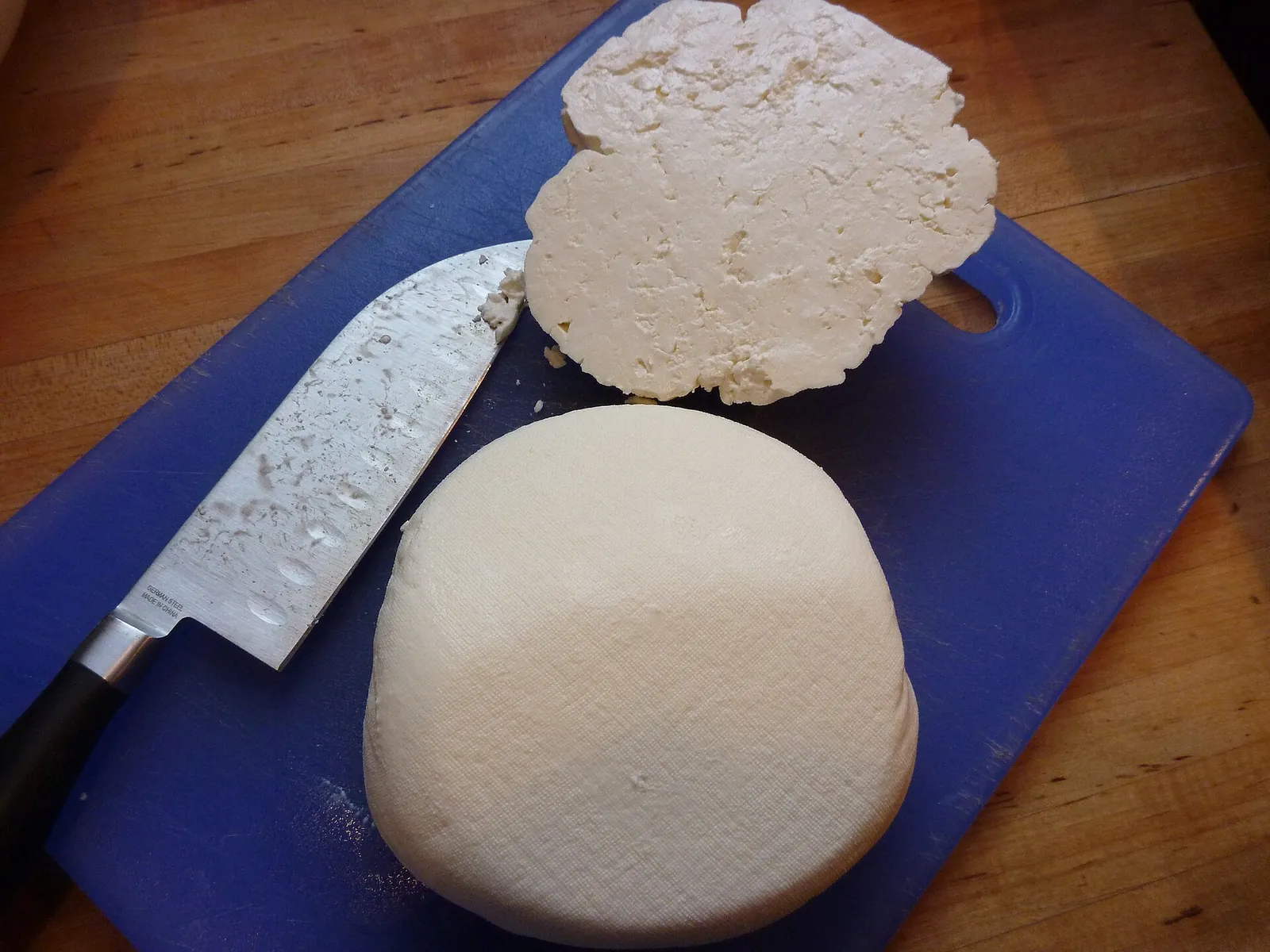
The spelling varies (mizithra, myzithra), but the two forms are what matter at the store.
It is made from the whey left after other cheese, plus some milk, and it is eaten far more in Greek homes than it is written about. Once you know which form you are holding, what to do with it is simple.
Mizithra cheese at a glance
Here is mizithra cheese at a glance, based on the Wikipedia entries and America's Test Kitchen.
| Detail | Fresh mizithra | Aged mizithra |
|---|---|---|
| Milk | Whey and milk from sheep or goats, or both | The same, then salted and dried |
| Salt | None added | Salted |
| Texture | Soft, moist, a little grainy | Drier, denser, firmer |
| Flavor | Sweet, milky, mild | Saltier, more sour, sharper |
| Typical use | With honey, in pies and pastries | Grated over pasta, shaved over salads |
How mizithra cheese is made
Mizithra cheese starts with whey, and Wikipedia's mizithra entry says the usual ratio is about 7 parts milk to 3 parts whey. Raw ewe's or goat's milk is brought to a slow boil, then curdled with rennet, whey from a previous batch, or an acid such as lemon juice or vinegar. The curds drain in cheesecloth for a few days, and the result is a soft, moist mass shaped like the bag it hung in.
No salt goes into the fresh cheese, which is why it tastes almost sweet and milky. This is the same family idea as Italian ricotta, where heat does the work, and the Cypriot whey cheese anari is a close cousin. The word anthotyros often turns up as a near-synonym, and Wikipedia calls it essentially the same cheese, though it notes mizithra may include some cow's milk.
Fresh vs aged mizithra cheese
Fresh and aged mizithra cheese are the same cheese at two points in its life. Fresh is the soft, sweet version; salting and aging turn it drier, denser, saltier and more sour. The sour dried form is often called xynomizithra, meaning sour mizithra.
The aged form is, per Wikipedia, the grating cheese of Greek cooking, and it suits hot pasta in particular. America's Test Kitchen describes dry myzithra as salty, much like ricotta salata, good grated over pasta or shaved into salads.
The PDO version
A protected version exists: Xynomyzithra Kritis is a PDO whey cheese from Crete, made from ewe's and goat's whey with a little whole milk, up to about 15 percent. Wikipedia's xynomizithra entry describes it as soft, snow-white, creamy and moist with a sour taste, pressed and ripened for at least 2 months. So "xynomizithra" on a Cretan PDO pack does not always mean a hard grating wheel; read the description.
How to use mizithra cheese
Fresh mizithra cheese works as a dessert or a filling, and aged mizithra cheese works as a seasoning. Spoon fresh mizithra onto bread with honey, or fold it into savory pies; the spanakopita page covers phyllo pies, and the cheese and honey guide shows the sweet side. The Crete guide notes it is eaten fresh with bread and honey.
The aged form is the one for pasta. A classic way is to melt butter in a pan until it browns, toss in hot spaghetti, and grate dry mizithra over the top. That is cooking guidance rather than a rule, but the nutty browned butter suits the salty, sour cheese. Use a light hand with salt in the dish, because the cheese carries plenty.
How to buy mizithra cheese in the US
Buying mizithra cheese in the US means a Greek or Mediterranean market, where the dry form is easier to find than the fresh one. Check whether the pack says fresh (soft, usually refrigerated) or dried (a hard, firm piece or already grated). A guide to Cretan cheese says fresh mizithra lasts only 24 to 48 hours without refrigeration, so buy it soft and cold.
Keep fresh mizithra in the fridge and use it within a few days; dry mizithra keeps much longer and can be grated as needed. The storing cheese guide explains wraps for the dry kind.
Mizithra cheese substitutes
The best substitute for fresh mizithra cheese is whole-milk ricotta, drained well so it is not watery; the ricotta versus cottage cheese page explains why ricotta is the better stand-in. For aged mizithra cheese, America's Test Kitchen names ricotta salata as the common substitute. Pecorino Romano works for grating but is sharper and saltier. The richer Greek whey cheese manouri is a different cheese, so it changes the dish.
What most mizithra cheese advice gets wrong
Most mizithra cheese advice describes one cheese, and a recipe that calls for "mizithra" is ambiguous.
Fresh and aged are not interchangeable
Fresh mizithra cannot be grated, and aged mizithra will not spread on bread. Swap one for the other and you lose either the creaminess or the salt.
It is not just a Greek ricotta
Mizithra is not just a Greek ricotta, because the aged form is salted and dried, and that makes it a seasoning more than a fresh cheese. Treat the dry version like a salty grating cheese.
Salt your dish after tasting
Aged mizithra is salty, so taste the finished dish before you add salt to a pasta that will be topped with it.
Questions about mizithra cheese
These are the questions about mizithra cheese that come up most.
Is mizithra cheese like ricotta?
Mizithra cheese is very like ricotta in its fresh form, because both are soft whey cheeses; the aged form is hard and used for grating.
What is the difference between fresh and aged mizithra cheese?
Fresh mizithra cheese is soft, moist and unsalted, while aged mizithra cheese is salted and dried, firmer, saltier and sharper.
What is mizithra cheese made from?
Mizithra cheese is made from sheep's or goat's whey, usually with milk added at about 7 parts milk to 3 parts whey.
How do you use mizithra cheese on pasta?
Mizithra cheese goes on pasta grated, in its aged form, over hot spaghetti dressed with browned butter.
Where can you buy mizithra cheese?
Mizithra cheese is sold at Greek and Mediterranean markets, usually as a dried form; check the pack for fresh or dry.
Your first mizithra cheese
For your first mizithra cheese, buy a piece of dry mizithra, brown a little butter, toss it with spaghetti and grate the cheese on top. Then try fresh mizithra with honey to taste the other side.
Sources
- Mizithra, Wikipedia
- Xynomizithra, Wikipedia
- 6 Greek cheeses you should seek out, America's Test Kitchen
- Cretan cheese guide, Crete Direct