
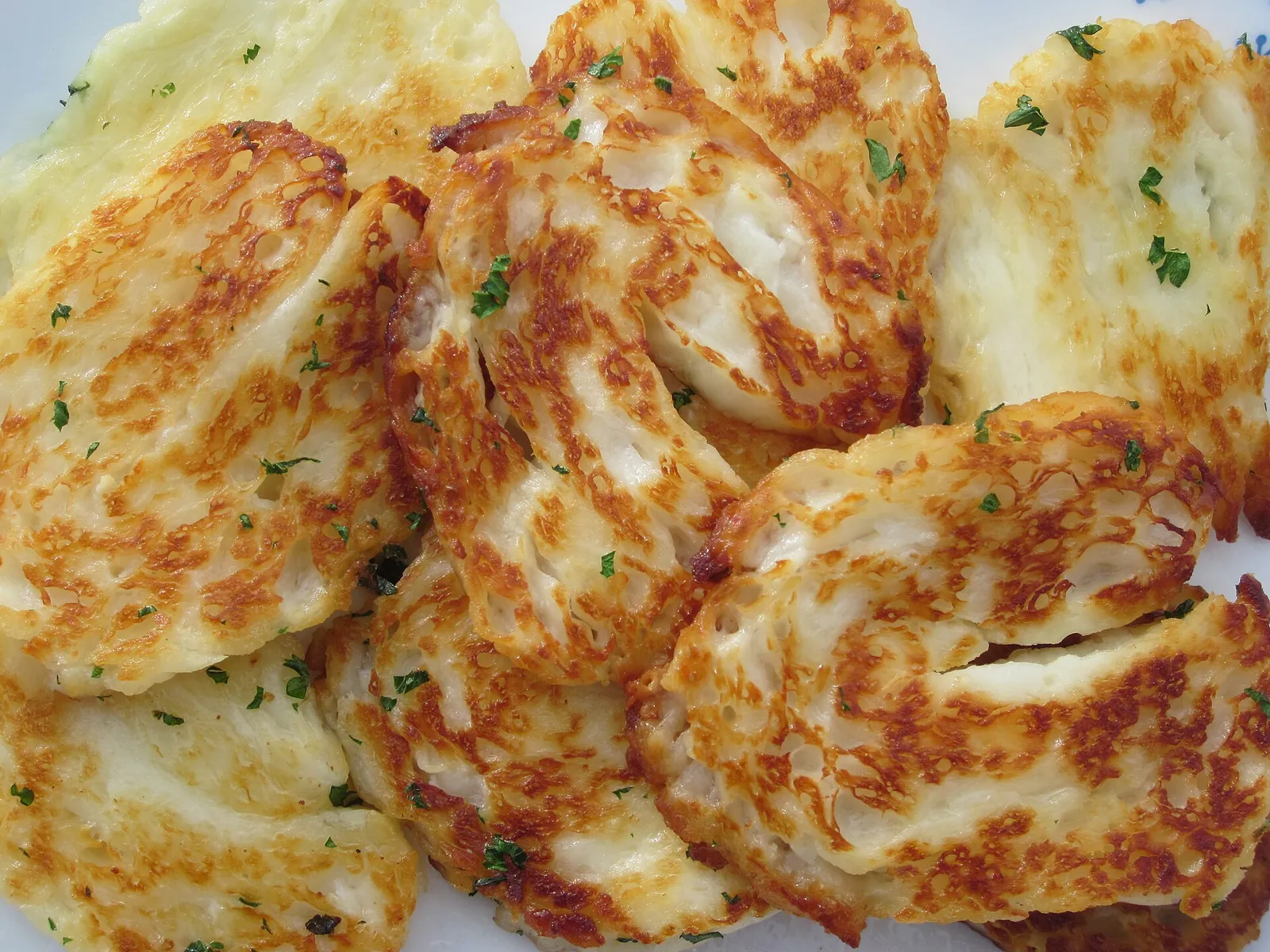
It is made in Cyprus, where it is also called hellim, and since 2021 the name has been a protected designation of origin (PDO) in the EU.
The reason it holds its shape is the whey. The curd is cooked in hot whey, above 194°F (90°C) for at least 30 minutes, before the cheese is folded and salted. That leaves a high pH and plenty of calcium, so the protein network stays rigid over a flame, and the leftover milk sugar browns it.
Halloumi cheese at a glance
Here is halloumi cheese at a glance, with figures from the PDO document and Norway's food composition table.
| Halloumi cheese | |
|---|---|
| Also called | Hellim (Turkish), Χαλλούμι (Greek) |
| Milk | Sheep's, goat's or both, with or without cow's; sheep and goat must outweigh cow's |
| Origin | Cyprus, the whole island |
| Protected name | EU PDO, applying from October 1, 2021; protected in the EU only |
| Fresh | At most 52% water and 3% salt; at least 43% fat in dry matter |
| Mature | At least 40 days in salted whey; at most 37% water and 6% salt |
| Size | 5 oz to 2.6 lb (150 to 1,200 g) |
| Flavor | Salty and milky, with mint |
| Per ounce, Norway's table | About 82 kcal, 6.3 g protein, 6.2 g fat, 476 mg sodium |
| Heat | Browns and holds its shape |
What halloumi cheese is
Halloumi cheese is a Cypriot cheese with a long paper trail: the PDO document dates its first written mention to 1554, in a codex now in a Venice library that calls it "calumi." Hellim is the Turkish name, and Turkish Cypriot makers use both names or just Hellim; the EU registration covers both, for the whole island.
Under the PDO document, the milk is sheep's, goat's or a mix, with or without cow's, and the sheep and goat share must outweigh the cow's. Mixed milks go on the label in decreasing order. The registration came with a transitional period that lets makers who cannot yet meet the milk rule use less sheep and goat milk, under conditions set by Cyprus.
The name is protected in the EU only: the registration notes that such intellectual property rights are territorial. A US pack can therefore come from any maker, so read the label, not the name.
How halloumi cheese is made
Halloumi cheese is made by setting milk with rennet, cooking the curd in hot whey, folding it around mint and salting it. The PDO document allows any rennet except pig rennet and calls the 30 minutes above 194°F (90°C) a feature unique to the cheese. Cypriot mint goes between the folds, which gives the cheese its minty aroma; since 2023 flat, unfolded halloumi is allowed too. The cheese is salted dry, in salted whey or both, and packed promptly to stop it ripening. Mature halloumi spends at least 40 days in salted whey and ends up drier and saltier.
Why halloumi cheese doesn't melt
Halloumi cheese doesn't melt because cooking the curd in whey leaves it with a high pH and plenty of calcium, which keeps its casein network rigid. Dr. Photis Papademas, a dairy scientist at the Cyprus University of Technology, explained to America's Test Kitchen that the cooking kills the bacteria and deactivates the rennet, so no lactic acid forms, and the PDO ingredient list has no starter culture either: just milk, rennet, mint and salt. At a lower pH calcium dissolves into the whey and the proteins can flow; at a high pH more calcium stays to bond them.
A 2025 study of cow's-milk halloumi-type cheese showed the switch. Made without starter culture, the cheese had a pH of 6.53, and in frying it held its shape above pH 6.41 or below 4.69. At pH 5.33 it melted most, as its calcium fell. Feta sits below that window, and paneer holds together another way, covered in halloumi vs. paneer. The leftover lactose also helps the surface brown.
How salty halloumi cheese is
Halloumi cheese is among the saltiest cheeses sold: the PDO caps fresh halloumi at 3 percent salt and mature at 6, and packs vary. A survey of 612 UK supermarket cheeses found halloumi averaged 2.71 grams of salt per 100 grams, tied with imported blue cheese for the highest, while Norway's food composition table lists 4.2 grams. That is roughly 300 to 475 milligrams of sodium an ounce, against 323 for feta in USDA data.
To tame it, soak slices in cold water for 15 to 30 minutes and pat them dry. Skip added salt in the dish.
How to cook halloumi cheese
The way to cook halloumi cheese is hot, in slices about 1/2 inch (1.3 cm) thick, patted dry so they brown instead of steam. For a skillet, America's Test Kitchen heats a little oil in a nonstick pan over medium-high heat and flips the slices every couple of minutes, so moisture evaporates and the crust builds gradually, until they are deeply browned and crisp. Its grill method is the same idea: slices on a gas grill heated to high, covered, flipped once the undersides are lightly browned. Serve at once, because the cheese stiffens as it cools.
Squeeze lemon over it, or serve it with honey, watermelon or mint and a crisp white wine; the pairing guide has more. Tuck it into wraps and salads, thread it on skewers, or bread strips for halloumi fries.
Buying and storing halloumi cheese
Buy halloumi cheese in a sealed pack and read the milk list. America's Test Kitchen says unopened halloumi keeps in the refrigerator for up to a year, so check the date, and that once opened it keeps up to two weeks in an airtight container of salted water.
Two label points matter. The PDO bans only pig rennet, so vegetarians should look for microbial rennet; see what rennet is. And a 2023 amendment lets PDO makers use raw milk, so if you are pregnant, choose a pasteurized pack and read cheese during pregnancy.
What most halloumi cheese advice gets wrong
Most halloumi cheese advice stops at "grill it" and skips two caveats.
Squeak does not mean sheep's milk. In a sensory study of ovine and bovine halloumi, trained panelists found the cow's-milk cheese squeakier, and the sheep's-milk cheese harder and more yellow.
Homemade halloumi can melt. If a recipe cultures or acidifies the milk first, the pH can fall into the melting window, as the 2025 study found. Use rennet alone, as in the home halloumi method.
Questions about halloumi cheese
These quick answers cover what people ask most about halloumi cheese.
What is halloumi cheese made from?
Halloumi cheese is made from sheep's milk, goat's milk or both, sometimes with cow's milk, plus rennet, salt and mint.
Is halloumi cheese healthy?
Halloumi cheese is rich and salty: Norway's table lists 290 calories, 22.3 grams of protein, 21.9 grams of fat and 1,680 milligrams of sodium per 100 grams. USDA has no entry for it, so check the Nutrition Facts on the pack.
What can you use instead of halloumi cheese?
The closest substitute for halloumi cheese is paneer, which Dairy Farmers of Wisconsin names first; it also lists queso panela, juustoleipa (bread cheese) and feta, though feta is stronger and softer. Paneer is unsalted, so marinate thick slabs with salt and lemon and cook them gently.
Is halloumi cheese vegetarian?
Halloumi cheese is not always vegetarian, because the PDO allows any rennet except pig rennet. Look for microbial rennet on the pack.
Can you eat halloumi cheese raw?
Halloumi cheese can be eaten as it is: the PDO document says so, and America's Test Kitchen notes that Cypriots sometimes eat it unheated with watermelon.
What does halloumi cheese taste like?
Halloumi cheese tastes salty and milky with a mint aroma; the PDO document adds a barnyard smell and a pungent, salty taste.
Your first halloumi cheese
For your first halloumi cheese, buy one fresh pack that lists its milks, slice it 1/2 inch thick and sear it in a hot skillet. Squeeze lemon over it and eat it hot.
Sources
- Publication of an approved standard amendment, 'Χαλλούμι / Halloumi / Hellim' PDO-CY-01243-AM03, with the single document (OJ C 165, 10.5.2023), Official Journal of the European Union
- Commission Implementing Regulation (EU) 2021/591 entering 'Χαλλούμι' (Halloumi)/'Hellim' in the register (OJ L 125, 13.4.2021), Official Journal of the European Union
- The effect of pH on the microstructure, rheological and functional properties of halloumi-type cheese (Food Chemistry: X, 2025), via PubMed Central
- Cross-sectional survey of salt content in cheese: a major contributor to salt intake in the UK (BMJ Open, 2014), via PubMed Central
- The characterization of the physicochemical and sensory properties of full-fat, reduced-fat, and low-fat ovine and bovine Halloumi (Journal of Dairy Science, 2009), via PubMed
- Halloumi: What Is Halloumi Cheese?, America's Test Kitchen
- Food composition tables: Cheese, Halloumi (Matvaretabellen), Norwegian Food Safety Authority, with halloumi values from the Swedish National Food Agency database (2017); and USDA FoodData Central, SR Legacy row for feta, USDA
- Halloumi, Dairy Farmers of Wisconsin