
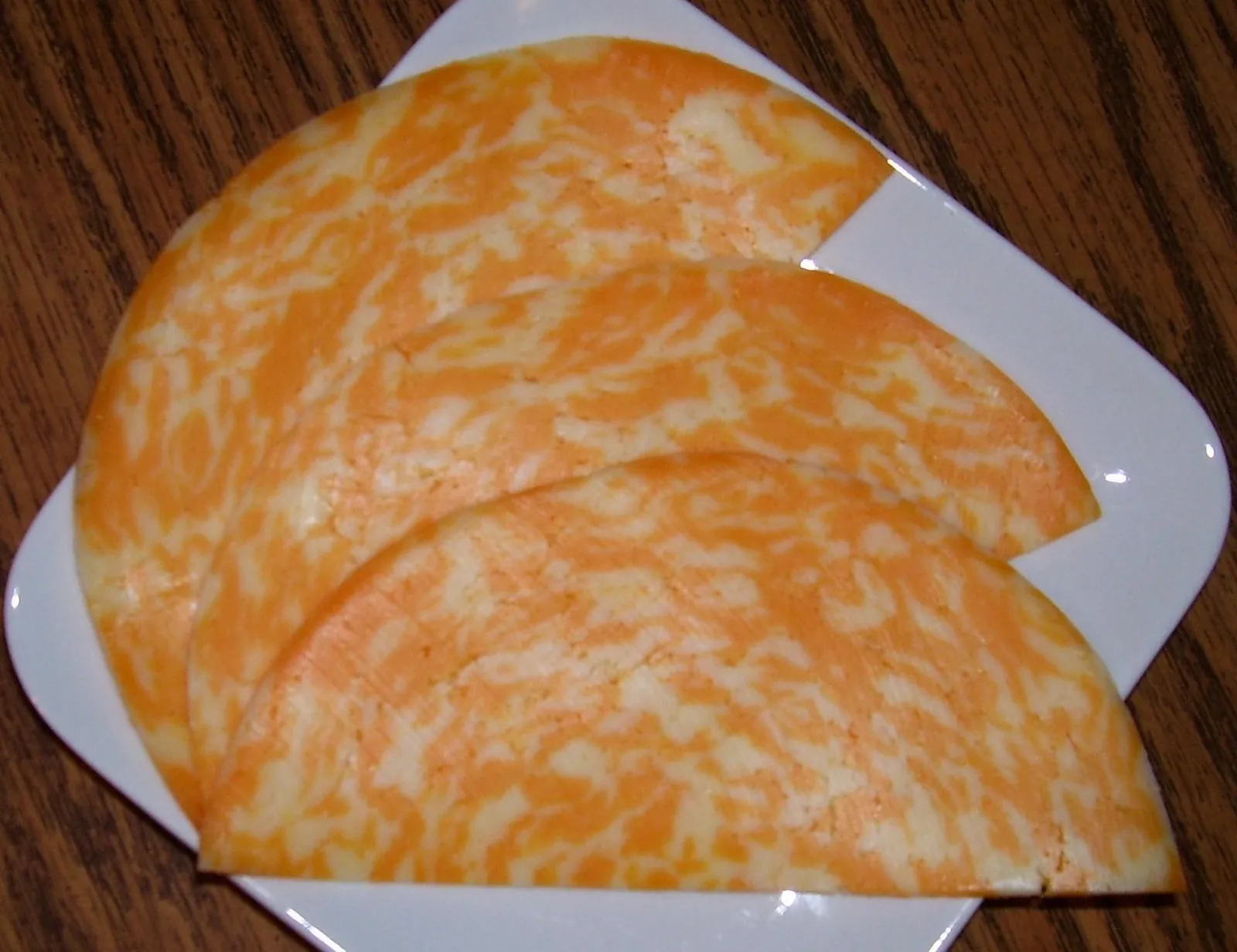
Colby-Jack is the marbled version, pressing Colby together with pale Monterey Jack.
Both are everyday cheeses built to be eaten young. Nothing in the process builds the sharp, crumbly edge of aged cheddar, so the appeal is melt, sweetness and an easy slice. For the head-to-head with cheddar, the Colby vs. cheddar comparison goes deeper.
Colby cheese at a glance
Here is Colby cheese at a glance, with Colby-Jack beside it.
| Detail | Colby | Colby-Jack |
|---|---|---|
| Milk | Cow | Cow |
| Origin | Colby, Wisconsin, 1885 | Wisconsin |
| Made from | Washed, stirred curd | Colby and Monterey Jack curds blended |
| Color | Orange (annatto) or pale | Marbled orange and white |
| Age | Pressed, then aged about 1 to 3 months | A few weeks to 3 months |
| Flavor | Lactic, mild, buttery, sweet | Mild, buttery, a hint of tang |
| US standard | 21 CFR 133.118 | Each half follows its own standard |
How Colby cheese is made
Colby cheese is made by stirring the curd and rinsing it with cold water instead of letting it mat into slabs. The Clark County, Wisconsin, history record credits Joseph Steinwand with working out the method in 1885 at his father's cheese factory near the town of Colby, after a cheesemaking course in Madison. Curds were kept loose while the whey drained, cold water was poured over them, and they were salted loose.
The water dilutes the milk sugar in the curd. Less lactose means less lactic acid, and a low-acid curd stays moist and soft. Dairy Farmers of Wisconsin lists the stirred curd, the cold-water wash and a short aging time as the three things that set Colby apart, and notes the small whey holes it develops. The cheese was traditionally pressed into long cylinders called longhorns and wrapped in cheesecloth.
What the FDA standard says about Colby cheese
The FDA standard for Colby cheese, 21 CFR 133.118, allows at most 40 percent moisture and requires at least 50 percent milk fat in the solids. It also writes the washing step into law: part of the whey is drained off and the curd is cooled by adding water, with stirring to keep the pieces from matting.
Two other rules matter at the store. Harmless artificial coloring is allowed, which is why most Colby is orange. And if the milk is not pasteurized, the cheese must be cured at 35°F or higher for at least 60 days. A separate entry, Colby cheese for manufacturing, drops the pasteurization and curing requirements for cheese headed into other foods.
Colby-Jack: how it is made and what it tastes like
Colby-Jack is made by blending the curds of two cheeses before pressing, which produces the marbled look. Dairy Farmers of Wisconsin says each cheese is made separately, annatto colors the Colby, and the drained curds are mixed together. It ages from a few weeks to three months and tastes mild and buttery with a hint of tang.
Because the Jack half is softer and wetter, Colby-Jack is a shade milder than plain Colby. Monterey Jack can hold up to 44 percent moisture, against Colby's 40, so the blend melts a little faster. The orange comes only from the Colby, since Jack is not colored. Each half follows its own FDA standard, so the label carries no separate Colby-Jack rule.
Colby cheese flavor and melt
Colby cheese tastes lactic, mild and sweet, with a buttery finish and a more open, springy texture than cheddar. USDA's table lists Colby at about 38 percent water, a touch above cheddar's 37, which is why it slices cleanly and melts without fuss.
Melt is where Colby earns its place. It softens evenly at low heat and rarely turns greasy, so it works in a quesadilla, on a burger or in a casserole. The limit is flavor: melted Colby is gentle and sweet, so it will not carry a cheese sauce alone. The best melting cheeses ranking shows where it sits.
How to use Colby cheese and Colby-Jack
Use Colby cheese and Colby-Jack wherever you want melt without a strong cheese taste. Good jobs:
- Burgers and grilled cheese, sliced thick so the center softens before the bread burns
- Nachos, tacos and quesadillas, shredded
- Casseroles and breakfast burritos
- Snack trays, cubed. Colby-Jack's two tones make a board look busy for no effort
- Mac and cheese, as a third to half of the cheese, with a sharper cheddar for flavor
Shred a block yourself when melt matters, since bagged shreds carry anti-caking starch (the pre-shredded cheese guide explains the trade-off).
Colby cheese substitutes
The best Colby cheese substitutes are cheeses just as young and mild. Dairy Farmers of Wisconsin says Colby-Jack can stand in for cheddar, Monterey Jack, Colby, mild Gouda, provolone and Muenster. Going the other way, mild cheddar or Monterey Jack replaces Colby in nearly any melting job. If you need more flavor, step up to sharp cheddar and use less. The substitute finder lists more.
What most Colby cheese advice gets wrong
Most Colby cheese advice treats it as cheddar's baby brother, which misses how it is built.
Colby is not young cheddar
Colby is not young cheddar, because the method is different from the first hour. Cheddar's curd is stacked and turned in slabs, which expels whey and builds acid. Colby's is washed and stirred, so it never gets that acid and never grows into a sharp cheese. Keeping a Colby for a year will not turn it into cheddar, and it will not keep as well: Colby is moister and best used within a couple of weeks of opening.
Orange color is only annatto
Orange color in Colby is only annatto, a plant dye the standard allows, so it tells you nothing about flavor or age. Pale "white Colby" tastes the same.
Questions about Colby cheese
These are the questions about Colby cheese that come up most.
Is Colby cheese the same as cheddar?
Colby cheese is not the same as cheddar. Colby's curd is washed and stirred, while cheddar's is stacked into slabs, so Colby is softer, moister and milder.
What is Colby-Jack made of?
Colby-Jack is made of Colby and Monterey Jack curds blended together before pressing. The result is a marbled orange and white cheese with a mild, buttery flavor.
Does Colby cheese melt well?
Colby cheese melts well, softening evenly without much oil. It is strongest in sandwiches, burgers and quesadillas, and weaker in sauces, where its mildness gets lost.
Does Colby cheese get sharp with age?
Colby cheese does not get sharp the way cheddar does. It is pressed and aged only about 1 to 3 months and is meant to stay mild.
Is Colby-Jack the same as pepper Jack?
Colby-Jack is not the same as pepper Jack, which is Monterey Jack with chile peppers added. Colby-Jack has no heat, and the pepper Jack guide covers the spicy one.
Choosing Colby cheese
Choosing Colby cheese is simple: buy a block, not the shreds, and keep it for sandwiches, snacks and melts. Grab Colby-Jack when you want the milder, softer version. For a first taste, put a slice of each on a burger and see which one you finish first.
Sources
- 21 CFR 133.118, Colby cheese, with 133.119, Colby cheese for manufacturing and 133.153, Monterey cheese, Code of Federal Regulations (Cornell Legal Information Institute)
- Colby Cheese, Dairy Farmers of Wisconsin
- Colby Jack Cheese, Dairy Farmers of Wisconsin
- Home of Colby Cheese, Clark County (Wisconsin) History
- Cheese, colby and Cheese, cheddar, USDA FoodData Central (SR Legacy)