
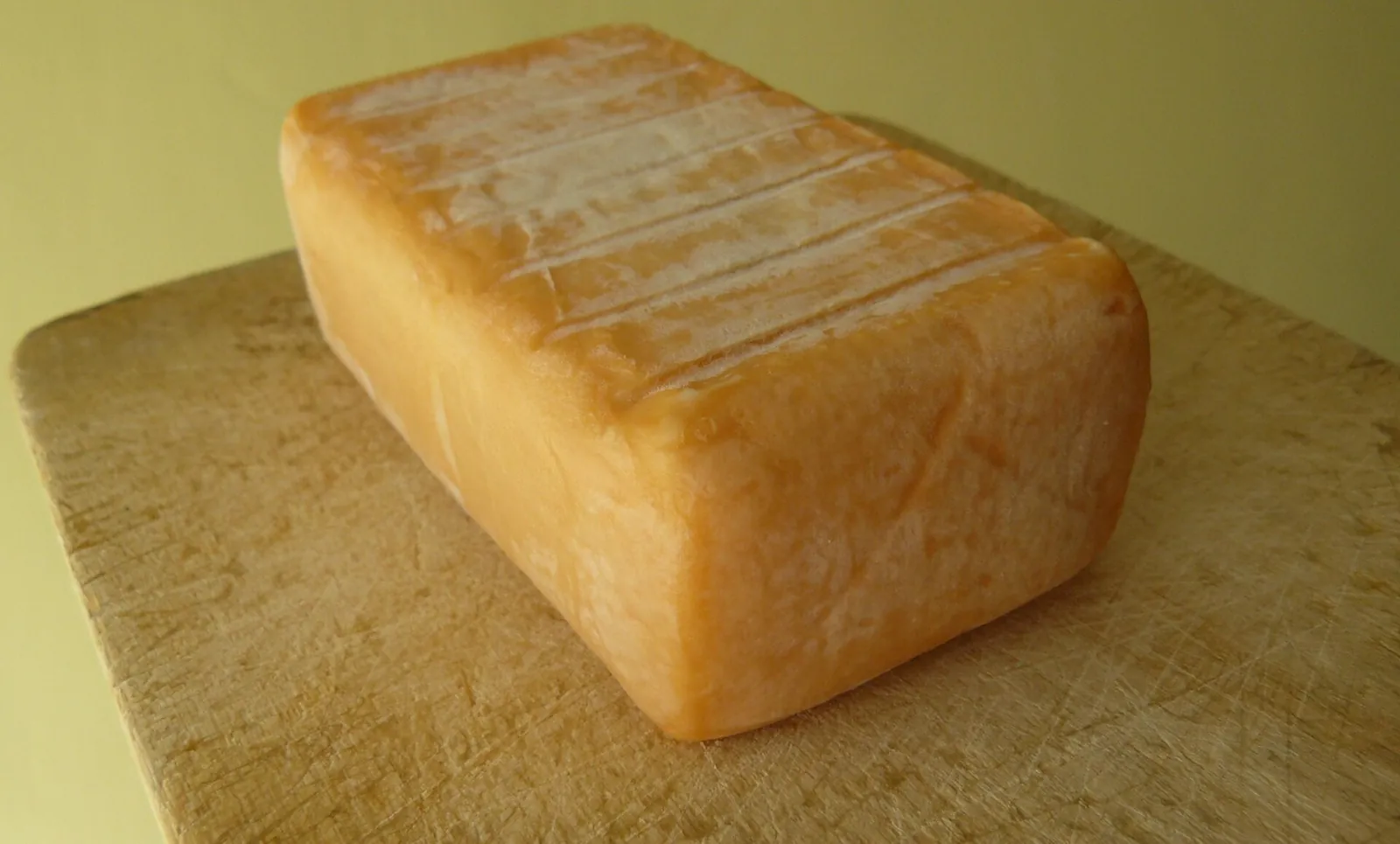
It started in Belgium, became a Bavarian favorite, and is still made in the US at exactly one factory, Chalet Cheese Cooperative in Monroe, Wisconsin.
The classic way to eat it is the Limburger sandwich: dark rye, thick slices of raw onion and a sharp mustard, with a cold beer. The onion and mustard are not a dare. They give the cheese's soft, earthy richness something to push against.
Limburger cheese at a glance
Here is Limburger cheese at a glance, from Chalet's own description of the Wisconsin version, the FDA's rules for the name and USDA nutrition data.
| Detail | Limburger |
|---|---|
| Milk | Cow's milk; Chalet uses pasteurized |
| Origin | Born in Belgium, popular in Bavaria since the 1800s; made in the US only by Chalet in Monroe, Wisconsin |
| Rind | Thin, brownish-orange, washed with brine and a bacterial smear |
| Paste | Ivory, smooth, semi-soft |
| Age (Chalet) | Firm and crumbly at 1 month, soft by about 6 weeks, creamy by 2 months, full aroma by about 3 months |
| Flavor | Creamy, buttery, a little salty; grassy and mushroomy, with a tangy finish |
| US standard | At least 50 percent milkfat in the solids, no more than 50 percent moisture |
| Per ounce | About 93 calories, 7.7 g fat, 5.7 g protein, 227 mg sodium |
Where Limburger cheese comes from
Limburger cheese was born in Belgium, hit it big in Bavaria and reached America in the 1800s, where Swiss immigrants in Wisconsin were the first to make it, according to Dairy Farmers of Wisconsin. Chalet, founded in 1885 by five dairy farmers, is now the only US factory that makes it, says its own site, and Travel Wisconsin, the state's tourism agency, agrees. At Chalet the rind of each brick is hand-washed with a brine propagated from cultures the co-op has used for over a hundred years, the Wisconsin dairy group reports. For other Wisconsin cheeses, see the Wisconsin cheese guide.
How Limburger cheese is made
Limburger cheese is made like other cow's milk cheeses until the rind. The FDA's standard of identity describes dry-salting the curd for 24 to 48 hours, then washing the surface again and again with weak brine until the right surface organisms grow, then wrapping the cheese and holding it for flavor. Raw-milk Limburger must also be cured at least 60 days at 35°F or warmer.
Why Limburger cheese smells
Limburger cheese smells because bacteria on its rind break protein and fat into volatile compounds, and the nose detects them at tiny levels. Dairy Farmers of Wisconsin names the smear bacterium as Brevibacterium linens. Researchers who studied that species say that breaking down the amino acid methionine into methanethiol is a key step behind its sulfur compounds, and that bacteria of this kind give Limburger its typical sulfur notes (Amarita and colleagues). A separate analysis of Limburger itself found 19 fatty acids, including acetic, propanoic and butanoic acids at more than 1 mg per gram of cheese, and discussed how bacteria on human skin make the same kinds of compounds (Knols and colleagues).
That overlap helps explain the comparison with feet. A 2006 study traced classic foot odor to isovaleric acid, made when Staphylococcus epidermidis breaks down leucine in sweat (Ara and colleagues). The microbes differ, but the method is the same: bacteria turning amino acids and fats into volatile acids. Malaria mosquitoes find the two equally attractive, which won researchers at Wageningen in the Netherlands the 2006 Ig Nobel Prize in Biology. The smelly cheese guide puts Limburger beside the other washed rinds.
What Limburger cheese tastes like
Limburger cheese tastes much milder than it smells: Chalet calls it creamy and buttery, a little salty, with a grassy, mushroomy flavor and a gentle tang at the end, and Dairy Farmers of Wisconsin adds that it gets punchier as it ages. Think of the aroma as the loud part and the paste as the quiet part, a split the rind types guide explains for all washed rinds.
How to eat Limburger cheese
Eat Limburger cheese the traditional way, as a sandwich on dark rye with thickly sliced raw onion and pub mustard, with a bock beer close by, as Chalet and Dairy Farmers of Wisconsin recommend. For one sandwich, let 1 to 2 ounces (30 to 55 g) of Limburger sit out for 30 minutes so it spreads. Spread it on one slice, lay on three or four rings of raw onion, spread horseradish or brown mustard on the other slice, and close it.
Stout, porter, pale ale and Belgian ales all stand up to it, per the same sources, and the beer and cheese guide has more. Other uses: a little over boiled, buttery potatoes, on a pizza with caramelized onions, or a small amount cut into bread dough, which Chalet says leaves a creamy loaf with the aroma greatly reduced.
How to buy and store Limburger cheese
Buy Limburger cheese as a foil-wrapped brick with an ivory paste and a brownish-orange rind, and ask how old it is, because age sets the strength. Store it in a tightly lidded glass container, as both Chalet and the Wisconsin dairy group advise, and wrap leftovers in their foil first.
What most Limburger advice gets wrong
Most Limburger advice repeats the legend and skips three practical details.
Young Limburger is not the stinky one
Young Limburger is not the stinky one: by Chalet's timeline it is firm, crumbly and chalky in its first weeks, creamy by two months, and only gets its infamous aroma at about three months. For the legend, buy an older brick; for a gentler start, buy a young one.
The rind sets the volume
The rind sets the volume on Limburger: it tends to be bitter, and trimming it greatly reduces both the aroma and the flavor, according to Dairy Farmers of Wisconsin. Trim it for a first taste, and leave it on once you are curious.
One knife for one cheese
One knife for one cheese is the rule with Limburger, because the smear on its surface transfers easily. The Wisconsin dairy group says to sanitize cutting equipment before using it on any other cheese, and the same logic applies to boards and wraps.
Questions about Limburger cheese
These are the questions about Limburger cheese that come up most.
Is Limburger cheese still made in the US?
Limburger cheese is still made in the US, but only at Chalet Cheese Cooperative in Monroe, Wisconsin, which calls itself the country's only Limburger factory.
Why does Limburger cheese smell like feet?
Limburger cheese smells like feet because bacteria on the rind and bacteria on skin both turn amino acids and fats into smelly acids and sulfur compounds. They are different microbes making different mixes.
Can you eat the rind of Limburger cheese?
You can eat the rind of Limburger cheese, but it tends to be bitter. See which rinds you can eat for the rest of the washed rinds.
What cheese is like Limburger?
The cheese most like Limburger is Brick, a milder Wisconsin washed rind that Chalet calls "married man's Limburger." Munster is another pungent washed rind with a gentle inside.
How many calories are in Limburger cheese?
Limburger cheese has about 93 calories per ounce, according to the USDA, along with 7.7 grams of fat, 5.7 grams of protein and 227 mg of sodium.
Where to start with Limburger cheese
Start with a small brick of Limburger cheese, trim the rind for your first taste, and build the rye and onion sandwich with a cold bock. If you like it, leave the rind on next time and try an older brick.
Sources
- Our Cheese, Chalet Cheese Cooperative
- Limburger, Limburger (cheese profile) and For the Love of Limburger, Dairy Farmers of Wisconsin
- Chalet Cheese Coop, Travel Wisconsin
- 21 CFR 133.152, Limburger cheese, Electronic Code of Federal Regulations
- Identification and functional analysis of the gene encoding methionine-gamma-lyase in Brevibacterium linens, Applied and Environmental Microbiology
- Behavioral and electrophysiological responses of the female malaria mosquito Anopheles gambiae to Limburger cheese volatiles, Bulletin of Entomological Research
- Foot odor due to microbial metabolism and its control, Canadian Journal of Microbiology, and The 2006 Ig Nobel Prize Winners, Improbable Research
- Cheese, limburger, USDA FoodData Central (SR Legacy)