
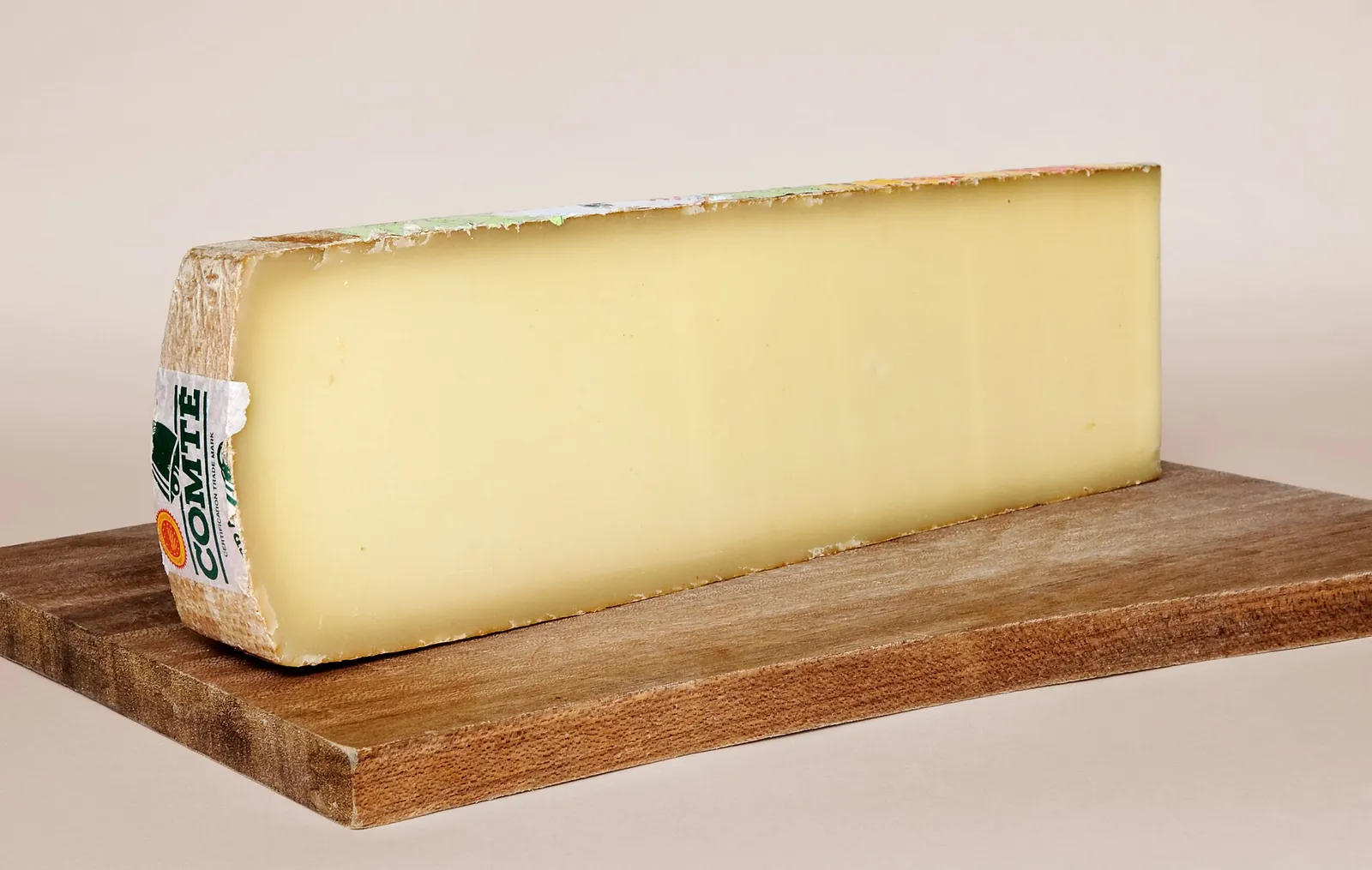
Young, it tastes of hazelnut and cooked milk; a year or two later it is deeper, nuttier and often crunchy.
The name works like a contract. Comté is an AOP (appellation d'origine protégée), and its rulebook fixes the cows, their feed, the copper vats and the minimum age, then has every wheel scored before it leaves the cellar. Learn to read that system and you can buy a good piece at almost any counter.
Comté at a glance
This Comté at a glance table covers the cheese and the main rules behind the name.
| Comté | |
|---|---|
| Milk | Raw cow's milk, Montbéliarde and French Simmental cows only |
| Where | Jura massif, eastern France: Doubs, Jura, Ain and a few communes of Saône-et-Loire |
| Style | Cooked, pressed curd with a natural rind rubbed with salt and brine |
| Wheel | 71 to 99 lb (32 to 45 kg), 22 to 30 in (55 to 75 cm) across |
| Minimum age | 120 days (4 months); some wheels go 24 months or more |
| Texture | Firm and supple, ivory to yellow; old wheels can crunch with crystals |
| Flavor | Hazelnut, soft caramel and cooked milk young; nuts, melted butter, citrus and toasted bread older |
| Rennet | Calf rennet |
| Protected name | French AOC 1958, EU PDO 1996 |
What Comté is and where the name comes from
Comté is a hard cheese whose name comes from Franche-Comté, the region of eastern France where most of it is made, as the Larousse dictionary notes. It belongs to the family of big, cooked and pressed Alpine cheeses, made to keep for months or years.
For about a century it carried a longer name: texts began calling it gruyère de Comté around 1880 to stress its origin, according to the Comté interprofession's history. "Gruyère de Comté" won protected status in court in 1952, a 1958 decree made it one of France's first AOC cheeses, and the word Gruyère left the name only in 1986.
Where Comté is made: the Jura and its fruitières
Comté is made in the Jura massif by about 140 village dairies called fruitières, most of them cooperatives owned by their farmers, a system with written records going back to 1264. About 2,400 family farms supply them, and each fruitière may collect milk only within a circle 25 km (about 16 miles) across, according to the Comté interprofession. Milk has to be worked within 24 hours, so Comté is made every day of the year, and 14 ripening houses, the affineurs, finish the wheels in their cellars.
The cows and the feed rules
The cows and their feed follow strict rules: only Montbéliarde and French Simmental cows may give milk for Comté, and each farm needs at least 1.3 hectares (3.2 acres) of forage per cow. They eat fresh grass in season and hay in winter. Silage, all other fermented feed and GMO feed are banned, and milking robots have been banned since 2018.
A new rulebook published in France's official journal on January 7, 2026, caps a farm's milk at 1.2 million liters a year, raises the minimum pasture per cow by 30 percent and grows the checklist to 170 control points, up from 125, according to the interprofession's summary of the new rulebook.
How Comté is made
Comté is made from raw milk that is never chilled hard or heated much before cheesemaking. The official specification keeps stored milk between 50 and 64°F (10 and 18°C) and forbids heating it above 104°F (40°C) before the rennet goes in, so the milk's own bacteria survive into the cheese.
The milk goes into open copper vats, each limited to 12 wheels' worth, with starter cultures and calf rennet; milk, cultures, rennet and salt are the only ingredients allowed. The curd is cut into small grains, heated to 127 to 135°F (53 to 57°C) and held there at least 30 minutes, which squeezes out whey. At molding, each wheel gets an oval green casein plaque on its side, marked with the month it was made and the dairy's code, and then it is pressed.
The wheels then age on spruce boards for at least 120 days, turned and rubbed with salt and brine so a natural rind forms. Coloring is banned, so the paste's ivory to yellow shade comes from the milk alone.
How Comté is graded: green and brown bands
Comté is graded wheel by wheel at the end of aging, when the ripener scores it out of 20 for taste and appearance and the score decides the colored band glued to its side.
| Score out of 20 | Band | Where it can be sold |
|---|---|---|
| 14 or more | Green band | Anywhere, including prepacked wedges |
| 12 to under 14, with a taste score of at least 6.5 out of 10 | Brown band | Cut to order at the counter |
| Under 12 | None | Cannot be sold as Comté |
For shoppers, the prepacked rule matters most: any prepacked wedge of Comté must come from a wheel that scored at least 14, so brown-band cheese only turns up at a cut-to-order counter. A brown score can come from a cosmetic flaw in an otherwise excellent wheel.
What Comté tastes like at each age
Comté tastes different at every age, and no two wheels are exactly alike; the specification sorts its aromas into six families: fruity, lactic, toasted, vegetal, animal and spicy.
Young Comté, under a year
Young Comté, under a year old, is supple and mild, with the fresh hazelnut, soft caramel and cooked milk notes the Comté Cheese Association describes. It melts the most smoothly, so buy it for cooking.
Comté at 12 to 18 months
Comté at 12 to 18 months is the middle ground: firmer and nuttier, still easy to slice.
Old Comté, 18 months and up
Old Comté, 18 months and up, is drier and denser, with nuts, melted butter, citrus and toasted bread in the flavor and tiny white crystals that crunch between your teeth. Those are tyrosine, an amino acid freed as the cheese's proteins break down, not salt and not a sign of spoilage.
Summer and winter Comté
Summer and winter Comté look different, too. Wheels made while the cows graze fresh grass, rich in carotene, come out a deeper yellow, while winter wheels made from hay-fed milk are paler.
How to buy Comté in the US
Buying Comté in the US is easy despite the raw milk. Federal rules let a raw milk hard cheese be sold once it has cured at least 60 days at 35°F or warmer (21 CFR 133.150), and Comté's minimum is 120 days.
At the store, these checks matter most:
- The age. It predicts flavor better than anything else on the label. If no age in months is printed, ask.
- The green bell. Every prepacked portion must carry the green bell-shaped Comté logo, and portions over 40 g (1.4 oz) must keep some rind.
- The cut face. It should be an even, matte ivory to straw yellow. Skip pieces that look gray or wet.
- A taste. At a cut-to-order counter, ask for one before you commit.
Comté and raw milk safety
Comté and raw milk safety come down to who is eating. The CDC advises people who are pregnant, adults 65 and older and anyone with a weakened immune system to avoid cheese made from raw milk unless it is heated to 165°F (74°C) or until steaming hot, which a bubbling gratin or fondue reaches. See cheese during pregnancy for safer choices.
How to serve and cook with Comté
Serve Comté cool rather than cold: the association suggests 59 to 65°F (15 to 18°C), about an hour out of the fridge.
In the kitchen, age decides the job. Young Comté melts evenly into pasta, sandwiches, quiche and cheese fondue. Older Comté adds more flavor to gratins, onion soup and salads but melts less evenly: with less water and more broken-down protein, its fat tends to separate. For a sauce or fondue, a good starting point is two parts young Comté to one part old, grated and tossed with 1 to 2 teaspoons of cornstarch per 8 ounces.
Comté pairings
Comté pairings start with the white wines of the Jura, including vin jaune, whose dried fruit and spice notes suit the cheese. Most dry whites, young reds and Champagne work as well. On a board, add walnuts, apples, pears or dried apricots and a crusty country loaf.
How to store Comté
Store Comté in parchment or cheese paper inside a loose bag or lidded box in the vegetable drawer; cheese left in plastic wrap for weeks can start to taste of it.
Comté substitutes
The best Comté substitutes are its mountain cousins. Gruyère, made from raw milk in western Switzerland, is the closest match for cooking (see how Swiss, Gruyère and Emmental differ). Beaufort, from Savoie, is the nearest French alternative, fruity and floral, and its smaller neighbor Abondance suits a board. From Wisconsin, Pleasant Ridge Reserve is made in the style of the French Alpine cheeses.
What most Comté advice gets wrong
Most Comté advice reads the band as an age and treats every wedge of the same age as interchangeable, and both mistakes cost you flavor.
Green is a grade, not an age. The band color comes from the score out of 20. A 6-month wheel and a 24-month wheel can both wear green, so read the months.
It is not from the Alps. Comté comes from the Jura, a separate mountain range of limestone plateaus; "Alpine" describes its cooked and pressed style, not its address.
Two wedges of the same age can taste nothing alike. Each fruitière works milk from its own small patch of pasture, and the season shows in the color. When a piece is a hit, note who made or aged it: the label must name the maker, the affineur or the packer, with an address inside the Comté area.
There is no farmhouse Comté. The rules require pooled milk from several farms, so a cheese sold as single-farm "Comté" is not Comté.
Questions about Comté
These are quick answers to common questions about Comté.
What is a comte?
A comte, without the accent, is a count, the French noble title, while comté with the accent means a county. The cheese, pronounced roughly kohn-TAY, takes its name from the Franche-Comté region.
What does Comté taste like?
Comté tastes nutty, buttery and lightly sweet, turning deeper and more savory with age.
Is Comté the same as Gruyère?
Comté is not the same as Gruyère: Comté is French and Le Gruyère is Swiss. Both are raw milk mountain cheeses, though, and Comté was officially called Gruyère de Comté until 1986.
Is Comté pasteurized?
Comté is never pasteurized; the rules require raw milk, and every wheel ages well past the US 60-day minimum for raw milk cheese.
Is Comté good for melting?
Comté is good for melting, especially under a year old; very old wedges can turn oily, so blend them with younger cheese.
Is Comté vegetarian?
Comté is not vegetarian for anyone who avoids animal rennet, because it is made with calf rennet.
Buying your first Comté
For your first Comté, buy two pieces at the same counter, one under a year old and one 18 months or older, and taste them side by side after an hour out of the fridge. Melt the younger one into a grilled cheese or a gratin, and save the older one for the board.
Sources
- Cahier des charges de l'appellation d'origine Comté (amendment approved November 21, 2024), INAO (Institut national de l'origine et de la qualité)
- Portrait d'un grand fromage, Comité Interprofessionnel de Gestion du Comté (CIGC)
- Une tradition millénaire, Comité Interprofessionnel de Gestion du Comté (CIGC)
- Nouveau cahier des charges, même recette, Comité Interprofessionnel de Gestion du Comté (CIGC)
- Tips for Serving Comté, Comté Cheese Association USA
- 21 CFR 133.150, Hard cheeses, Electronic Code of Federal Regulations
- Preventing Listeria Infection, Centers for Disease Control and Prevention
- Comté, nom masculin, Larousse