
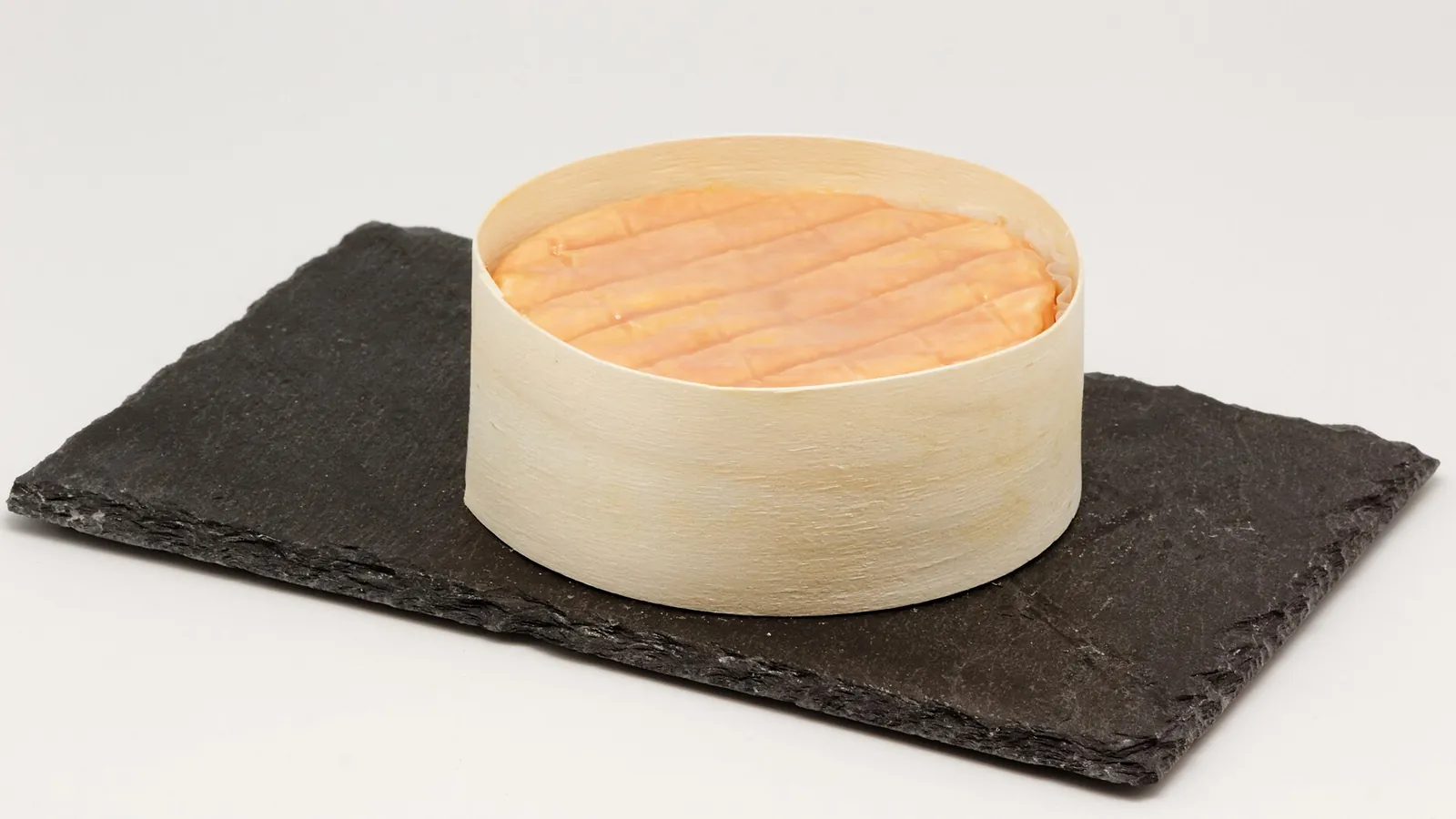
The smell is made on the outside. During at least four weeks of ripening, each wheel is washed with water that grows richer in marc de Bourgogne, a brandy distilled from grape pomace. The syndicate that defends the name describes the result as a powerful animal nose over a fruity sweetness and a creamy feel in the mouth.
Époisses at a glance
This Époisses at a glance table shows what the protected name requires.
| Époisses | |
|---|---|
| Milk | Whole cow's milk from Brune, Montbéliarde or French Simmental cows; raw milk not required |
| Made in | The Côte-d'Or, with parts of the Yonne and southern Haute-Marne |
| Curd | Slow lactic set of 16 hours or more; cut coarsely, drained on its own, dry-salted |
| Ripening | At least 4 weeks from making, washed 1 to 3 times a week |
| Rind | Smooth to slightly wrinkled, shiny, ivory-orange to brick red; no added color |
| Paste | Light beige, soft, creamy, lightly salted |
| Size | Small: 8.8 to 12.3 oz (250 to 350 g), 3.7 to 4.5 in (95 to 115 mm) across. Large: 1.5 to 2.4 lb (700 to 1,100 g) |
| Fat | At least 50 g per 100 g of dry matter |
| Protected name | French AOC 1991, EU PDO June 21, 1996 |
What is Époisses cheese?
Époisses cheese takes its name from the village of Époisses in the Côte-d'Or, and its makers' oral tradition credits a community of religious who settled there in the 16th century. The specification reaches back further, to 1386 tax accounts from the Valois dukes of Burgundy that attest a farmhouse cheese sold in local markets around the village.
Farm women carried the craft on, and production peaked in the early 1900s at nearly 300 farms. The First World War began a decline that left the cheese gone from markets by the 1950s, until a farming couple in Époisses restarted it around 1955. It earned its French appellation in 1991 and EU protected designation of origin status on June 21, 1996, according to the eAmbrosia register. The syndicate calls it the last French appellation cheese made with both a lactic curd and a washed rind.
How Époisses is made
Époisses is made from whole cow's milk, never skimmed, that sets slowly for 16 to 24 hours with lactic bacteria and rennet, which gives a fragile, acid-driven curd. The cows belong to three local breeds. The curd is cut into rough cubes of about 1 to 2 cm (under an inch), molded in perforated molds, drained on its own for about a day, dried for about two days in a cool, humid room and salted dry.
Then comes the washing, one to three times a week: plain or salted water at first, then water with marc added in rising strength. The wash feeds the yeasts and red-pigment bacteria that turn the rind orange-red, and the specification bans added coloring.
Époisses smell vs taste
Époisses smells far stronger than it tastes because the odor is made on the rind, by bacteria that turn the amino acid methionine into sulfur compounds the nose detects in tiny amounts. French microbiologists writing in Applied and Environmental Microbiology name Époisses among the smear cheeses whose typical sulfur notes come from those surface bacteria. The smelly cheese guide covers the science of washed rinds.
The paste is another story. The specification describes it as light beige, soft, creamy and lightly salted, with a heart that is only partly broken down, depending on ripeness. Taste the paste from the middle first, because the rind is the strongest-tasting part.
How to buy Époisses in the US
To buy Époisses in the US, check the label for the milk. The specification asks for whole cow's milk and says nothing about raw milk, while US law requires cheese made from unpasteurized milk to be cured at 35°F or warmer for at least 60 days. Époisses needs only four weeks under its rules, so a US counter can legally sell a pasteurized wheel, or a raw-milk one at least 60 days old. Ask which you are getting.
Pick a wheel that gives when pressed, with a glossy rind running from orange to brick red, and look for the name Époisses with the words Appellation d'Origine Protégée or AOP. The small wheel covers roughly four to twelve appetizer portions at 1 to 2 ounces a person, a figure explained in how much cheese per person. The name carries a quality check: the syndicate says each producer's cheeses are tasted at least four times a year by a panel of about fifteen accredited tasters and must score at least 14 out of 20.
How to serve Époisses
Serve Époisses at room temperature by taking it out of the refrigerator about an hour ahead and setting out a spoon or a small knife, since a ripe wheel is soft enough to scoop. Put it on a baguette or country bread, with pears, grapes or walnuts for contrast.
The syndicate's own recipes show how far it stretches: medium-ripened Époisses spread on toast with raw ham and strawberries, melted into béchamel for a croque-monsieur-style pastry, worked into shortbread with curry, or stirred into risotto with zucchini and ham. To drink, Burgundy wine, red or white, is the local match, and a small glass of marc de Bourgogne echoes the wash; the regional pairings guide explains the logic.
How to store Époisses
Store Époisses in the refrigerator in its original paper or box, inside a lidded container so the smell stays put, and eat an opened wheel within about a week. The guide to storing cheese in containers explains why washed rinds still need some air.
If the label says raw milk, the CDC advises people who are pregnant, 65 or older, or have a weakened immune system to skip it unless it is heated to 165°F (74°C) or until steaming hot. See cheese during pregnancy for other cheeses.
Époisses mistakes that cost you flavor
The most common Époisses mistakes come from taking its reputation too literally.
Calling it brandy-soaked. Époisses is not steeped in spirits. The rules call for a wash of water with marc added, and the flavor the syndicate describes is fruity and creamy.
Assuming it is raw milk. The specification requires whole milk that is not skimmed, standardized or concentrated, but it never mentions raw milk, so an AOP label is not a promise of it.
Trusting the nose for ripeness. Smell is the rind's work and says little about the middle. Press the wheel: a ripe one is soft through the heart, while a firm center means a young cheese.
Questions about Époisses cheese
These are the questions about Époisses cheese that come up most.
What does Époisses taste like?
Époisses tastes creamy, lightly salted and fruity, and its powerful animal smell is stronger than its flavor. The rind is the strongest part.
Can you eat the rind of Époisses?
You can eat the rind of Époisses; it is a natural layer of yeasts and bacteria, colored without dye. It tastes stronger than the paste, so trim it if it is too much, and see which rinds you can eat for other cheeses.
Where is Époisses made?
Époisses is made around the village of Époisses in the Auxois and Châtillonnais regions, across the Côte-d'Or, the Yonne and a corner of Haute-Marne. Milk, cheesemaking and ripening must all happen inside that area.
What can you substitute for Époisses?
Other soft washed-rind cheeses such as Munster, Maroilles or Taleggio come closest to Époisses, though none matches it for creaminess. The Substitute Finder can narrow the choice.
How do you eat Époisses?
Eat Époisses at room temperature with a spoon or small knife, on bread, with pears, grapes or walnuts alongside. The syndicate's own recipes also melt it into sauces and fillings.
Buying your first Époisses
For your first Époisses, buy the small wheel, check whether the label says pasteurized, let it warm for an hour and spoon it onto bread with a glass of Burgundy. Start with the paste from the middle, then decide about the rind.
Sources
- Cahier des charges de l'appellation d'origine Epoisses (version 1, 2010), INAO (Institut national de l'origine et de la qualité)
- Syndicat de Défense de l'Époisses, the appellation's producer association
- Époisses, PDO-FR-0118, European Commission eAmbrosia register
- Identification and functional analysis of the gene encoding methionine-gamma-lyase in Brevibacterium linens (Amarita et al., 2004), Applied and Environmental Microbiology
- 21 CFR 133.182, Soft ripened cheeses, Electronic Code of Federal Regulations
- Preventing Listeria Infection, Centers for Disease Control and Prevention