
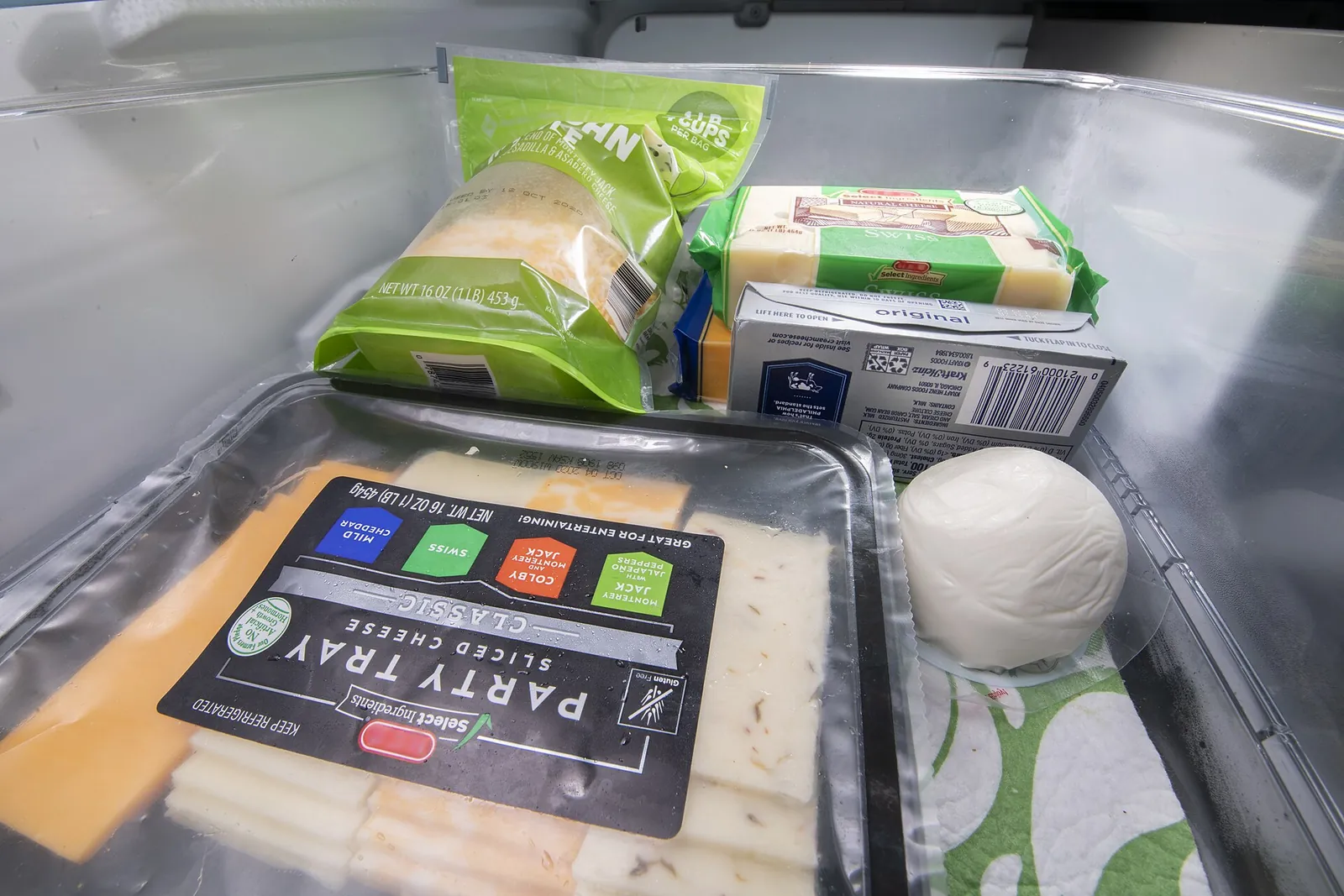
Hard, aged cheese such as cheddar or Parmigiano-Reggiano can go into an airtight glass or plastic container. Soft and rinded cheeses such as brie, blue and Taleggio are still ripening, so they need a wrap that breathes, usually paper, inside a box that is vented or not fully sealed.
A container has two jobs: slow down moisture loss and keep smells in. USDA's refrigeration guidance puts it simply, telling cooks to cover food to retain moisture and keep it from picking up odors. The catch is that a cheese with a living rind also needs air, and an airtight box suffocates it.
Cheese storage containers and wraps compared
This cheese storage comparison covers the common wraps and containers, from fully sealed to fully breathable.
| Option | Lets air in | Best for | Watch out for |
|---|---|---|---|
| Original vacuum pack | No | Unopened blocks and wedges | Rewrap once opened |
| Plastic wrap or zip-top bag | Barely | Hard cheese, shredded cheese | Smothers living rinds |
| Airtight glass or plastic container | No | Hard cheese, shredded cheese, grated Parmesan | Traps moisture around soft cheese |
| Wax paper or parchment | Yes | First layer for soft and semi-soft cheese | Dries cheese out unless boxed or bagged |
| Cheese paper | Yes | Rinded, soft and blue cheeses | Costs more; replace when greasy |
| Vented box or cheese vault | Some | Several paper-wrapped cheeses at once | Needs washing between cheeses |
| Container of brine or whey | No | Fresh mozzarella, feta | Keep the cheese submerged |
Which container for which cheese
Which container works for which cheese comes down to moisture and rind. Cheesemakers ripen cheese at 80 to 95 percent relative humidity, according to the University of Guelph's cheesemaking text, so the goal at home is to hold some of that moisture without trapping it.
Hard and aged cheese
Hard and aged cheese is the easy case. The Parmigiano-Reggiano consortium says a freshly cut piece keeps its flavor and texture at the right humidity and away from other food, and calls glass or plastic airtight containers an ideal solution, along with food-grade plastic film. Its reason applies to most cheese: the fat absorbs other smells in the fridge. Cheddar, Swiss and Gruyère do fine the same way. Rewrap in fresh film or paper each time you cut it.
Soft and bloomy-rind cheese
Soft and bloomy-rind cheese such as brie, Camembert and fresh goat cheese needs a first layer that breathes. Use cheese paper, wax paper or parchment, then put the wrapped piece in a loosely closed bag or a box with a vent; Dairy Farmers of Wisconsin suggests wax paper covered with plastic wrap or foil for opened brie. In commercial packaging, the Guelph text names oxygen-permeable wraps, such as greaseproof paper or unsealed foil laminates, as the preferred packaging for surface-ripened soft cheese.
Blue and washed-rind cheese
Blue and washed-rind cheeses are the ones plastic wrap ruins fastest. Penn State Extension notes that blue cheese needs packaging that lets it breathe, because without air flow the mold dies and leaves off-colors and off-flavors. The Taleggio consortium is blunter about its washed rind: store it at 39 to 43°F (4 to 6°C) in the paper it was sold in or another wrap that lets oxygen through, and never in plastic wrap, which makes the cheese ferment. Then box it, so the smell stays put.
Fresh cheese in liquid
Fresh cheese packed in liquid, like fresh mozzarella or brined feta, should stay in that liquid in a lidded container. Fresh mozzarella has no rind to protect it, so Dairy Farmers of Wisconsin says it should stay submerged until it is eaten. Cottage cheese, ricotta and cream cheese keep best in their own tubs with the lids pressed on.
The best container to store shredded cheese
The best container to store shredded cheese is an airtight one: the original zip bag with the air pressed out, or a small lidded container it fills nearly to the top. In factory packaging, nitrogen is the gas that suits shredded cheese because it keeps the bag loose, the Guelph text notes, and gas flushing holds off mold. Once the bag is open any protective gas is gone, and USDA's FoodKeeper data gives shredded cheese about a month in the fridge or 3 to 4 months frozen. Reach in with a clean, dry spoon rather than fingers; moldy shreds cannot be saved, as the mold section below explains. For melting quality, see block vs. pre-shredded cheese.
How long cheese keeps in the fridge
How long cheese keeps in the fridge depends on its type, and the times below come from the FoodKeeper, developed by USDA's Food Safety and Inspection Service with Cornell University and the Food Marketing Institute.
| Cheese | Refrigerator | Freezer |
|---|---|---|
| Hard (cheddar, Swiss, block Parmesan) | 6 months unopened; 3 to 4 weeks after opening | 6 months |
| Parmesan, shredded or grated | 12 months | Not recommended |
| Shredded (cheddar, mozzarella) | 1 month | 3 to 4 months |
| Processed slices | 3 to 4 weeks | Not recommended |
| Soft (brie, Bel Paese, goat) | 1 to 2 weeks | 6 months |
| Cottage cheese | 2 weeks; 1 week after opening | Not recommended |
| Cream cheese | 2 weeks | Not recommended |
| String cheese | 5 months | Not listed |
Makers can be stricter for flavor. The Parmigiano consortium gives a freshly cut piece about 15 days if it is 12 to 18 months old and about a month at 24 months or more, and the Taleggio consortium recommends eating Taleggio within 5 to 7 days for the best aroma. Freezer times are about quality: frozen at 0°F, food stays safe indefinitely, according to the FDA's storage chart. More detail is in how long cheese lasts and freezing cheese.
Where to keep cheese in the fridge
Where you keep cheese in the fridge matters as much as the wrap. USDA says refrigerators should hold 40°F or below, and it notes that meat and cheese drawers are designed to give cheese an optimal storage environment, with extra cool air to keep food very cold without freezing it. Skip the door: USDA warns that door bins swing in temperature more than the main cabinet. Keep strong cheeses boxed and away from mild ones, and put an appliance thermometer in the fridge if it has no display.
What mold means on hard and soft cheese
Mold means different things on hard and soft cheese, according to USDA's guide to molds on food.
| Cheese | What USDA says to do | Why |
|---|---|---|
| Hard cheese (cheddar, Swiss, Parmesan) | Cut off at least 1 inch around and below the spot, keeping the knife out of the mold, then rewrap in fresh wrap | Mold rarely reaches deep into hard cheese |
| Firm blue cheese with surface mold (such as Stilton) | Trim 1 inch the same way | Its blue veins are safe; the extra mold is not |
| Brie, Camembert and other soft mold-ripened cheese with stray mold | Discard | Molds that are not part of the cheese can be dangerous |
| Soft cheese (cottage, cream cheese, Neufchâtel, chèvre, Bel Paese) | Discard | Mold can spread below the surface, with bacteria alongside |
| Crumbled, shredded or sliced cheese of any type | Discard | The cutting tool can spread mold through it |
The molds used to make blue cheese, brie and Camembert are safe to eat, USDA adds, and it advises against sniffing moldy food. If you are unsure whether a white bloom belongs on the rind, see white mold on cheese.
What most cheese storage container advice gets wrong
Most cheese storage container advice crowns one product, but the people who make famous cheeses disagree with each other, because their cheeses differ.
Airtight is right for some cheeses and wrong for others. The Parmigiano consortium endorses airtight containers and plastic film; the Taleggio consortium forbids plastic wrap. Both are correct for their own cheese: one is hard and dry, the other is soft and, in its consortium's words, keeps aging even while it is being eaten. Sort your fridge the same way.
Vacuum sealing is not a cure-all. Guelph's text says vacuum alone is not recommended for cheese packaging, since removing all the oxygen is difficult and small mold spots often appear; commercial packs often add a carbon dioxide or nitrogen flush. Home sealing has trade-offs covered in vacuum-sealing cheese.
A cheese that looks fine is not always fine. USDA notes that bacteria that cause illness generally do not change how food tastes, smells or looks, and that Listeria, if present, can multiply in the refrigerator over time. Soft cheese past its window should go, mold or no mold.
Questions about cheese storage containers
These are the questions about cheese storage containers that come up most.
Should cheese be stored in an airtight container?
Cheese should be stored in an airtight container only if it is hard or shredded, like cheddar, Parmesan or a bag of shreds. Soft, blue and washed-rind cheeses need to breathe, so wrap them in paper and use a vented or loosely closed box.
Is it a good idea to store cheese in parchment paper?
Storing cheese in parchment paper is a good first layer for soft and semi-soft cheese, since it lets the rind breathe. On its own it lets cheese dry out in the fridge, so slip the wrapped piece into a loose bag or a box.
How should you store cheddar cheese to keep it fresh?
Store cheddar cheese in plastic wrap, a zip bag with the air pressed out, or an airtight container in the cheese drawer. USDA's FoodKeeper gives an opened block 3 to 4 weeks; trim any small mold spot with an inch to spare.
Do cheese vaults work?
Cheese vaults work well for several soft or rinded cheeses at once, because the vented box holds humidity and smell while paper-wrapped cheese breathes inside. A plain lidded container with its lid left slightly ajar does a similar job for less money.
Can you freeze cheese to make it last?
You can freeze hard and shredded cheese to make it last, for 6 months and 3 to 4 months by USDA's FoodKeeper times, but freezing is not recommended for cream cheese, cottage cheese, processed slices or grated Parmesan. Thawed cheese is better for cooking than for a cheese board.
Setting up cheese storage at home
Setting up cheese storage at home takes a roll of cheese paper or parchment, one airtight container for hard and shredded cheese, and one vented box for soft and rinded cheeses, kept in the cheese drawer at 40°F or below. Date each piece when you open it, and check soft cheeses first. For the full wrap-by-wrap test, see cheese paper vs. plastic wrap, and for a cave-style setup, home cheese caves.
Sources
- USDA Food Safety and Inspection Service: Molds on Food: Are They Dangerous? and Refrigeration, U.S. Department of Agriculture
- FoodKeeper App and its data file, USDA Food Safety and Inspection Service
- Refrigerator and Freezer Storage Chart, U.S. Food and Drug Administration
- Cutting and Storage, Consorzio del Formaggio Parmigiano Reggiano
- The Taleggio, Consorzio Tutela Taleggio
- Introduction to Making Cheese, Penn State Extension
- Ripening and Packaging, Cheese Making Technology e-Book, University of Guelph
- Wisconsin Cheese: Brie and Fresh mozzarella, Dairy Farmers of Wisconsin