
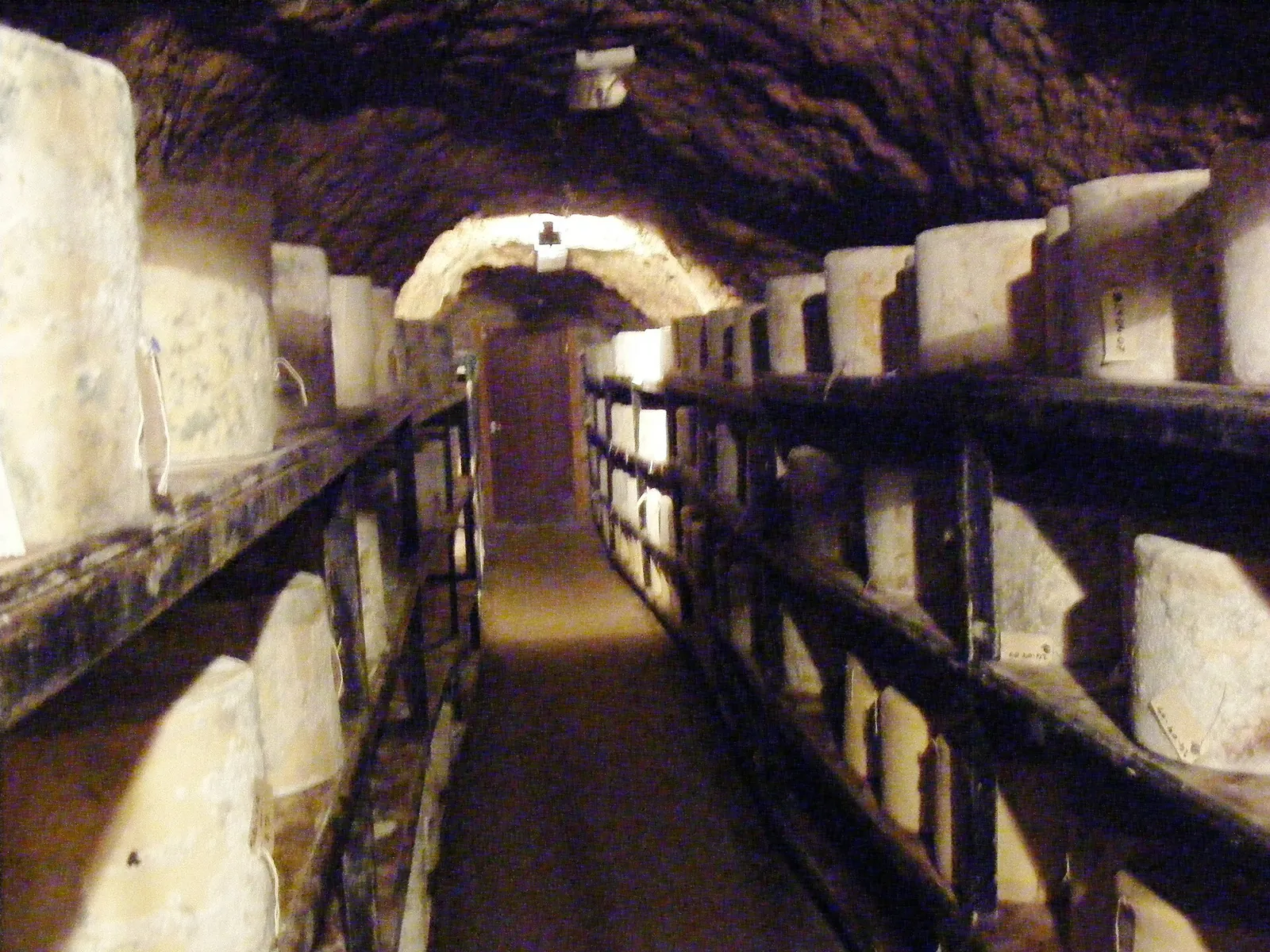
Some are natural caves, some are dug or built, and many today are ordinary rooms with a refrigeration system and a humidifier.
What makes a cave useful is not romance but stability. Temperature and humidity barely move, so a cheese loses moisture and develops flavor at a steady pace, and the rind grows the molds and bacteria the maker wants. The sections below cover the famous natural cave, the built ones, and what that means if you want your own at home.
Natural cheese caves: Roquefort and the Combalou
Natural cheese caves are best known from Roquefort-sur-Soulzon in southern France. The village sits in the scree of the Combalou mountain, and the official Roquefort site says the regulations require a minimum of 14 days of aging in the natural caves there, on the debris of the Combalou. The Roquefort page covers the cheese itself: raw sheep's milk, at least 90 days from making, and the fleurines, the cracks in the rock that let air move through the cellars.
So the cave is part of the specification. Under the rules, the same recipe aged elsewhere cannot be called Roquefort. The site lists five producers that run cave tours year-round, which is the easiest way to stand in one.
Other natural caves in Spain and beyond
Other natural cheese caves exist in the Picos de Europa in Asturias, where the Cabrales cheese page explains that the blue is ripened in natural mountain caves for at least two months. In both places the blue mold likes cool, damp air with some movement, and the cave provides it without a machine.
Man-made cheese caves and aging rooms
Man-made cheese caves are cellars, tunnels or built vaults that copy what the natural ones do. They are far more common than natural caves, and they let makers age many styles at once.
The Caves of Faribault in Minnesota are partly natural and partly dug. According to a summary of the site, natural caverns cut by glacial rivers in Saint Peter Sandstone were enlarged by excavation, and the caves hold 52.5°F and 99.9 percent humidity year round. The original Treasure Cave Cheese Company opened in 1936 as the first commercial maker of blue cheese in the United States, and the caves reopened in 2001 and took their present name in 2010. They age blue, Gouda and cheddar.
In Vermont, The Cellars at Jasper Hill is a 22,000 square foot facility built underground in Greensboro, with seven separate vaults. Each vault suits a different style of cheese: bloomy rinds with high air exchange, washed rinds in a high-moisture room, cheddar at lower humidity, and natural rinds with high humidity. The facility ages cheese from Jasper Hill Creameries and several other producers.
Why cheese caves work: temperature, humidity and airflow
Cheese caves work because they hold temperature, humidity and airflow steady. A home cheesemaking supplier describes a cave temperature of around 50 to 55°F, and the Jasper Hill vaults show how the other two settings vary with the cheese: more air exchange for bloomy rinds, a damp room for washed rinds, and lower humidity for cheddar. Different cheeses need different rooms, which is why the biggest facilities have several.
The rind and the cheese react to that room. Moisture leaves slowly, microbes work on the paste, and the surface grows the rind the cheese style needs. The rind types guide shows how natural, washed and bloomy rinds differ.
What most cheese cave talk gets wrong
Most cheese cave talk gets wrong the idea that a cave is a place where cheese is merely stored. It is a tool, used with turning, brushing, washing and wiping by an affineur, the person who ripens the cheese. Without that work, a cheese in a cave just dries out or molds unevenly.
The other mistake is thinking caves must be natural. Roquefort is the exception where law ties the name to a particular place; at Faribault and Jasper Hill the cave is chosen or built for the result, and plenty of fine cheese is aged in a plain, controlled room.
A cheese cave at home
A cheese cave at home is a small fridge, a temperature controller and a humidity source. The full setup, the numbers and the safety notes are in the guide to aging cheese at home. If you only want to keep cheese fresh, a cave is more than you need; the storing cheese guide covers the fridge.
Questions about cheese caves
These questions about cheese caves come up from first-time visitors and home cheesemakers.
What is a cheese cave?
A cheese cave is a cool, humid, stable space for aging cheese, which can be a natural cave, a dug or built cellar, or a purpose-built room.
Why is Roquefort aged in caves?
Roquefort is aged in caves because the regulations require at least 14 days in the natural caves of Roquefort-sur-Soulzon, according to the official Roquefort site.
What temperature is a cheese cave?
A cheese cave runs at about 50 to 55°F by one supplier's guidance, and the Caves of Faribault report 52.5°F.
Are cheese caves natural or man-made?
Cheese caves are both: Roquefort's are natural, Faribault's are natural caverns enlarged by digging, and Jasper Hill's are built vaults.
Can you make a cheese cave at home?
Making a cheese cave at home is possible with a mini fridge, a controller and a humidity source.
Visit or build a cheese cave
To see cheese caves, book a cave tour at one of the Roquefort producers, or look for a US maker near you that offers one. To build your own, start with a mini fridge and a controller.
Sources
- Visit the caves, Roquefort official site
- Caves of Faribault, Wikipedia
- The Cellars, Jasper Hill Farm
- How to Make an Inexpensive Cheese Cave, New England Cheesemaking Supply