
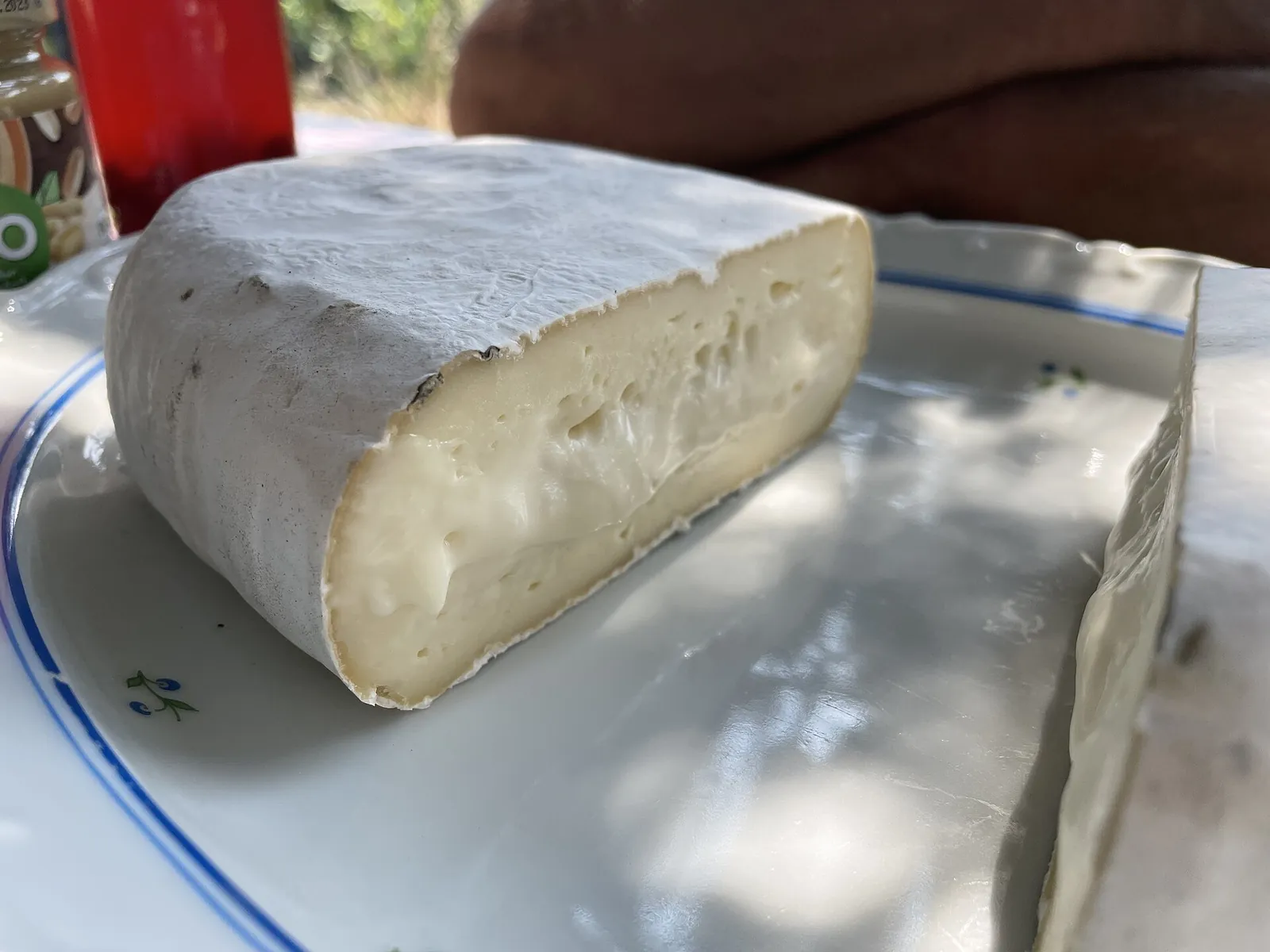
Yes, when the rind formed naturally on the cheese: eat the white rind on Brie and Camembert, taste a washed rind before you decide, and treat a hard natural rind as optional. Wax, cloth, paper and bark are wrappings, and you do not eat them.
Edible does not always mean enjoyable, which is why this page is a decision aid. The full sorting of rind types, with how each forms, is in cheese rind types; here the question is only whether to put it in your mouth.
Can you eat cheese rind at a glance
This can you eat cheese rind table gives the decision for each rind and the one thing to check.
| Rind | Example cheeses | Eat it? | Check this |
|---|---|---|---|
| Bloomy (white, velvety) | Brie, Camembert | Yes | Even white, no colored patches |
| Washed (orange, sticky) | Taleggio, Limburger | Usually | It can be salty and strong |
| Natural (dry, gray or brown) | Cheddar, Parmesan, tomme | Optional | Often bitter and hard to chew |
| Wax | Edam balls, Babybel | No | Peel it off |
| Cloth | Clothbound cheddar | No | Trim the cloth |
| Paper or bark | Wrapped soft cheeses | No | Remove it |
Eating bloomy rinds on Brie and Camembert
Bloomy rinds on Brie and Camembert are meant to be eaten. Wisconsin Cheese says bloomy rinds are almost always worth eating, with a woodsy, mushroomy taste. The rind is the mold that ripened the cheese, so it comes with the creamy paste in one bite.
If you dislike the texture, cutting it off is fine. If the white rind has colored patches or the cheese smells of ammonia, see white mold on cheese.
Eating washed rinds
Washed rinds are edible, and the choice is about taste. Wisconsin Cheese says they may be quite salty, and lists Limburger and brick among its examples. Taleggio is the one many shoppers meet first. Taste a small piece of rind with paste: the rind carries much of the savory flavor, so many people keep it. If it is too strong, trim it.
Eating natural rinds
Natural rinds are the dry, aged crust on cheddar, Parmesan and tommes. Wisconsin Cheese says you can eat one, but it will likely taste bitter and not be pleasant to chew. So the answer is yes, but you will probably not want to.
A thin rind on a young tomme is easy to eat. A thick Parmesan rind is better used in cooking, which is covered in what to do with cheese rinds. Take it out before serving.
Cheese rinds you should not eat
The cheese rinds you should not eat are wax, cloth, paper and bark, which are protective wrappings, not rinds. Wisconsin Cheese notes that wax, paper, bark and cloth are used to wrap and protect cheese. Peel the wax from a Babybel or an Edam ball, and trim the cloth from clothbound cheddar such as Cabot Clothbound. Plastic film is not edible either.
Check the label if you are not sure. A rind that looks like plastic, lacquer or a bright color is usually a coating.
How to decide whether to eat the rind
How to decide whether to eat the rind takes three quick steps, all guidance rather than rules. First, look at the surface: if it is a coating (shiny, colored, fabric or paper), peel it. Second, taste a small piece of rind together with paste; if the rind is bitter or very salty, cut it away from the rest of that slice. Third, think about the dish. On a board, a soft Brie rind rides along with the cheese, while a hard Parmesan rind belongs in the soup pot.
Young cheeses have thinner, softer rinds that are easier to eat, and older ones have hard, dry rinds. A rind that has gone slimy, patchy or colored is a mold question, and the USDA's mold rules decide it.
What most can you eat cheese rind advice gets wrong
Most can you eat cheese rind advice stops at "if it is natural, eat it," and that skips three things.
Safe and pleasant are different questions. A hard natural rind is not harmful, but it can be bitter, so many cooks use it for flavor instead.
The rind is not the safety question for soft cheeses. Pregnancy guidance on soft, mold-ripened cheeses concerns the cheese, not whether you eat the rind; see cheese during pregnancy.
Mold you did not expect is not a rind. If a cheese has fuzz that was not there at purchase, the USDA mold rules apply: trim hard cheese 1 inch, discard soft cheese. See how to prevent cheese mold.
Questions about eating cheese rind
These questions about eating cheese rind are the ones asked most.
Can you eat the rind on Brie?
You can eat the rind on Brie: it is a bloomy rind, almost always worth eating, with a mushroomy flavor.
Can you eat the rind on Parmesan?
You can eat the rind on Parmesan, but it is a natural rind and will likely be bitter and hard to chew, so many people simmer it in soup instead.
Can you eat the wax on cheese?
You cannot eat the wax on cheese: it is a protective coating, so peel it off before you eat the cheese.
Can you eat the orange rind on Taleggio?
You can eat the orange rind on Taleggio, which is a washed rind, though it can be salty and strong.
Is cheese rind safe during pregnancy?
Cheese rind safety in pregnancy depends on whether the cheese itself is advised, so ask your doctor about the cheese, not the rind.
Can you eat the rind on a goat cheese log?
You can eat the rind on a goat cheese log if it is a thin bloomy or ash-dusted rind, but a waxed or leaf-wrapped one should be peeled.
Decide if you eat cheese rind
To decide if you eat cheese rind, ask what formed it. Eat the white bloom on Brie, taste washed rinds, try natural ones in small bites, and peel anything that is wax, cloth or paper. If you want the cheese to last, store it well, as covered in how to store cheese properly.
Sources
- Cheese Rind Types, Wisconsin Cheese, Dairy Farmers of Wisconsin
- Molds on Food: Are They Dangerous?, USDA Food Safety and Inspection Service
- Mold on Cheese: The Basics of Moldy Cheese, Wisconsin Cheese, Dairy Farmers of Wisconsin