
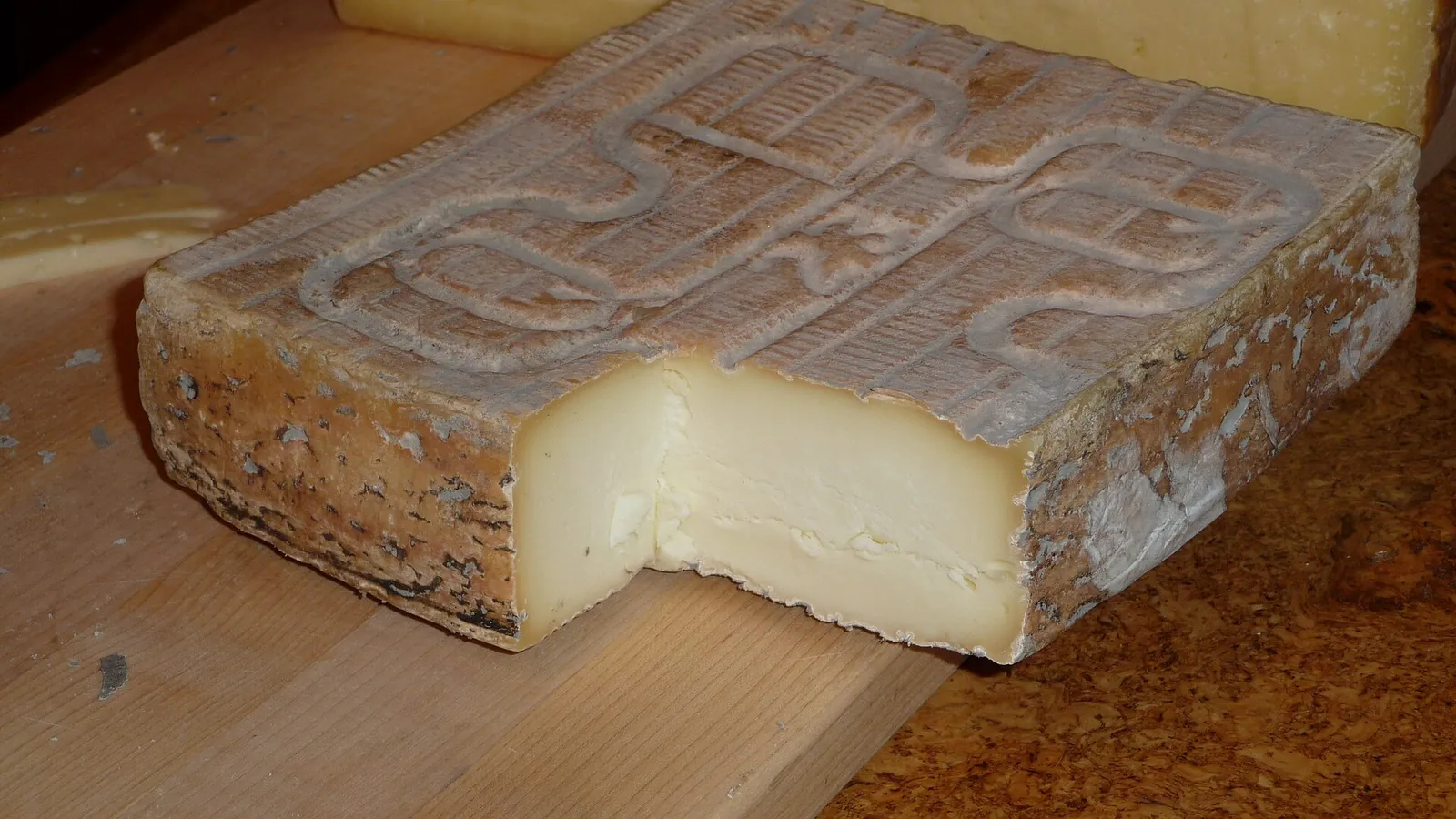
It is a square Italian cow's milk cheese, ready after at least 35 days, and it melts into a smooth fondue as easily as it slices onto a board.
The split between smell and taste comes from how Taleggio ripens: from the outside in. The rind is where the microbes work hardest, so that is where the aroma lives, while the paste near the center is the youngest and mildest part.
Taleggio cheese at a glance
Here is Taleggio cheese at a glance, from the rules of its protected designation of origin (PDO).
| Detail | Taleggio |
|---|---|
| Milk | Whole cow's milk, raw or pasteurized |
| Rennet | Animal only (veal or young beef) |
| Made in | 12 provinces of Lombardy, Piedmont and Veneto, Italy |
| Protected name | PDO since June 21, 1996 |
| Age | At least 35 days |
| Slab | Square, 18 to 22 cm (7 to 9 in) wide, 4 to 7 cm (1.6 to 2.8 in) high, 1.5 to 2.5 kg (3.3 to 5.5 lb) |
| Rind | Thin, soft, natural pink; edible; treated only with water and salt |
| Paste | White to straw yellow; firmer in the center, softer under the rind |
| Flavor | Sweet and aromatic, with notes of milk and an aftertaste of truffle |
| Fat | At least 48 percent milk fat in the dry matter |
| Per ounce | About 88 calories, 7.4 g fat, 5.4 g protein, 0.6 g salt (consortium figures) |
Taleggio cheese origin and PDO rules
Taleggio cheese is named for Val Taleggio, a valley in Lombardy, and its PDO limits production to 12 provinces across Lombardy, Piedmont and Veneto. The EU's 2022 notice on the Taleggio specification says the cheese spread across the plains as herders came down from the mountains each winter. The name was registered in 1996, and the updated rules were approved in 2022.
At least half the dry matter in the cows' feed must come from the production area, and the cheese must be matured and portioned there too. A genuine slab is stamped on one flat face with four circles, three letter Ts and the dairy's number. Packaged pieces carry the Taleggio name and the consortium's red, white and green logo.
How Taleggio cheese is made
Taleggio cheese is made from whole cow's milk, raw or pasteurized, set with a starter culture and animal rennet. The curd is cut to hazelnut size, scooped into square molds and stamped, then held in a warm room for 8 to 16 hours to finish draining. After salting, dry or in brine, the slabs go to a cool, humid room, traditionally a cave, for at least 35 days. There they are turned and sponged with brine once a week, the consortium explains, and the rind turns pink.
Why Taleggio smells strong but tastes mild
Taleggio smells strong but tastes mild because its aroma is built on the rind, while most of the cheese is still milky paste. The EU document lists the rind's residents: pink-pigmented micrococci, yeasts, and fungi such as Geotrichum, Mucor and Penicillium, which break down protein and fat from the surface inward. University of Milan researchers who analyzed the volatile compounds on Taleggio's surface found 13 groups, with sulfur compounds and ketones behind the aroma (abstract).
Taste in order: the center first, then the softer layer under the rind, then the rind, which is the strongest part. The smelly cheese guide explains the smell chemistry in more detail.
How to melt Taleggio cheese
Melt Taleggio cheese slowly over low heat, because it flows into a smooth sauce rather than stretching. The consortium's gnocchi recipe is a good model: for four servings, melt 5 ounces (150 g) of diced Taleggio with 2 teaspoons (10 g) of butter and about 3 tablespoons (50 ml) of cream, stirring gently with a wooden spoon, then stir in up to 2 more tablespoons (25 ml) of cream until it reaches a fondue consistency. Spoon it over gnocchi or pasta, bake it over scallops, or fold it into a béchamel for lasagne, all uses the consortium's recipes show.
For polenta or risotto, stir diced cubes in off the heat. On sandwiches and pizza, about an ounce is plenty; it flows more than it pulls, which the melting cheese ranking lists beside Brie. Trim the rind if you want a perfectly smooth sauce.
How to serve Taleggio cheese
Serve Taleggio cheese at room temperature, in slices, as a second course or at the end of the meal. The consortium suggests splitting the slab twice at right angles and cutting soft slices from the quarters. At the end of a meal it recommends apples or pears, and for drinks, still red wines or sparkling wine. A Nebbiolo or a Prosecco fits, and the pairing finder lists more.
How to buy and store Taleggio cheese
Buy Taleggio cheese cut to order from a slab with a supple, pink-orange rind that gives slightly under your thumb. A faint yeasty smell is normal; a sharp ammonia sting is not.
Store it at 39 to 43°F (4 to 6°C) in the paper it came in, never in plastic wrap, which cuts off air and makes the cheese ferment, the consortium warns. Eat it within 5 to 7 days for the best aroma, though it keeps for weeks. Do not freeze it: the PDO rules bar selling Taleggio that has ever been frozen.
What most Taleggio advice gets wrong
Most Taleggio advice skips two rules that the PDO sets in writing.
Taleggio is not vegetarian
Taleggio is not vegetarian, because the specification requires liquid animal rennet from veal or young beef and bans rennet from genetically modified microorganisms. Any cheese sold as PDO Taleggio therefore contains animal rennet.
Washed rind does not mean washed in wine or beer
A washed rind on Taleggio does not mean a wash of wine, beer or brandy, as with some other smelly cheeses. The rind may be treated only with water and salt, so its pink color and aroma come from the cheese's own microflora.
Questions about Taleggio cheese
These are the questions about Taleggio cheese that come up most.
What does Taleggio cheese taste like?
Taleggio cheese tastes sweet and aromatic, with notes of milk and an aftertaste of truffle, according to the EU specification. The rind is the strongest part.
Should you eat the rind of Taleggio?
You can eat the rind of Taleggio: the consortium calls it fully edible. Trim it if you find it too strong or want a smoother melt.
Does Taleggio taste like Brie?
Taleggio does not taste much like Brie: both are soft and creamy, but Brie ripens under a white mold coat with a mild mushroom note, while Taleggio's pink, brine-washed rind gives it a sweeter, more aromatic edge.
What cheese is similar to Taleggio?
The cheeses most similar to Taleggio are fontina and Reblochon, the two that the substitute finder suggests, and both melt well.
Is Taleggio made with raw milk?
Taleggio can be made with raw or pasteurized milk, so check the label. The CDC says people who are pregnant, 65 or older or have weakened immune systems should avoid cheese made with raw milk unless it is heated to 165°F or until steaming hot.
Your first Taleggio cheese
For your first Taleggio cheese, buy a small piece cut to order, let it sit out for 30 to 60 minutes, and taste the center before the rind with a ripe pear. Then melt a few cubes into hot polenta and see how the same cheese changes.
Sources
- The Taleggio and Scallops with Taleggio PDO fondue, Consorzio Tutela Taleggio
- Publication of an application for approval of an amendment to the product specification, 'Taleggio' (2022/C 72/10) and Commission Implementing Regulation (EU) 2022/955, Official Journal of the European Union
- Commission Regulation (EC) No 1107/96, Official Journal of the European Communities
- Analisi delle sostanze volatili del taleggio (Cantoni, Chiesa and Cesana, 2005), Industrie Alimentari, via University of Milan repository
- Preventing Listeria Infection, Centers for Disease Control and Prevention