
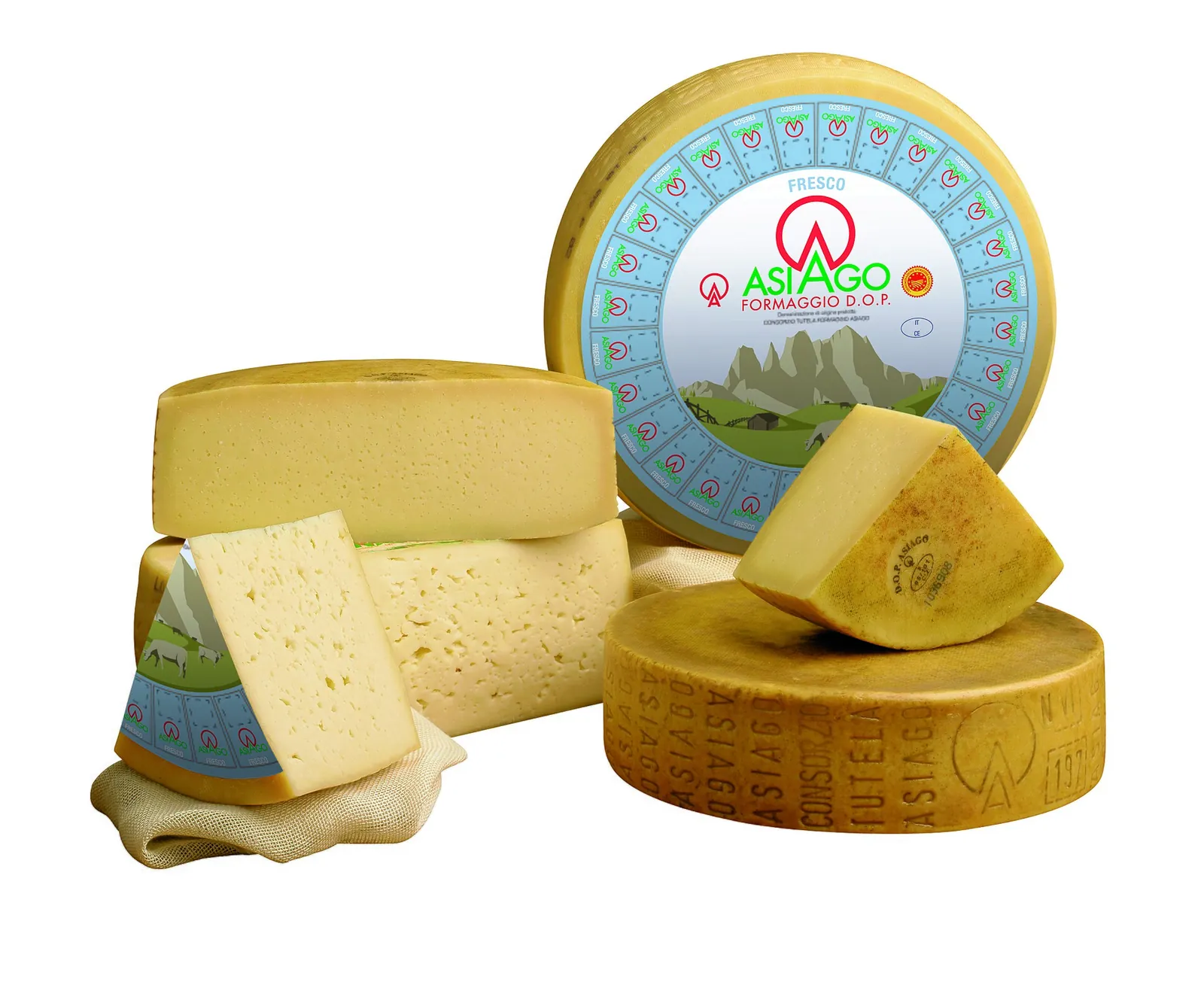
Both are made only from cow's milk, in the mountains and foothills of northeastern Italy.
The age on the label tells you what to do with it. A cheese aged a few weeks goes in a sandwich; one aged more than a year goes over pasta. Most confusion about Asiago comes from treating the name as a single flavor.
Asiago cheese at a glance
Here is Asiago cheese at a glance, taken from the EU summary of its protected-name specification.
| Detail | Asiago |
|---|---|
| Milk | Cow's milk only; the curd is semi-cooked |
| Made in | Provinces of Vicenza, Trento, Padua and Treviso, Italy |
| Protected name | PDO "Asiago", in two versions: Pressato (pressed) and Allevo (ripened) |
| Minimum age | Pressato 20 days; Allevo 60 days |
| Rind | Thin and springy on Pressato; smooth and regular on Allevo; not edible on either |
| Texture | Pressato: marked, irregular eyes. Allevo: small to medium eyes, firmer with age |
| Flavor | Pressato: delicate. Allevo: sweet when semi-mature, fragrant when mature |
| Wheel | Pressato 11 to 15 kg (about 24 to 33 lb); Allevo 8 to 12 kg (about 18 to 26 lb) |
Where Asiago cheese can be made
Asiago cheese can be made only in the provinces of Vicenza, Trento, Padua and Treviso, using milk from cows kept in that area and dairies inside it. The cheese began on the Asiago Plateau, and production spread into the adjoining foothills after local people migrated during the First World War, the specification says. Land at or above 600 meters (about 1,970 feet) counts as mountain area.
That matters for one label. Only Asiago made from milk produced in mountain cow houses, made in mountain dairies and ripened in mountain areas may be marked "Prodotto della montagna". The mountain version bans silage in the cows' diet and food colorings or anti-mold agents on the rind. The guide to PDO and PGI labels explains what the protected-name seal promises in general.
How Asiago cheese is made
Asiago cheese is a semi-cooked cow's milk cheese under the EU specification, and the milk is handled differently for each style. Pressato uses milk from one or two milkings, raw or pasteurized at 72°C for 15 seconds. Allevo uses milk from one or two milkings that is partially skimmed at the surface, raw or thermised at 57 to 68°C for 15 seconds. Taking some cream off is why Allevo is leaner and eventually drier and crumblier than its fresh sibling.
Then the two split on time. Pressato must mature at least 20 days from the date it was made. Allevo must mature at least 60 days, counted from the last day of the month of production, and it ripens inside the production area. The mountain version has longer minimums: 30 days for Pressato and 90 days for Allevo. Allevo may also be made with lysozyme (E 1105), an additive allowed in the milk, and the label may say whether it was used. The mountain version bans it.
Pressato and d'Allevo Asiago cheese by age
Pressato and d'Allevo Asiago cheese differ in age, moisture and use, and the specification puts numbers on both. Pressato at 20 days is white or slightly yellowish with marked, irregular eyes, a delicate flavor and about 39.5 percent moisture. At 60 days, Allevo is drier at about 34.5 percent moisture, with small to medium eyes and a sweet flavor that turns fragrant as it matures.
Labels add words as Allevo ages. "Mezzano" means ripened for 4 to 6 months, "vecchio" over 10 months, and "stravecchio" over 15 months. The Asiago consortium also labels the youngest cheese "fresco" and the ripened one "stagionato". A wedge marked stravecchio is the one that behaves like a grating cheese: hard, savory and sharp, though it keeps its own nutty character.
Two clues help in the store. Pressato has visible, uneven holes and a pale paste. Allevo gets denser and more golden with age, and a stamped letter on the heel of a whole wheel marks its production month.
How to buy Asiago cheese in the US
Buying Asiago cheese starts with reading the age words and the origin. Real PDO wheels carry stamped bands with the designation repeated and a numbered casein plate, and a cut piece should still show a bit of that marking along the heel, since whole cheese may be cut and pre-packaged in pieces that let the heel be seen. A package that just says "Asiago" with no Italian origin or PDO mark may not be the protected cheese.
US-made Asiago follows different rules. The FDA's standards say Asiago fresh or soft cheese is cured at least 60 days, with at most 45 percent moisture and at least 50 percent milkfat in its solids, and Asiago old cheese is cured at least a year, with at most 32 percent moisture. So an American "fresh" Asiago is older than Italian Pressato, which is only 20 days.
Ask for the age. For melting, buy fresco or Pressato, or anything labeled young. For grating, buy vecchio or stravecchio, and grate it yourself, because pre-grated cheese loses its aroma fast. If a counter sells only one unlabeled Asiago, expect something in the middle that does both jobs passably.
How to cook with Asiago cheese
Cook with Asiago cheese by matching the age to the job. Young Asiago has more moisture, so it slices and melts smoothly: use it in panini, on pizza, in a quesadilla or an egg bake, and with bread and fruit. It browns rather than turning oily if you keep the heat moderate. For more melters, see the best melting cheeses.
Aged Asiago is a finishing cheese. Shave it over risotto, shred it into soup, grate it on a salad or break it into chunks for a board with cured meat and honey. It does not melt into a stretchy pool, so stir it into a hot sauce off the heat. Fresh Pressato pairs with Pinot Grigio or Prosecco, while aged Asiago holds up to Merlot; the pairing guide has beer and fruit matches too.
Asiago cheese substitutes
Asiago cheese substitutes depend on which style the recipe wants. For young Asiago, use young fontina or dolce provolone, which melt just as easily. For aged Asiago, use Parmigiano-Reggiano or Grana Padano, a touch saltier and more granular. Aged Montasio is another close match from the same corner of Italy. The Substitute Finder lists more.
What most Asiago advice gets wrong
Most Asiago advice treats the name as one flavor, which leads to a few avoidable mistakes.
Asiago is not always a grating cheese
Asiago is not always a grating cheese, because Pressato is a young, soft, eyed cheese that clumps in a grater and tastes mild. Check the age before you reach for the grater.
The rind of Asiago is not for eating
The rind of Asiago is not meant to be eaten: the specification calls the surface not edible, and it may be treated with permitted substances after the minimum maturation period. Cut it off, or simmer a piece in soup and fish it out. The guide to eating cheese rind covers which rinds are fine.
Many shoppers skip the mezzano stage
Many shoppers skip the mezzano stage, which sits between mild and sharp. At 4 to 6 months, Allevo has lost much of its fresh sweetness but is not yet hard, so it slices, shaves and grates, a good all-rounder when you want one wedge for everything.
Questions about Asiago cheese
These are the questions about Asiago cheese that come up most.
What is the difference between fresh and aged Asiago?
Fresh Asiago (Pressato) is aged at least 20 days and is mild and soft with irregular holes, while aged Asiago (Allevo) is aged at least 60 days and gets harder and sharper over months. The names on the label are fresco, mezzano, vecchio and stravecchio.
Is Asiago like Parmesan?
Aged Asiago is like Parmesan in use, since both are hard grating cheeses, but Asiago is made from partially skimmed cow's milk in the Veneto and Trentino area and has its own nutty character. Fresh Asiago is nothing like Parmesan.
Can you melt Asiago cheese?
Asiago cheese melts well when it is young: Pressato melts smoothly in sandwiches, on pizza and in baked dishes, while aged Asiago is better grated over the top.
Is Asiago cheese pasteurized?
Asiago cheese can be raw or heat-treated, because the specification allows raw milk or pasteurized milk for Pressato and raw or thermised milk for Allevo. Check the label if you avoid raw milk, and see the guide to pasteurized and raw-milk cheese.
How long does Asiago cheese last?
Asiago cheese lasts about a couple of weeks once Pressato is opened, and longer for aged wedges, which are drier. Wrap it in wax paper or parchment in a lidded container; the storing cheese guide covers wraps.
Your first Asiago cheese
For your first Asiago cheese, buy two small pieces: a Pressato or fresco for sandwiches and a mezzano or vecchio for grating. Taste them side by side, and you will know which one your pasta night needs.
Sources
- 21 CFR 133.102, Asiago fresh and Asiago soft cheese, with 21 CFR 133.104, Asiago old cheese, Legal Information Institute, Cornell Law School
- Updated summary, "Asiago" PDO (EC No IT/PDO/117/0001), European Commission
- Asiago Cheese (age categories and consortium), Consorzio Tutela Formaggio Asiago