
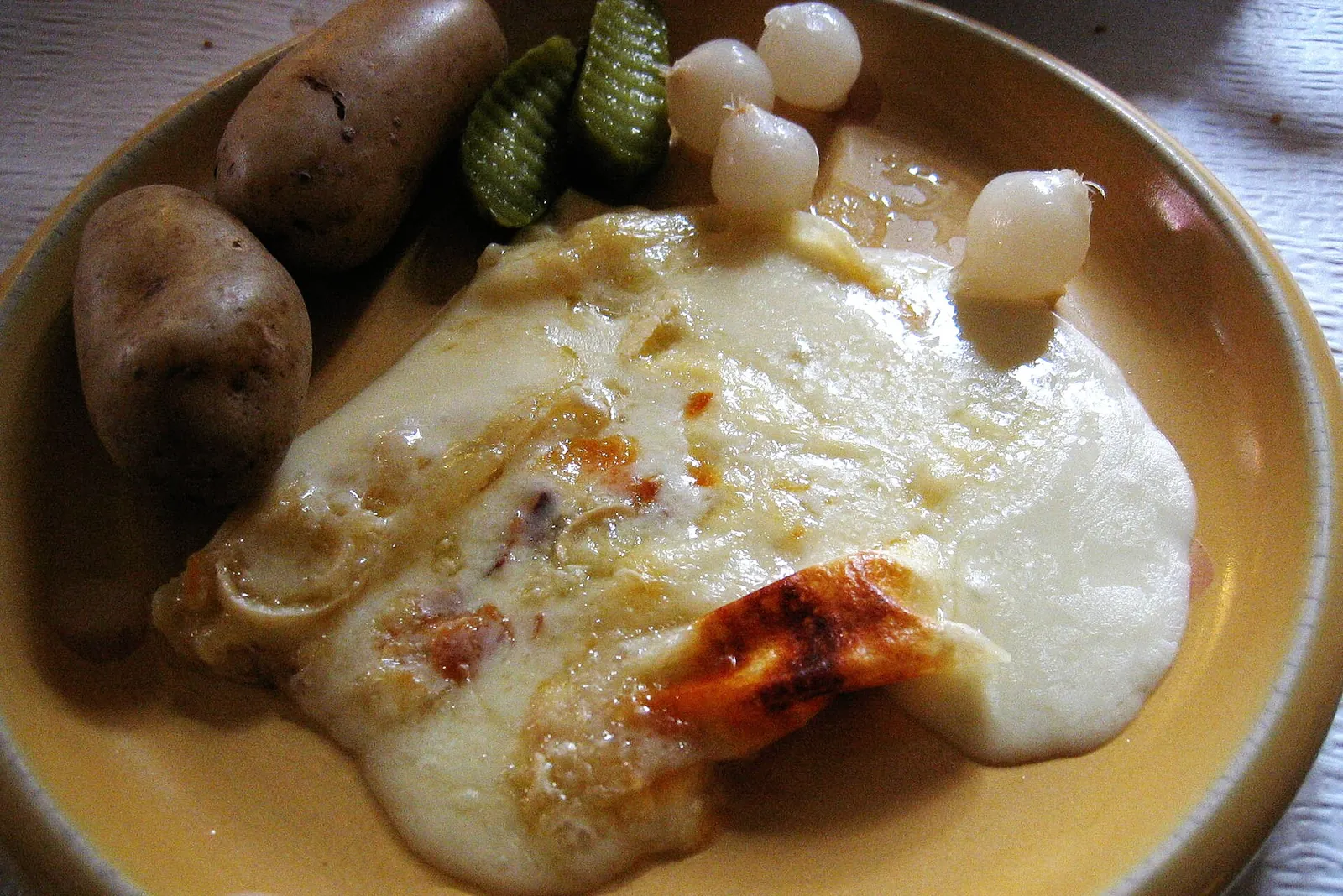
The name comes from the French verb for scraping, and the cheese and the meal share it.
What matters at the store is that the word raclette protects nothing by itself. Two names are protected, Raclette du Valais from Switzerland and Raclette de Savoie from France, and each follows written rules. Anything else labeled raclette can be made anywhere, by any method.
Raclette cheese at a glance
Here is raclette cheese at a glance, comparing the two protected names with cheeses sold simply as raclette.
| Raclette du Valais AOP | Raclette de Savoie PGI | Other raclette | |
|---|---|---|---|
| Made in | Canton of Valais, Switzerland | Savoie and Haute-Savoie, plus a few nearby communes | Anywhere |
| Milk | Raw cow's milk, no heating | Cow's milk, raw or lightly heated (thermised) | Raw or pasteurized |
| Aging | At least 3 months | At least 8 weeks | Varies; one Wisconsin farmstead raclette ages at least 60 days |
| Wheel | 29 to 32 cm wide, 4.6 to 5.8 kg (10 to 13 lb) | About 30 cm wide, 6 kg (13 lb) | Varies |
| Flavorings | None allowed | None; always plain | Wine, mustard seeds or smoke are possible |
| Protected | Swiss AOP, registered 2007 | EU PGI since 2017 | The word raclette is not protected |
How raclette cheese is made
Raclette cheese is made like other pressed Alpine cheeses: milk is set with rennet, the curd is cut, heated, pressed into wheels and salted, then ripened on boards while the rind is washed. The Valais rules add detail. The raw milk goes into open copper vats, the curd is heated to 97 to 113°F (36 to 45°C) and pressed for at least an hour, and the wheels spend at least 3 months in a cellar at 45 to 57°F (7 to 14°C) on red spruce boards. The specification advises turning and brushing them daily for the first 10 days, then less often.
Raclette du Valais AOP vs other raclette
Raclette du Valais is the strictest raclette: it comes only from the canton of Valais, from raw cow's milk that gets no heat treatment beyond cooling. The cows may not eat silage, at least 75 percent of their roughage must come from Valais, and the only ingredients allowed are water, salt, calf rennet, lactic cultures and the smear that forms the rind. Cheese was already being melted in Valais in 1574, according to the Swiss PDO-PGI association, which says the name became official in 1874. The guide to Alpine cheeses puts it beside Gruyère and Comté.
Raclette de Savoie is the French equivalent, an EU protected geographical indication. Its makers say it is always plain, never flavored or smoked, and that it melts without turning oily. A green casein plaque on the wheel means farmhouse, and a red one means dairy-made, according to Fromages de Savoie. Elsewhere the word is free. Dairy Farmers of Wisconsin notes that some raclette is made with white wine or mustard seeds, or smoked, and that Alpinage in Oak Creek makes a raw-milk version aged at least 60 days. The guide to PDO and PGI labels explains the protected-name system.
What raclette cheese tastes like
Raclette cheese tastes mild, creamy and a little fruity: the Valais specification describes fresh butter and cream, with floral, vegetal and fruity notes in a smooth, supple paste. Dairy Farmers of Wisconsin adds a nutty note and a touch of funk, which comes from the washed rind.
How to melt raclette cheese at home
Melt raclette cheese at home with a tabletop grill or an oven, using slices about 1/4 inch (6 mm) thick. A raclette grill has four to eight small trays, called coupelles, under a heating element, so each person melts their own cheese, with a griddle on top for potatoes and vegetables, Dairy Farmers of Wisconsin explains. With no grill, heat the oven to 400°F (200°C), put the slices in an enameled baking dish, and bake 4 to 6 minutes until melted, as the group's raclette recipe directs. Either way, scrape the cheese over the food the moment the surface bubbles.
Plan on 5 to 6 ounces (140 to 170 g) of cheese per person, in line with the cheese per person guide, plus small boiled potatoes kept warm in a towel-lined bowl. Cornichons, pickled onions, cured meats and crusty bread are the classic partners. Savoie's makers advise a slicer with a cutting wire rather than a knife, for even slices that melt well. The raclette at home guide covers hosting the full dinner.
How to buy and store raclette cheese
Buy raclette cheese by its full name, Raclette du Valais AOP or Raclette de Savoie IGP, or ask a cheese counter for sliced raclette cut for grills. Keep it in its original paper, or wrap it in plastic film pierced with small holes, in the lower part of the fridge, since the Savoie producers say cheese without air can turn slightly bitter. Leftovers keep 2 to 3 weeks and work in sandwiches, on toast or on pizza.
What most raclette advice gets wrong
Most raclette advice treats the word as a guarantee and the cheese as a one-trick melter.
Raclette on a label guarantees nothing
Raclette on a label guarantees nothing, because the word itself is unprotected. The Valais specification notes that Switzerland's Federal Supreme Court ruled in 2007 that the term is not protected, so a pack marked raclette may be flavored, smoked, pasteurized or made anywhere. Read for the full protected name.
Raclette is not only a melting cheese
Raclette is not only a melting cheese: Savoie's makers suggest serving theirs at the end of a meal on a cheese board, and Dairy Farmers of Wisconsin calls its Alpinage raclette as good a table cheese as a melting one. Eat a slice cold first to taste what the cheese is.
A hotter grill does not make better raclette
A hotter grill does not make better raclette, because overheated cheese turns oily as the fat separates. Pull the pan as soon as the surface bubbles and just begins to brown at the edges.
Questions about raclette cheese
These are the questions about raclette cheese that come up most.
Is raclette a cheese or a dish?
Raclette is both a cheese and a dish: the cheese is a semi-hard Alpine cow's milk cheese, and the dish is melted raclette scraped over potatoes, pickles and cured meats.
Can you eat raclette cheese cold?
You can eat raclette cheese cold, and it is also served on cheese boards, as both Savoie's makers and Dairy Farmers of Wisconsin note.
What can you use instead of raclette cheese?
The best substitutes for raclette cheese are fontina and Gruyère, which melt smoothly; the substitute finder also suggests Reblochon.
Do you need a special grill to melt raclette cheese?
You do not need a special grill to melt raclette cheese: a 400°F oven and an enameled baking dish melt 1/4-inch slices in 4 to 6 minutes.
Is raclette cheese made with raw milk?
Raclette du Valais is always made with raw milk, Raclette de Savoie may use raw or lightly heated milk, and other raclette varies, so check the label. The CDC says people who are pregnant, 65 or older or have weakened immune systems should avoid cheese made with raw milk unless it is heated to 165°F or until steaming hot.
Your first raclette cheese
For your first raclette cheese, buy a wedge labeled Raclette du Valais AOP or Raclette de Savoie IGP, slice it 1/4 inch thick, and melt it in a 400°F oven over boiled potatoes with cornichons. Then try a Wisconsin raclette beside it and see how the protected names differ.
Sources
- Cahier des charges, Raclette du Valais (AOP), Swiss Federal Office for Agriculture, via the Swiss PDO-PGI Association
- Walliser Raclette AOP, Swiss PDO-PGI Association
- IGP Raclette de Savoie, Fromages de Savoie, and Savoicime's storage advice and recognition guide
- Commission Implementing Regulation (EU) 2017/138, Raclette de Savoie (PGI), Official Journal of the European Union
- The raclette grill, Raclette Dinner Party and What Is Raclette Cheese?, Dairy Farmers of Wisconsin
- Preventing Listeria Infection, Centers for Disease Control and Prevention