
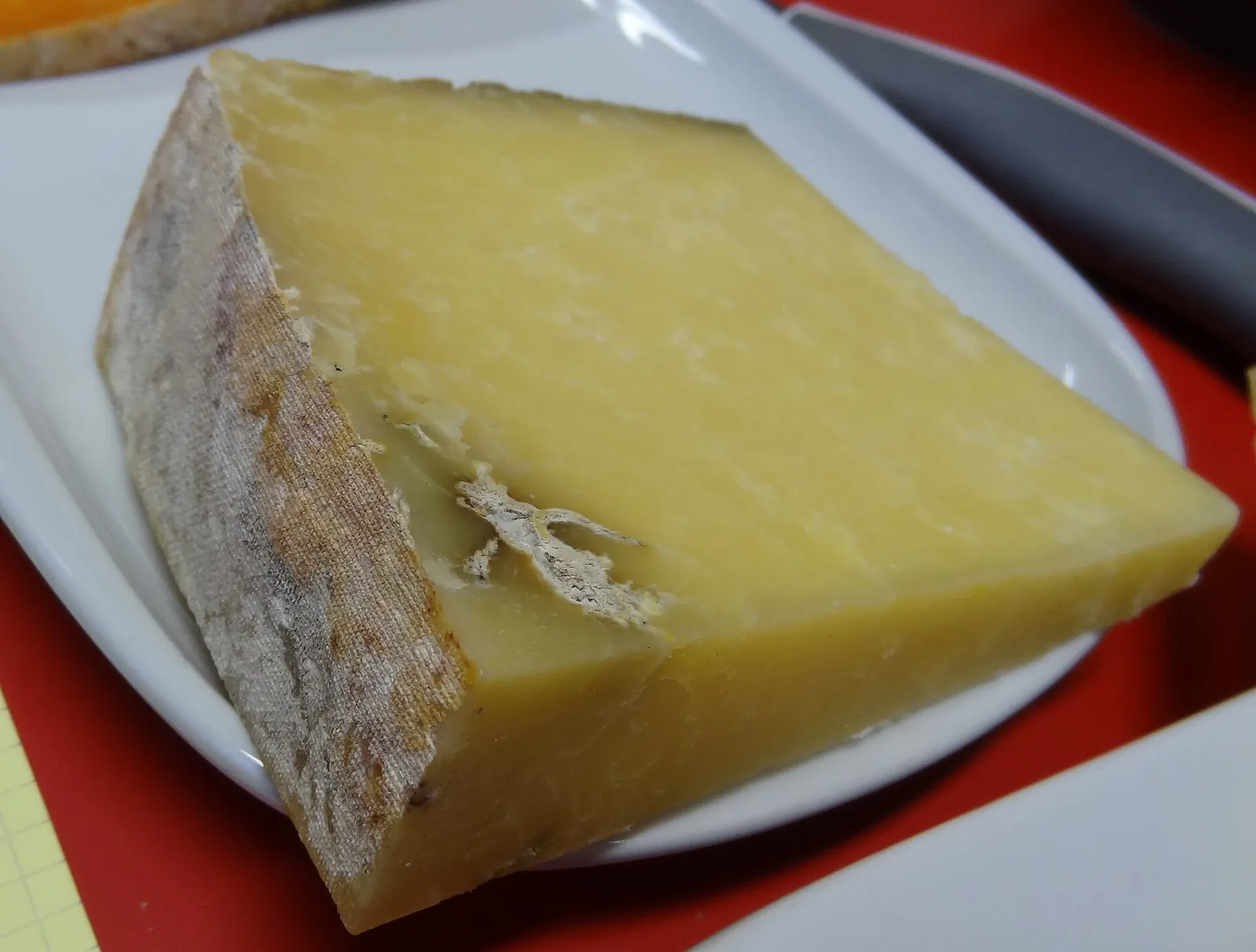
Each wheel gets a coat of lard and a layer of cloth, which gives it a natural rind and the crumbly, savory character of English farmhouse cheddar.
The cloth is the point. Block cheddar ages sealed in film, keeps its moisture and grows no rind, while a cloth-wrapped wheel breathes through its coating and ends up with a rind and a drier, more savory paste.
Cabot Clothbound Cheddar at a glance
Here is Cabot Clothbound Cheddar at a glance, taken from the cheese's page at Jasper Hill Farm.
| Detail | Cabot Clothbound Cheddar |
|---|---|
| Milk | Pasteurized cow's milk from Cabot's cooperative farms |
| Made by | Cabot Creamery, the dairy cooperative |
| Aged by | Jasper Hill Farm, in its cellars in Greensboro, Vermont |
| Age | 9 to 14 months |
| Wheel | 35 pounds |
| Rind | Natural rind under a coat of lard and a layer of cloth |
| Texture | Crumbly and crystalline, creamy on the palate |
| Flavor | Savory and slightly tangy, with caramel sweetness, broth and toasted nut |
| Protected name | None; the English PDO covers only four West Country counties |
Who makes Cabot Clothbound Cheddar
Two companies make Cabot Clothbound Cheddar: Cabot makes the young cheese and Jasper Hill Farm ages it. Jasper Hill's page for the cheese says the milk comes from Cabot's cooperative farms and that the collaboration began in 2003, when Cabot Creamery asked Jasper Hill to age a special batch of cheddar. For the basics of how any cheddar is made, see the guide to where cheddar comes from and how it is made.
At Jasper Hill the wheels ripen in a specially calibrated vault where they are brushed, turned and monitored for quality. Jasper Hill lists an American Cheese Society Best in Show from 2006 among the cheese's awards. A wheel weighs 35 pounds, so shoppers usually buy a cut wedge, and Vermont's artisan cheese scene covers more of what the state makes.
How cloth-binding changes the cheese
Cloth-binding changes the cheese by letting a wheel breathe while its rind forms, which a sealed block cannot do. The UK specification for West Country Farmhouse Cheddar describes the English method: seal each pressed cylinder by bandaging it in muslin dipped in melted lard, or by smearing the fat on and then bandaging. The bandage helps a hard rind form, lets the cheese breathe and keeps mold from penetrating, and the wheels are turned regularly so moisture leaves evenly. Jasper Hill's version is the same idea: it coats the young cheese in lard and adds a layer of cloth.
Block cheddar is wrapped in a semi-permeable film and does not lose moisture while it ages, so makers start from a drier curd. A cloth-bound wheel does lose moisture through its rind, so makers start with a moister curd, and Jasper Hill describes this cheese as crumbly with a rustic crystalline texture.
Cabot Clothbound vs English farmhouse cheddar
Cabot Clothbound vs English farmhouse cheddar comes down to the same wrapping method used under very different rules.
| Cabot Clothbound | West Country Farmhouse Cheddar (PDO) | Artisan Somerset Cheddar (Slow Food Presidium) | |
|---|---|---|---|
| Where | Made by Cabot, aged in Greensboro, Vermont | Farms in Somerset, Dorset, Devon and Cornwall | Three farms in Somerset |
| Milk | Pasteurized, from cooperative farms | Cow's milk mostly from the region, raw or pasteurized | Raw milk from the maker's own cows, used within a day |
| Wrap | Coat of lard plus cloth | Cylinders bandaged in lard-dipped muslin; blocks also allowed | Lard-soaked muslin, natural crust never shrink-wrapped |
| Age | 9 to 14 months | At least 9 months | At least 11 months, up to 2 years |
| Flavor | Tangy, caramel, broth, toasted nut | Nutty and round, with a hint of sharpness | Caramelized milk, hazelnut, bitter herbs |
The protected name sets a floor, not a ceiling. The specification lets West Country Farmhouse Cheddar use pasteurized milk, be sold as a block as well as a cloth-bound cylinder, and age for only 9 months, and the guide to PDO and PGI labels explains what such seals do and do not promise. The three farms in Slow Food's Artisan Somerset Cheddar Presidium go further: raw milk from their own cows, old pint-starter cultures, calf rennet, at least 11 months in cloth, and only 10 to 20 cheeses made a day on each farm.
Cabot Clothbound sits between the two. It borrows the lard-and-cloth method and a similar aging time, but it starts from pasteurized cooperative milk and is aged by a separate company, so it is neither a raw-milk cheese nor covered by the West Country name. Tasting notes overlap, with caramel and nuttiness in both makers' descriptions, while the Somerset cheeses add bitter herbs and a hay-yellow curd.
What Cabot Clothbound Cheddar tastes like
Cabot Clothbound Cheddar tastes savory and slightly tangy, with caramel sweetness at the finish, according to Jasper Hill. It calls the cheese approachable but complex, with a nutty aroma, a crumbly body and a rustic crystalline texture that turns creamy on the palate, and it lists medium acidity, caramel sweetness and savory notes of broth and toasted nuts. Crystals like these are common in long-aged cheddar, and aged vs young cheddar explains what they are and why they appear.
Where to buy Cabot Clothbound Cheddar
Buy Cabot Clothbound Cheddar from a cheese counter that cuts to order, or online, where Jasper Hill's own page offers it. Judge the cut face of the wedge: look for a pale gold, crumbly paste with a few white crystals and no gray, slimy or dried-out patches, and ask for a taste. Expect a specialty-cheese price per pound, since each wheel is aged for most of a year.
How to serve Cabot Clothbound Cheddar
Serve Cabot Clothbound Cheddar on a board at room temperature, broken into chunks rather than sliced thin. Take it out of the fridge about an hour ahead so the flavor opens up, and peel off any cloth that comes with the piece. Jasper Hill suggests apple jelly, chestnut honey and charcuterie, with off-dry sparkling cider, a hoppy ale or an oaked Cabernet Sauvignon to drink; the guides to cider and cheese and making a cheese board help with the rest.
It can go into cooking, but treat it as a finishing cheese. At 9 to 14 months it sits near the age where cheddar starts to clump in a hot sauce, so grate it over a finished dish instead.
Storing Cabot Clothbound Cheddar
Storing Cabot Clothbound Cheddar is simple: wrap a cut wedge in wax paper or parchment and keep it in the fridge in a loose container, since tight plastic traps moisture. The guide to storing cheese has more on wraps.
What most Cabot Clothbound Cheddar advice gets wrong
Most Cabot Clothbound Cheddar advice gets a few details wrong, and they change how you buy and eat it.
Cabot Clothbound Cheddar is American, not English
Cabot Clothbound Cheddar is American, not English: the style comes from England, but the cheese is made by a cooperative and aged in Vermont, and the West Country name is protected for farms in four English counties.
The cloth is not for eating
The cloth on a clothbound wheel is packaging for the aging, not food, so peel it off. The rind underneath is a matter of taste: try a small piece and decide.
Mold on a clothbound rind is normal
Mold on a clothbound rind is normal, because the bandage is designed to let the cheese breathe while keeping mold from penetrating, and Slow Food describes the Somerset cheeses as having a moldy brownish-gray rind. Mold on a cut face is different: cut it away with a generous margin.
Questions about Cabot Clothbound Cheddar
These are the questions about Cabot Clothbound Cheddar that come up most.
What does clothbound mean?
Clothbound means the cheese is wrapped in cloth, usually with a coat of fat, and aged as a whole wheel so it can breathe and form a natural rind.
Where is Cabot Clothbound Cheddar aged?
Cabot Clothbound Cheddar is aged in the cellars of Jasper Hill Farm in Greensboro, Vermont.
How long is Cabot Clothbound Cheddar aged?
Cabot Clothbound Cheddar is aged 9 to 14 months, according to Jasper Hill.
Is Cabot Clothbound Cheddar pasteurized?
Cabot Clothbound Cheddar is made from pasteurized cow's milk, according to Jasper Hill, unlike the raw-milk Artisan Somerset cheddars. Pasteurized vs raw cheese explains the difference.
What is a good substitute for Cabot Clothbound Cheddar?
A good substitute for Cabot Clothbound Cheddar is an English farmhouse cheddar aged at least 9 months, which the specification describes as nutty and round with a hint of sharpness.
Your first Cabot Clothbound Cheddar
For your first Cabot Clothbound Cheddar, buy a small wedge, let it warm for an hour and eat it in chunks with apples and a glass of off-dry sparkling cider or a hoppy ale. If it hooks you, taste it next to an English farmhouse cheddar to see how the same wrapping shows up with different milk.
Sources
- Cabot Clothbound, Jasper Hill Farm
- Product specification: West Country Farmhouse Cheddar (PDO), UK Department for Environment, Food and Rural Affairs (GOV.UK)
- Artisanal Somerset Cheddar, Slow Food Foundation for Biodiversity