
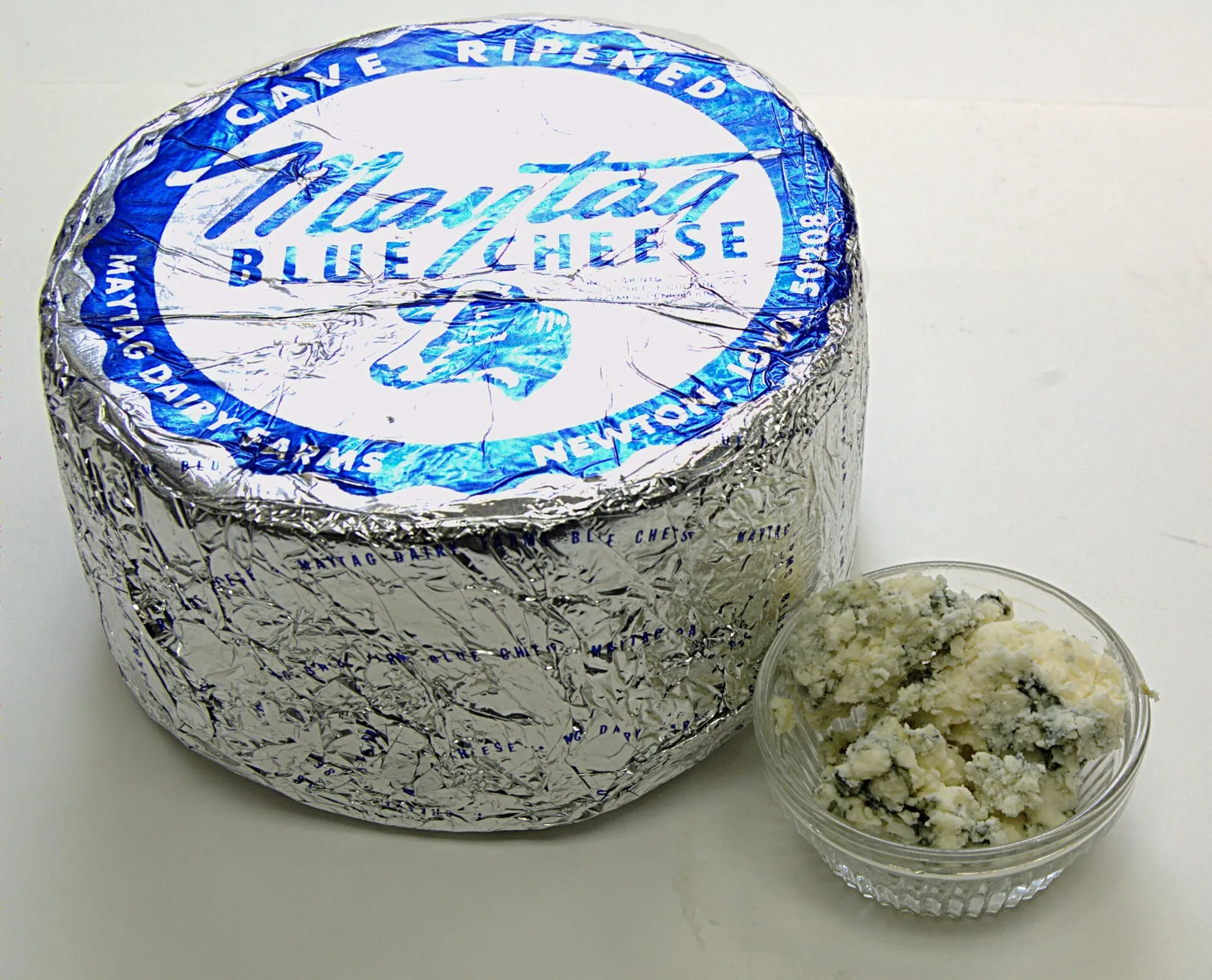
Its first wheels were formed on October 11, 1941, and today it is a firm, moist, salty blue that stands up to steak, salad greens and sweet fruit.
The Maytag name is real: the cheese began as a project of the washing machine family. It is also a very American kind of blue, pressed and aged in caves like a European one, but sold in foil wedges and crumbles you can find at a US grocery counter.
Maytag Blue cheese at a glance
Here is Maytag Blue cheese at a glance, based on the dairy's own history page and the Culture cheese library.
| Detail | Maytag Blue |
|---|---|
| Maker | Maytag Dairy Farms, Newton, Iowa |
| Milk | Cow's milk from Holstein-Friesian herds |
| Style | Pressed, cave-aged blue |
| Age | About 4 to 6 months |
| Texture | Firm, moist and slightly crumbly; ivory paste with sapphire-colored veins |
| Flavor | Rich and creamy, assertively salty, savory finish |
| Wrap | Silver foil, after each wheel is hand-scraped |
| Sold as | Wheels (2 and 4 lb), wedges (4 and 8 oz), crumbles |
Where Maytag Blue cheese comes from
Maytag Blue cheese comes from a family farm, not from the appliance factory. According to the Maytag Dairy Farms story, E.H. Maytag, a son of the appliance founder, bought one Holstein cow in 1919 so his children would have milk. The herd grew, and when he died in 1940 his sons Frederick and Robert took over.
Fred worked with Iowa State University to develop a blue cheese recipe, and the dairy's history says the first wheels were formed on October 11, 1941. By the 1950s the cheese had a national reputation. Fritz Maytag, Fred's son, ran the dairy from 1962 for about 50 years. In 1990 the farm moved to blue cheese only, sold off its herd and began buying milk from local farmers. AgCertain Industries acquired the company in 2022.
How Maytag Blue cheese is made
Maytag Blue cheese is made like a classic pressed blue, following the steps Culture magazine describes. Milk is heated with cultures and vegetable rennet; the curd is cut into cubes and drained, then blue mold powder is mixed in before the curd goes into hoops and is pressed. After the wheels come out of their molds they are brined, then moved into caves dug into a hillside behind the cheesemaking room.
Pressing matters here. A pressed curd is denser than the loose, unpressed curd of a cheese like Stilton, so Maytag Blue is firm and slightly crumbly rather than flaky. During aging the wheels are pierced so air reaches the mold and the veins form, which is the mechanism covered in Blue Cheese 101. Before wrapping, each wheel is hand-scraped to remove surface mold.
What Maytag Blue cheese tastes like
Maytag Blue cheese tastes rich and cream-like, with assertive saltiness and a savory finish. The paste is ivory, firm but moist, and breaks into slightly crumbly pieces; the veins are a deep, bright blue rather than gray-green.
Salt is the thing to plan around. The cheese is not a mild, sweet blue like a dolce-style Gorgonzola, so it needs something sweet, fatty or acidic next to it. A little goes a long way on a plate, and a lot of it goes into a dressing only if you cut back the salt elsewhere.
How to buy Maytag Blue cheese
Buying Maytag Blue cheese is easy to get right because the dairy sells it in a few set formats. The company lists 2 pound and 4 pound wheels, 4 ounce and 8 ounce wedges, and crumbles in 4 ounce cups and 5 pound boxes.
For the table, buy a wedge and crumble it yourself. For dressings and salads, crumbles save time. Look for even blue veining in an ivory paste that looks moist, not dry or chalky at the cut face. At the counter, ask for a piece cut from a wheel if your store has one.
How to use Maytag Blue cheese
Maytag Blue cheese is a good all-purpose blue because its firm body crumbles cleanly and still melts. Use it where its salt and tang have a job to do:
- Wedge salad or blue cheese dressing. Crumble about 1 ounce per salad, or mash it into sour cream or buttermilk for dressing.
- Steak. Melt a spoonful over a hot ribeye for the last minute of resting, or stir it into a warm cream sauce off the heat.
- Burgers. Press a crumbled ounce into the patty or top it in the last minute.
- Cheese board. Serve a wedge at room temperature with honey, pears, apples, figs and walnuts. The cheese board guide covers how much to put out.
For drinks, the port and blue cheese guide explains why sweet fortified wine works; Culture suggests a honey drizzle or a barleywine-style ale. More ideas are in the blue cheese pairing guide.
Maytag Blue cheese substitutes
Maytag Blue cheese substitutes should match its firm, salty character, so reach for another pressed or semi-firm blue. Danablu is a close stand-in for salads and dressings, and a Stilton or a piquant Gorgonzola works for steak and sauces. Roquefort is saltier and sharper, so use a little less. For a creamier result, a younger blue melts more smoothly.
What most Maytag Blue cheese advice gets wrong
Most Maytag Blue cheese advice repeats a few shortcuts that cost you flavor.
Maytag Blue cheese is not the appliance company's cheese
Maytag Blue cheese is made by a separate dairy that grew out of the family's farm. The appliance founder's grandsons Frederick and Robert launched the cheese, so the connection is family, not corporate.
Maytag Blue cheese is not a mild blue
Maytag Blue cheese is often called gentler than European blues, but Culture describes assertive saltiness. Taste before you season a dressing, and pair it with sweetness.
Maytag Blue cheese tastes best crumbled fresh
Maytag Blue cheese dries and loses its creaminess once it is pre-crumbled and left open. Crumble only what you will use, keep the rest in a wedge and let it warm up for about 30 minutes before serving.
The sources opened for this page do not say whether the milk is pasteurized, so check the label or ask the dairy if that matters to you, for example during pregnancy; the pregnancy cheese guide explains the rules.
Questions about Maytag Blue cheese
These are the questions about Maytag Blue cheese that come up most.
Is Maytag Blue cheese made by the Maytag appliance company?
Maytag Blue cheese is made by Maytag Dairy Farms, started by the appliance founder's grandsons, not by the appliance maker. The first wheels were formed on October 11, 1941.
Where is Maytag Blue cheese made?
Maytag Blue cheese is made at Maytag Dairy Farms near Newton, Iowa, and aged in caves dug into a hillside behind the cheesemaking room.
What does Maytag Blue cheese taste like?
Maytag Blue cheese tastes rich and cream-like with assertive saltiness and a savory finish, with a firm, moist, slightly crumbly paste.
How long is Maytag Blue cheese aged?
Maytag Blue cheese is aged about 4 to 6 months, according to Culture, pierced in caves so the blue veins develop.
What is a good substitute for Maytag Blue cheese?
A good substitute for Maytag Blue cheese is Danablu, Stilton or a piquant Gorgonzola, which match its firm, salty body.
How do you store Maytag Blue cheese?
Store Maytag Blue cheese wrapped in foil or parchment in the fridge and use it within a week or two of opening; the storing cheese guide shows more wraps.
Your first Maytag Blue cheese
For your first Maytag Blue cheese, buy a 4 ounce wedge, let it warm up for half an hour and serve it with honey and pears. If you like it, crumble the rest over a wedge salad or a steak.
Sources
- The Maytag History, Maytag Dairy Farms
- Behind the Blue: The History of Maytag Blue Cheese, Maytag Dairy Farms
- Maytag Blue, Culture: The Word on Cheese