
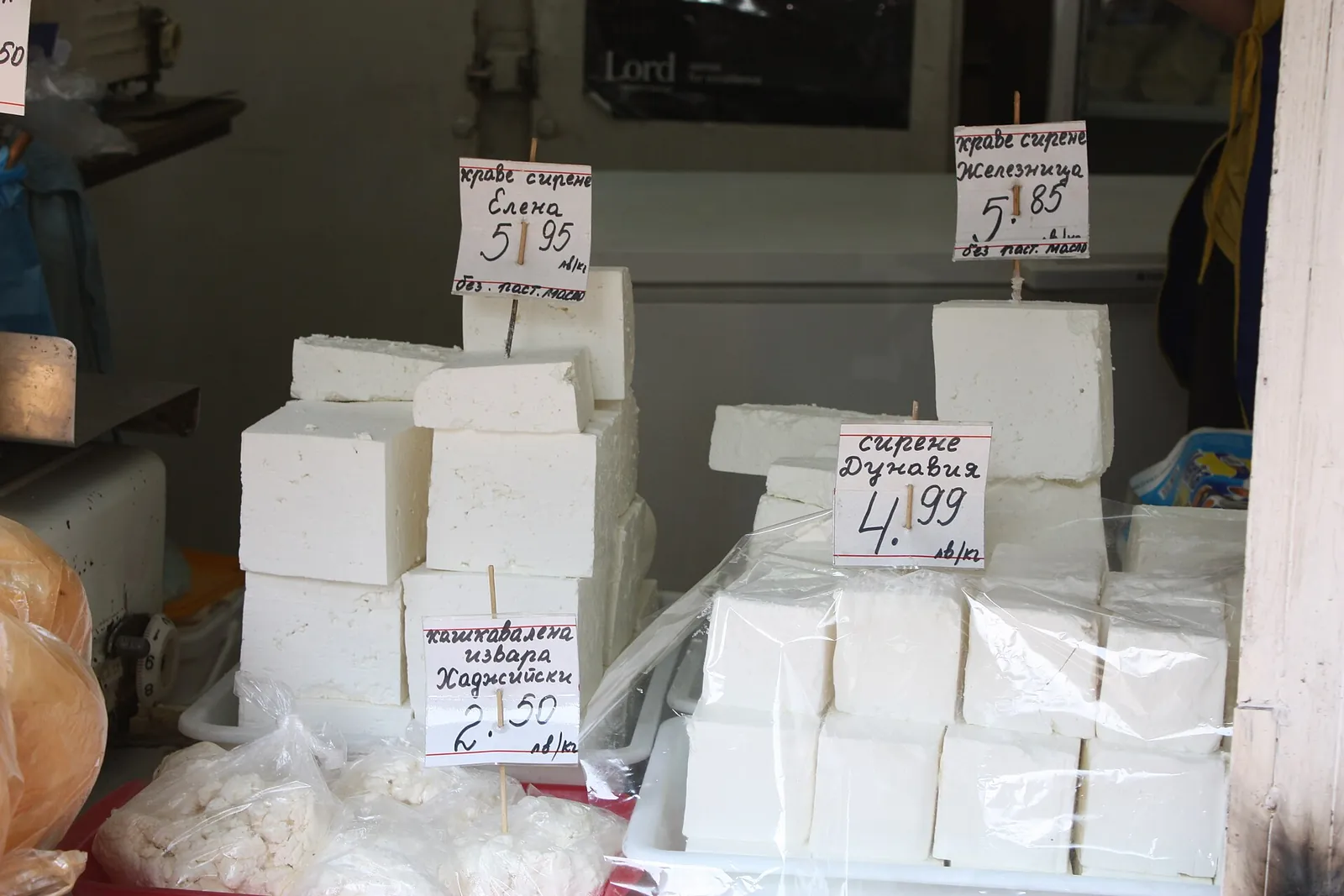
Its full name, byalo salamureno sirene, means white brined cheese, and since 2023 the EU has protected the Bulgarian version as a PDO.
The idea that explains it is the brine. The cheese ripens for weeks in salt water of 6 to 10 percent and ends up about 3.5 percent salt, while the same bacteria that make Bulgarian yogurt sour it to a sharp, clean tang. Greek feta is made much the same way, which is why the two get confused, and why EU law now keeps their names apart.
Bulgarian white cheese at a glance
Here is Bulgarian white cheese at a glance, from the EU rules for the protected version.
| Bulgarian white brined cheese (sirene) | |
|---|---|
| Bulgarian name | Бяло саламурено сирене (byalo salamureno sirene) |
| Milk | Cow's, sheep's, goat's, buffalo's or mixed; pasteurized |
| Starter | Lactococcus lactis and Lactobacillus casei, plus the yogurt bacteria L. bulgaricus and S. thermophilus |
| Ripening in brine | At least 45 days (cow's, goat's) or 60 days (sheep's, buffalo's, mixed) |
| Salt | 3.5% ± 0.5% in the cheese; 6 to 10% in the brine |
| Acidity | pH 4.2 to 4.4 |
| Texture | Moderately firm and pliant; cuts cleanly, porcelain white |
| Flavor | Moderately salty, with a pronounced lactic tang |
| Calories | About 264 (cow's milk) to 287 (sheep's milk) kcal per 100 g |
| Protected name | EU PDO since 2023, covering all of Bulgaria |
What Bulgarian white cheese is
Bulgarian white cheese is the country's everyday cheese: researchers at the Bulgarian Academy of Sciences call white brined cheese the second most widespread traditional dairy product after yogurt, defined by the national standard BDS 15:2010. Bulgarians call it simply sirene, the word for cheese, and set it beside kashkaval, the yellow cheese. The pairing is old: the EU file for the cheese cites records of cheese dairies from 1558 and a 1903 manual titled How to Make Yellow Cheese and White Brined Cheese.
The bacterium behind its tang, Lactobacillus delbrueckii subsp. bulgaricus, was identified in 1905 by Stamen Grigoroff, a medical student at the University of Geneva, and in 1934 the Bulgarian Agricultural Company brought pasteurized milk and pure cultures into production.
How Bulgarian white cheese is made
Bulgarian white cheese is made in nine steps under its EU rules, from pasteurizing the milk to weeks of ripening in brine. The PDO specification requires whole Bulgarian milk and starters produced in Bulgaria. Rennet sets the milk, cheesemakers cut the curd into cubes by hand with multi-blade knives, and the curd is pressed, salted wet or dry, pre-ripened, then sealed in brine to mature. No preservatives, stabilizers or emulsifiers are allowed.
Its flavor builds in the brine: about 130 aroma compounds form there as the cheese matures, and the breakdown of its proteins adds a light bitterness under the tang.
Bulgarian white cheese vs feta
Bulgarian white cheese and feta are made the same basic way, but EU law treats them as two protected cheeses, and only Greek cheese may be called feta there. Their rules differ on place, milk, ripening and brine.
| Bulgarian white brined cheese (PDO) | Feta (PDO) | |
|---|---|---|
| Where | Anywhere in Bulgaria | Mainland Greece (Macedonia, Thrace, Epirus, Thessaly, Central Greece, Peloponnese) and Lesbos; not Crete or the other islands |
| Milk | Cow's, sheep's, goat's, buffalo's or mixed | Sheep's, or sheep's with up to 30% goat's |
| Ripening | At least 45 or 60 days, by milk | At least 2 months |
| Brine | 6 to 10% salt | 7% salt |
| Protected since | 2023 | 2002 |
Feta's own protection took a court fight. The EU first registered the name in 1996, the Court of Justice annulled that in 1999, and the 2002 registration survived a 2005 challenge by Germany and Denmark. In that 2005 judgment, the court accepted that white cheeses soaked in brine have long been made across the Balkans but noted they are known there by other names, and that more than 85 percent of EU feta consumption per head was in Greece. A later ruling found Denmark at fault for letting its dairies call their cheese feta even when shipped outside the EU.
The US is looser. US federal cheese standards do not define feta at all, US shops often sell sirene as "Bulgarian feta," and even Bulgaria's tourism ministry glosses it as white brine (feta) cheese. Side by side with feta, sirene's required yogurt cultures give it the pronounced lactic tang its rules ask for.
Other Balkan white cheeses
Other Balkan white cheeses follow the same brine method under their own names, as the EU court noted, and two from Romania have protected names.
Romanian telemea
Romanian telemea is that country's brined white cheese: the Romanian dictionary DEX defines telemea as cheese of well-pressed curd, cut into usually rectangular pieces and kept in brine, a word borrowed from Turkish.
- Telemea de Ibănești (PDO): cow's milk from the Gurghiu Valley in Mureș County, salted with natural brine from a local salt-water well at 21 to 23 percent salt. It is sold fresh a day after making or mature after at least 20 days, and its specification puts it at 198 kcal per 100 g, lighter than sirene.
- Telemea de Sibiu (PGI): raw sheep's milk only, from Sibiu County, with up to 6 percent salt when fresh and up to 8 percent after at least 21 days of maturing, per its specification.
Serbian white cheese
Serbian white cheese, beli sir, is the country's most popular cheese type and a salty one: University of Belgrade researchers put its white brined cheeses at 55 to 90 grams of salt per liter of the cheese's moisture. Homoljski sir, from the Homolje mountains, is made from cow's, goat's or sheep's milk, ripened at least a month and protected by a Serbian geographical indication. Zlatar cheese is a traditional, semi-hard white cheese made at home from raw cow's milk without added starter.
How to use Bulgarian white cheese
The best way to use Bulgarian white cheese is the way Bulgarians do, starting at breakfast. The tourism ministry calls banitsa, dough with fillings such as cheese, one of the country's most famous breakfasts, and the shopska its most popular salad.
- Salads: grate or crumble it over chopped tomatoes, cucumbers, peppers and onion.
- Pastry: mix crumbled sirene with eggs and plain yogurt and layer it between sheets of phyllo; the guide to cheese phyllo pies covers the technique.
- Baking: it softens and browns in the oven but does not melt into strings; its pH of 4.2 to 4.4 sits where, as the melting cheese guide explains, cheese stops flowing.
- Breakfast: slices with tomatoes, bread and a drizzle of olive oil, or with honey.
Storing white brined cheese
Storing white brined cheese is simple if you keep it in its brine, covered, in the refrigerator. The EU rules call the cheese highly hygroscopic, meaning it soaks up other smells easily, so keep the lid tight. If you have lost the brine, a good starting point is 1 tablespoon of table salt dissolved in 1 cup of water, about 7 percent, inside the range the rules use.
Lift pieces out with a clean fork. Salt does not stop yeasts: a recent survey of Bulgarian white cheeses found yeasts in nearly every sample, and a review of brined cheese spoilage links them to fizzy gas, fruity, soapy or bitter off-flavors, softening and discoloration. A swollen pack or a cheese with those signs goes in the trash.
Protected sirene is made from pasteurized milk, but Telemea de Sibiu and many farmhouse cheeses are not; the CDC advises pregnant people and others at higher risk to avoid raw-milk cheese unless it is heated until steaming hot. More is in cheese during pregnancy.
What most Bulgarian white cheese advice gets wrong
Most Bulgarian white cheese advice files it under "Bulgarian feta" and stops, which misses how the cheese is actually defined.
Sheep's milk is not the whole story. Sheep's milk sirene is richer, since the rules require at least 48 percent fat in its dry matter against 44 for cow's, but the same rules say the starter and brine shape the flavor more than the milk. A well-made cow's milk sirene is the real thing, not a compromise.
Good sirene does not crumble. The rules ask for a porcelain-white, clean cut and pieces that separate easily without crumbling. A tub of dry crumbs is not what they describe.
Salt varies widely from cheese to cheese. Protected sirene carries about 3.5 percent salt, mature Telemea de Sibiu can reach 8, and USDA's feta has 323 mg of sodium per ounce. Taste before you salt a dish, and soak a salty block in cold water or milk for an hour or two before using it.
Questions about Bulgarian white cheese
These questions about Bulgarian white cheese come up most at Balkan and Middle Eastern grocers.
Is Bulgarian white cheese the same as feta?
Bulgarian white cheese is not the same as feta, though both are white cheeses ripened in brine. Feta must be Greek sheep's milk, or sheep's with some goat's, while Bulgarian white cheese may use five milks and must contain yogurt bacteria.
What are the different types of Bulgarian cheese?
The two classic types of Bulgarian cheese are white brined sirene and yellow kashkaval, each defined by its own national standard. Sirene is sold by milk: cow's, sheep's, goat's, buffalo's or mixed.
What is the most famous cheese from Bulgaria?
The most famous cheese from Bulgaria is sirene, its white brined cheese, and it is the only Bulgarian cheese with an EU-protected name.
What does Bulgarian white cheese taste like?
Bulgarian white cheese tastes salty and sharply lactic, with a yogurt-like tang and a light bitterness from ripening. Sheep's milk versions taste richer.
Is Bulgarian white cheese healthy?
Bulgarian white cheese runs about 264 to 287 kcal per 100 g under the national standard, and at 3.5 percent salt it carries roughly 390 mg of sodium per ounce. Count it toward the day's sodium, as with feta.
Buying your first Bulgarian white cheese
For your first Bulgarian white cheese, buy a tub packed in brine with its milk on the label, from a Balkan, Russian or Middle Eastern grocer. Start with a slice at breakfast with tomatoes and bread, then crumble the rest over a salad or bake it into a phyllo pie.
Sources
- Single document: Bulgarsko byalo salamureno sirene, PDO-BG-02656 (OJ C 129, 13.4.2023), Official Journal of the European Union
- Bulgarsko byalo salamureno sirene, PDO-BG-02656, European Commission eAmbrosia register
- Traditional Bulgarian Dairy Products: Ethnic Foods with Health Benefits (Petrova et al., 2021), Microorganisms, via PubMed Central
- Feta, PDO-GR-0427, with summary of the specification, European Commission eAmbrosia register
- Judgment of the Court (Grand Chamber), Germany and Denmark v Commission, Joined Cases C-465/02 and C-466/02 (2005), Court of Justice of the European Union
- Single document: Telemea de Ibănești (OJ C 6, 10.1.2015), Official Journal of the European Union
- Single document: Telemea de Sibiu (OJ C 203, 17.6.2019), Official Journal of the European Union
- Sodium Reduction by Partial and Total Replacement of NaCl with KCl in Serbian White Brined Cheese (2022), Foods, via PubMed Central