
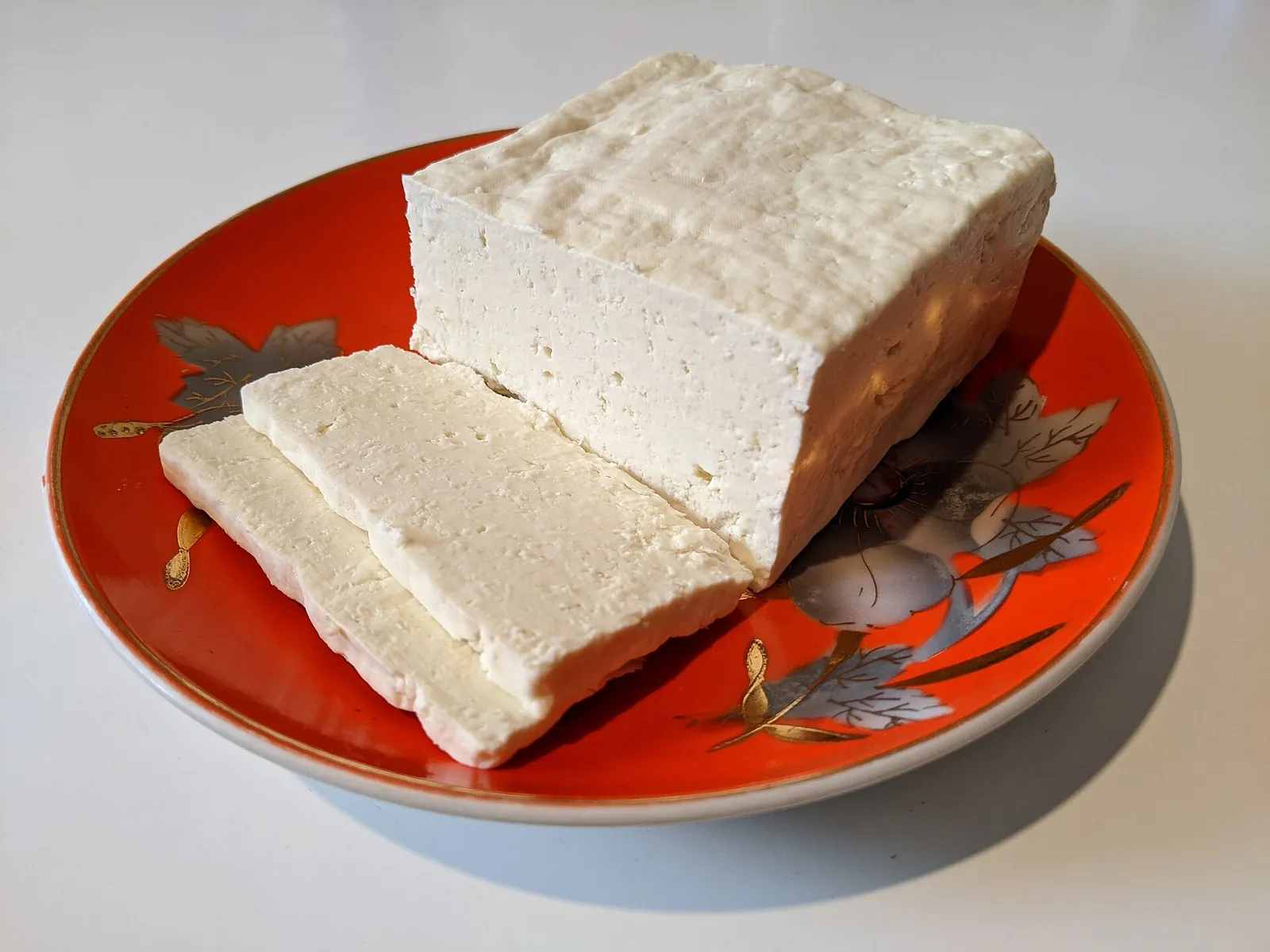
It tastes sharp, salty and a little sour, and you spread it, stir it or crumble it rather than slice it.
The idea that explains it is the grind. Bryndza is not set from milk in one step: a cheese is made and ripened first, then milled into a paste, so the bite of the ripened cheese comes through in a texture you can spread.
Bryndza at a glance
Here is bryndza at a glance, with the Slovak details taken from the EU notice for Slovenská bryndza.
| Detail | Slovenská bryndza |
|---|---|
| Protected name | PGI (Protected Geographical Indication) |
| Made from | Ripened sheep's lump cheese, or sheep's lump cheese mixed with cow's lump cheese |
| Sheep's cheese | More than 50 percent (a minimum of 50 percent of the dry matter) |
| Region | The mountainous parts of Slovakia, over 80 percent of its territory |
| Appearance | White, spreadable, lumpy |
| Flavor | Pleasantly sour, moderately sharp and salty |
| Related protected name | Bryndza Podhalańska, Poland, PDO since June 11, 2007 |
Where bryndza comes from
Bryndza comes from the Carpathians, and two countries have a protected name for their own version. The EU notice for Slovenská bryndza, published in the Official Journal in October 2007, describes a natural white, easily spreadable, lumpy ripened cheese made in the traditional way by grinding ripened sheep's lump cheese, or that cheese mixed with cow's lump cheese. Commission Regulation (EC) No 642/2007 registered "Bryndza Podhalańska" as a protected designation of origin (PDO) on June 11, 2007.
The two are not interchangeable. Slovenská bryndza is a PGI, a looser tie to place; Bryndza Podhalańska is a PDO, the stricter one, and the PDO and PGI guide explains the difference. Similar cheeses go by bryndza or brinza elsewhere in the Carpathians and the Balkans, and the Slovak paper says the Slovak method gives its bryndza a quality distinct from the Romanian and neighboring versions; outside the two protected names, milk and style vary by maker.
A trader named Ján Vagač is credited with the first commercial bryndza, made in 1787, according to a Slovak University of Agriculture paper on bryndza authenticity. His cheese was fattier than the shepherds' own, which made it easier to spread and helped it keep. Later, Teodor Wallo is credited with the saline solution method that made the paste creamier, giving Slovak bryndza a quality distinct from Romanian and neighboring versions.
How bryndza is made
Bryndza is made by milling ripened sheep's cheese into a paste, and the Slovak notice says that cheese gets its character from the natural microflora of raw sheep's milk lump cheese. Those microbes include Lactobacillus, Enterococcus, Lactococcus, Streptococcus and the yeasts Kluyveromyces marxianus and Geotrichum candidum.
The paste was once packed into 5 to 10 kilogram wooden tubs called geleta. Today it is sold in 1 to 5 kilogram tubs for trade and in 0.125 to 1 kilogram packs for shoppers, in foil blocks, wood-covered sticks or plastic-wrapped cylinders, depending on the maker.
The notice names the sheep breeds of the area as Valaška, improved Valaška, Tsigai and East Friesian, grazed from low ground in March and April up to higher pasture in May and through summer. The Slovak paper adds that the quality of bryndza depends on factors such as the milk production period, the quality of the ewe's milk and the starter used.
What bryndza tastes like
Bryndza tastes tangy, salty and savory, with the clean sour note of ripened sheep's cheese and a moderate sharpness that the Slovak notice describes as characteristic of sheep's cheese. The texture is granular and soft, between a spreadable cream cheese and a crumbly feta.
A cow's cheese share softens the flavor and lightens the color, which is why 100 percent sheep versions taste more assertive. Think feta's salt with a sourer, creamier finish and no brine bath.
How to use bryndza
Bryndza is used three main ways: as a sauce, as a spread and as a filling. The classic is bryndzové halušky: small potato dumplings tossed with bryndza and topped with fried bacon or its rendered fat. The same paper lists bryndzové pagáčiky (scones), pirohy stuffed with bryndza and many other dishes.
For halušky, boil the dumplings, drain them, keep a few spoonfuls of the cooking water, then stir the bryndza in off the heat, loosening it with the water until it coats them. Boiling bryndza itself makes it grainy. As a spread, mash it with butter and a little minced onion for bread, radishes or boiled potatoes, and use it in pierogi and other cheese dumplings as the filling. Beer is the natural drink. The pairing guide lists more matches.
How to buy bryndza in the US
Buying bryndza in the US means a Polish, Slovak or other Eastern European deli, where it usually comes in a plastic tub or foil-wrapped block. Read the label for the milk: some tubs are all sheep, others mixed with cow's milk, and Slovenská bryndza with the PGI emblem is the one that guarantees more than 50 percent sheep's cheese. Imported tubs are not always easy to find, and a shop that sells Eastern European cheeses is the best place to ask.
Traditional bryndza starts from raw sheep's milk cheese. If you are pregnant, choose a pasteurized product or heat it until steaming hot, which the CDC advises for soft cheeses made with raw milk, and see the pregnancy cheese guide.
What most bryndza advice gets wrong
Most bryndza advice trips over three points.
Bryndza is not feta
Bryndza is not feta, although both are salty sheep cheeses. Feta is cured in brine as a block; bryndza is ripened, milled and packed as a paste. Mashing feta gets you close but not identical.
Bryndza labels differ
Bryndza labels differ in meaning: only Slovenská bryndza and Bryndza Podhalańska are protected names, and a tub marked simply bryndza may use any proportion of milks. The authors of the Slovak study note that products like this are open to substitution by cheaper milk for economic gain, which is another reason to read the milk line.
Heat changes bryndza
Heat changes bryndza more than most cheeses: it does not melt cleanly, so a long simmer turns it grainy and sour. Add it at the end, off the heat.
Bryndza substitutes
Bryndza substitutes start with feta, mashed with a little sour cream, plain yogurt or cream cheese to reach a spreadable paste. Feta alone gives the salt; the dairy gives the creaminess. Fresh goat cheese adds tang, and oscypek is a smoked Polish sheep cheese, but it is firm rather than spreadable and not a swap. The substitute finder has more.
Questions about bryndza
These are the questions about bryndza that come up most.
What is bryndza?
Bryndza is a soft, tangy, spreadable cheese made by milling ripened sheep's cheese, sometimes mixed with cow's cheese, from Slovakia and the wider Carpathian region.
What is bryndzové halušky?
Bryndzové halušky is the Slovak dish of small potato dumplings coated in bryndza and topped with fried bacon. The Slovak authenticity study calls it a national dish.
Is bryndza the same as feta?
Bryndza is not the same as feta, although both are salty sheep cheeses: bryndza is a ripened cheese milled into a paste, while feta is a brined block.
Is bryndza made from sheep's milk?
Bryndza is made from sheep's milk cheese, and Slovenská bryndza must contain more than 50 percent sheep's cheese, with cow's cheese allowed for the rest.
What is a good bryndza substitute?
A good bryndza substitute is mashed feta mixed with sour cream or yogurt; a starting point is 4 parts feta to 1 part sour cream.
Your first bryndza
For your first bryndza, buy one tub of Slovenská bryndza or another sheep-based product at a Polish or Slovak deli, boil potato dumplings and stir the bryndza through them with a spoonful of the cooking water, and top with crisp bacon.
Sources
- Summary of the product specification, "Slovenská bryndza", PGI, Official Journal of the European Union C 232, October 4, 2007
- Commission Regulation (EC) No 642/2007 of 11 June 2007 registering "Bryndza Podhalańska", European Commission
- Authenticity analysis of 100% sheep's bryndza from selected establishments in the Slovak Republic, Čapla et al., Slovak University of Agriculture in Nitra
- Listeria prevention, Centers for Disease Control and Prevention