
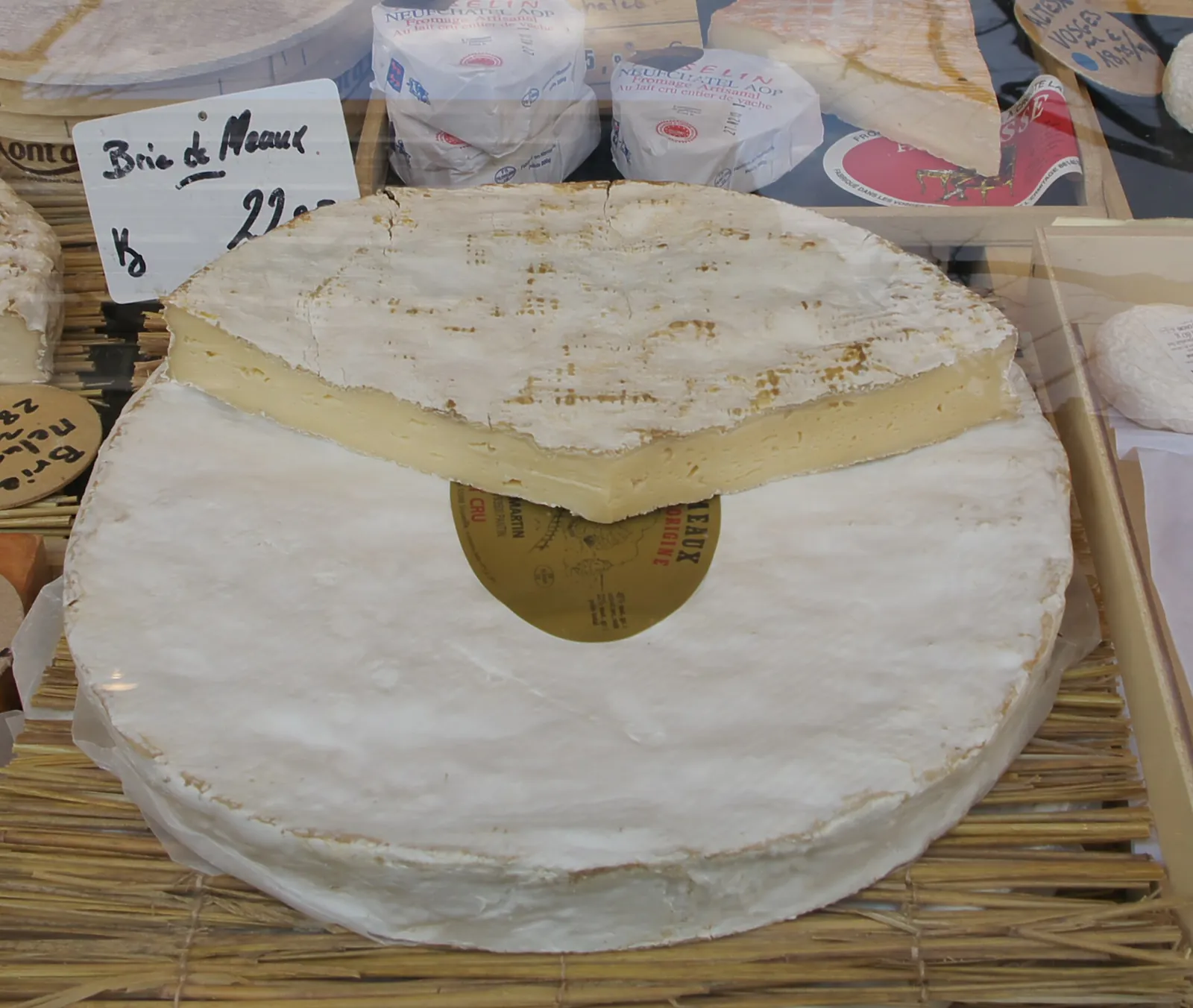
Young, it is firm and chalky at the center and tastes of fresh milk; ripe, it is supple throughout, with the cream, butter and hazelnut aromas France's rules for Brie de Meaux describe.
The rind does the work: a white mold ripens the cheese from the outside in, so the same wheel changes week by week. Plain "brie" can be made anywhere, but Brie de Meaux and Brie de Melun are protected raw-milk cheeses that US rules make hard to find.
Brie at a glance
This brie at a glance table compares the everyday cheese with the two protected French originals.
| Everyday brie | Brie de Meaux | Brie de Melun | |
|---|---|---|---|
| Milk | Cow's milk, usually pasteurized | Raw cow's milk only | Raw cow's milk only |
| Where it's made | Anywhere | Seine-et-Marne and listed towns in nearby departments, east to the Meuse | Seine-et-Marne and listed towns in Aube and Yonne |
| Rind | White, downy, edible | Thin white rind with red streaks or spots | Thin white felt with red or brown streaks |
| Size | Small rounds, or wedges cut from bigger wheels | About 14 in (36 to 37 cm) across, 5.7 to 7.3 lb (2.6 to 3.3 kg) | About 11 in (27 to 28 cm) across, 3.3 to 4.9 lb (1.5 to 2.2 kg) |
| Minimum ripening | None for pasteurized brie | 4 weeks | 5 weeks |
| Ripe to the core | Varies by recipe | 6 to 8 weeks | 8 to 10 weeks |
| Flavor | Mild, milky, buttery | Cream, butter, hazelnut | Milky, yeasty, tangy, a hint of bitterness |
| Protected name | No | AOC 1980, EU PDO 1996 | AOC 1980, EU PDO 1996 |
Brie origin: the Brie region of France
Brie takes its name from the Brie region of France, a plateau of grain farms between the Marne and Seine valleys that begins at the edge of Paris. According to the Brie de Meaux specification, dairy cows there ate the straw, bran and beet by-products of the harvest, and Paris next door bought the cheese. The two protected Bries are named for the region's towns of Meaux and Melun.
The same document dates the name "Brie de Meaux" to 1379 and tells the cheese's favorite story: at the Congress of Vienna in 1815, a contest of 60 cheeses crowned a Brie de Meaux from the Villeroy farm "king of cheeses." See France for the country's other cheeses.
Brie de Meaux and Brie de Melun, the protected originals
Brie de Meaux and Brie de Melun are the only two bries with protected names. Both won France's appellation d'origine in August 1980 and became EU protected designations of origin on June 21, 1996, according to the EU's eAmbrosia register. Both require raw cow's milk from a mapped area and dry salt only, and neither may be cut before its minimum ripening ends. The PDO and PGI guide explains what those labels promise.
Brie de Meaux rules
Brie de Meaux rules start with size: molds 36 to 37 cm (about 14 inches) across and wheels of 5.7 to 7.3 pounds. The milk is set with rennet at no more than 98.6°F (37°C) in under two hours, and the curd is ladled by hand in thin layers with a pelle à brie, a perforated scoop about a foot wide. At the four-week minimum the wheel is only a quarter ripe, milky and a touch bitter; it softens from the rind inward and is ripe to the core at six to eight weeks.
Brie de Melun rules
Brie de Melun rules describe a smaller, tangier cheese. Its specification calls for molds of 27 to 28 cm (about 11 inches) and wheels of 3.3 to 4.9 pounds. The milk takes at least 16 hours to set, a slow, acid-driven curdle that leaves a fragile curd, hence the smaller molds. At the five-week minimum the paste is white and crumbly, with a milky, then yeasty, faintly sour taste. At eight to ten weeks it is ripe to the core and supple, with a hint of bitterness.
How brie is made
Brie is made by setting warm milk with lactic cultures and rennet, ladling the soft curd into wide, shallow molds and letting it drain on its own. The young cheeses are salted, seeded with the white mold Penicillium candidum, which researchers call Penicillium camemberti, and ripened in a cool, humid room. Georges Roger first isolated it from a brie in 1897, the Brie de Meaux specification notes.
As the mold spreads into a downy coat, the surface loses its acidity first. In a Journal of Dairy Science study of Camembert-type cheeses, the rind reached a neutral pH within 10 days, while the center took 35 to 50 days to catch up. That gradient is the creamy band around a chalky core in a half-ripe wheel.
Brie in the US: pasteurized, and sometimes stabilized
Brie in the US is almost always pasteurized, because of a federal curing rule. Under the FDA standard for soft ripened cheeses, one made from unpasteurized milk must be cured at 35°F or warmer for at least 60 days. Both French originals are fully ripe at six to ten weeks, so a wheel that waits out 60 days arrives at the end of its best days, or after them.
Pasteurized brie is the norm anyway: Britannica notes that most brie today is factory-made from pasteurized milk, which keeps longer but tastes weaker. A "French brie" in an American shop is almost always one of these, not an AOP original.
Stabilized vs traditional brie
Stabilized brie is the reason some wheels never turn runny. Cheesemakers can adjust the acidity and the curd handling to make a "stabilized curd" cheese that holds its shape and keeps longer. When Oregon State University food scientists made five styles of Camembert-type cheese, the stabilized one oozed just 4 mm (about 1/6 inch) from the cut after 50 days, against 27 mm (about 1 inch) for a lactic-curd cheese, and had the longest estimated shelf life. A brie that stays firm and mild right up to its date is probably stabilized, and more time will not make it flow.
How to pick a ripe brie
To pick a ripe brie, press gently near the center through the wrapper: it should give evenly, like a ripe avocado, while a firm middle means a chalky core. The rind should be white and dry, though red or brown streaks are normal on traditional wheels; skip any that are sticky, deep brown or cracked. A hint of mushroom is right, and a sharp ammonia smell means it is past its peak. How to choose a ripe brie has the full checklist.
How to serve brie
To serve brie at its best, take it out of the refrigerator 30 to 60 minutes ahead and keep it wrapped while it warms; cold brie tastes flat. Pair it with something that cuts the richness: sparkling wine, dry cider, Chardonnay or Pinot Noir, plus apples, pears, walnuts, honey or fig jam.
The brie rind
The brie rind is edible and meant to be eaten: it is the mold coat that ripened the cheese, and it adds a faintly earthy bite. Trim it only if it has turned hard or harsh. Other cheeses are covered in which rinds you can eat.
Baked brie
Baked brie is the easiest party dish in the cheese case. For an 8-ounce round, a good starting point is 350°F (175°C) for 10 to 15 minutes, until the sides bulge and the center feels loose. Keep the rind on to hold it together, and top it with honey and walnuts, fig jam or cranberry sauce, or try one of these ten baked brie ideas.
How to store brie
Store brie in the refrigerator, wrapped in cheese paper or parchment and then loosely in a zip-top bag, and plan to finish a cut piece within about a week. A joint FDA and Health Canada risk assessment found that for pasteurized soft-ripened cheese, the main driver of Listeria risk was bacterial growth while the cheese sat in home refrigerators, since Listeria can grow in the cold.
Brie vs Camembert, and other substitutes
Camembert, Normandy's white-rind cheese, is the closest substitute for brie, and the two swap freely on a board or in the oven; the full brie vs Camembert comparison covers how they differ. For something richer, try a triple-crème such as Brillat-Savarin. Blue cheese fans can try Cambozola, a creamy brie-style cheese with blue veins.
Brie and pregnancy
Brie during pregnancy comes down to the milk. FDA and CDC count pregnant people among those most vulnerable to Listeria, and the CDC advises higher-risk people to avoid any cheese made from raw milk, Brie de Meaux and Brie de Melun included, unless it is heated to 165°F (74°C) or until steaming hot. Pasteurized brie is far lower risk, though not zero: the FDA and Health Canada assessment estimated that for pregnant people in the US, a serving of raw-milk soft-ripened cheese carries about 96 times the listeriosis risk of a pasteurized one. Ask your doctor or midwife, and see cheese during pregnancy for other cheeses.
Brie mistakes that cost you flavor
The most common brie mistake is treating every wheel the same, when the label, the knife and the fridge decide what you get.
Cutting off the nose. Lopping the tip off a wedge leaves the next person a strip of rind. Cut along the length instead; the Brie de Meaux rules allow only halves or wedges cut from the center to the rind.
Skipping the fine print. "Soft-ripened cheese" on a US label is a legal category: the FDA standard requires at least 50 percent milkfat in the solids, and a brie made with goat's or sheep's milk must say "made from" that milk.
Mistaking ammonia for extra ripeness. Britannica notes that brie far along in ripening smells of ammonia, then dries out and hardens. A faint whiff that fades as the cheese airs is fine; a sting with a brown, shrinking rind is not.
Questions about brie
These are the questions about brie that come up most at the cheese counter.
What is brie cheese made of?
Brie cheese is made of cow's milk, lactic cultures, rennet, salt and a white surface mold, Penicillium candidum.
Where is brie from?
Brie is from the Brie region of France, between the Marne and Seine valleys east of Paris.
Is brie cheese French?
Brie cheese is French by origin, but only the two protected versions must come from France. The name itself is generic, so brie is also made in the US and many other countries.
What type of cheese is brie?
Brie is a soft-ripened type of cheese, also called bloomy-rind, because its white mold rind ripens it from the surface inward.
What does brie taste like?
Brie tastes mild, milky and slightly salty when young, then buttery and nutty, with a faint mushroom note, as it ripens. Brie de Melun is tangier and a little yeasty.
Which soft cheeses have a white rind?
Soft cheeses with a white rind include brie, Camembert and triple-crèmes such as Brillat-Savarin. All of them ripen under a coat of white mold.
Buying your first brie
For your first brie, buy a small pasteurized round or a counter wedge that gives slightly when pressed, let it warm for 45 minutes, and serve it with a baguette and pears. Then ask a good cheese shop for its ripest traditional French brie and taste the two side by side.
Sources
- Cahier des charges de l'appellation d'origine Brie de Meaux, INAO (Institut national de l'origine et de la qualité)
- Cahier des charges de l'appellation d'origine protégée Brie de Melun, INAO (Institut national de l'origine et de la qualité)
- Brie de Meaux, PDO-FR-9110, European Commission eAmbrosia register
- 21 CFR 133.182, Soft ripened cheeses, Electronic Code of Federal Regulations
- Brie, Encyclopaedia Britannica
- Influence of cheese-making recipes on the composition and characteristics of Camembert-type cheese (Batty, Waite-Cusic and Meunier-Goddik, 2019), Journal of Dairy Science via PubMed
- Quantitative Assessment of the Risk of Listeriosis from Soft-Ripened Cheese Consumption in the United States and Canada: Interpretive Summary (2015), FDA and Health Canada
- Preventing Listeria Infection, Centers for Disease Control and Prevention