
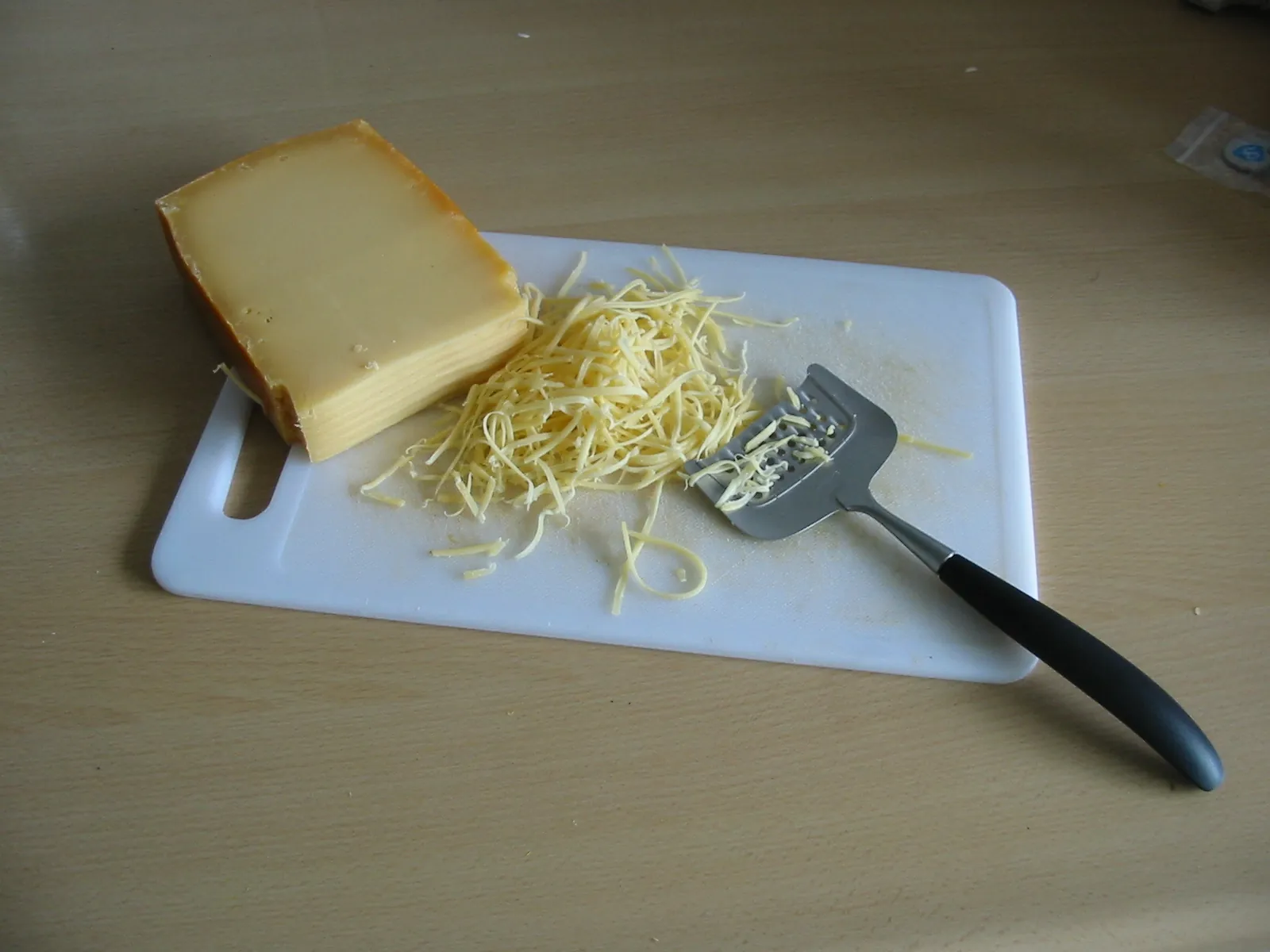
You pay for the shredding, and you get a dryer, more convenient product that behaves a little differently in a sauce.
For toppings and bakes the difference is small. For a smooth cheese sauce or fondue it is worth the two minutes at a box grater. The rest of this page is the specifics: what is in the bag, what the research shows about melt, and when each is the right buy.
Block vs pre-shredded cheese at a glance
This block vs pre-shredded cheese table compares the two on the points a shopper meets in the aisle.
| Block, grated at home | Pre-shredded bag | |
|---|---|---|
| Ingredients | Cheese, and sometimes a surface mold inhibitor on retail blocks | Cheese plus an anti-caking agent, often a mold inhibitor |
| Common anti-caking agents | None needed | Potato starch, powdered cellulose, corn starch, calcium sulfate |
| Melt in a sauce | Smoother in most cooks' experience | Can feel less smooth |
| Melt on pizza or casserole | Excellent | Perfectly good |
| Convenience | Two minutes at the grater | Open and pour |
| Cost | Check the unit price | Check the unit price |
| Customizing | Pick your own blend and age | Fixed blends |
What is in pre-shredded cheese
The anti-caking agents in pre-shredded cheese are fine powders that stop shreds from fusing in the bag. The University of Wisconsin's Center for Dairy Research, in a presentation on anticaking agents, says these agents prevent matting and fusion and are widely used in shredded cheese stored at refrigeration. Its 2021 count of 21 retail brands of shredded low-moisture part-skim mozzarella found potato starch on 16 labels, powdered cellulose on 11, corn starch on 10, calcium sulfate on 5, tapioca starch on 2 and dextrose on 1, counting both sole agents and blends.
The powders work by different mechanisms. The researchers propose that they compete for water on the shred surface, stop water from bridging between shreds, or act as a physical barrier. In their lab test powdered cellulose absorbed the most water, about 4.9 grams per gram, against 2.2 for potato starch and 2.0 for corn starch. They applied the agents at 2 percent of the cheese's weight in the experiment.
Federal rules allow this: the best melting cheeses guide notes that shreds can carry anti-caking agents and mold inhibitors. Read the ingredient line to see which one is in your bag.
Natamycin on shredded cheese
Natamycin is a mold inhibitor, and you may see it on a bag of shreds or on a retail block. FDA's 21 CFR 172.155 describes natamycin, also called pimaricin, as an antimycotic and allows it to be applied to cheese in amounts up to 20 milligrams per kilogram (20 parts per million) of the finished product. It is a surface treatment that slows mold, which is why it appears on cheese that will sit on a shelf for weeks.
Natamycin is not an anti-caking agent and does not stop clumping; it is a separate line on the label. If you want a bag without it, check the ingredients, and if you want to avoid all additives, grate a block. Federal law governs the amount allowed, but whether to buy it is your call.
Melt: does pre-shredded cheese melt worse
Pre-shredded cheese melts worse in a sauce for most cooks, though the research is more nuanced than the folk wisdom. The Center for Dairy Research tested mozzarella shreds with powdered cellulose, potato starch or corn starch against shreds with none. In its texture test, which heated the shreds and measured how far they stretched, the fresh samples did not differ significantly between the control and any of the three agents, and the differences after three months at refrigerator temperature were also small.
That test measured stretch, not how smooth a sauce turns out, so it does not settle the cheese sauce question. The practical explanation is moisture and structure: a dry shred and a fine powder dispersing into a hot sauce can leave it a little grainy, while a fresh grate melts in cleanly. For what actually happens when cheese melts, see how to shred cheese for best melt.
For pizza and casseroles, the cheese bakes in dry heat for a long time and the powder disappears into the browning, so a bag works. The best cheeses for pizza guide makes the same point about block mozzarella: it is the better choice, but a good bag is not a mistake.
Cost and shelf life of block vs pre-shredded cheese
The cost of block vs pre-shredded cheese is easy to check and worth checking, because the shelf tags do the math for you. Compare the unit price per ounce or per pound, not the package price, and shop the sales. Shredded bags often cost more per pound, since the price includes the work of shredding and packaging, but store brands and promotions can reverse that.
Shelf life favors the block once opened. The anti-caking agent exists because shreds mat in the bag, and the Wisconsin researchers found moisture and storage temperature shape that. A block keeps its moisture inside; shreds have far more surface area to dry out. Wrap blocks tightly, and press the air out of bags and reseal them. For longer storage, see freezing cheese.
The USDA's generic entries show that a shredded version is not a different food. A low-moisture part-skim mozzarella entry shows 5.6 grams of fat and 6.7 grams of protein per ounce; the shredded entry shows the same, with a bit more sodium (193.3 against 188.8 milligrams) and slightly less water (44.81 against 47.07 grams per 100 grams). The USDA figures for block mozzarella and shredded mozzarella are listed separately.
What most block vs pre-shredded advice gets wrong
Most block vs pre-shredded advice gets four things wrong: that bagged cheese is not real cheese, that the powder is dangerous, that bagged cheese never melts, and that grating at home always wins.
It is real cheese. The cheese in the bag is the same cheese as the block. The additive is a small fraction of the weight; the Wisconsin study dusted agents on at 2 percent.
The powder is not a warning label. The additives in shreds are ordinary food ingredients that exist to stop clumping, and the natamycin amount is capped by FDA. If you prefer to avoid them, that is a taste decision.
Bagged cheese does melt. It melts well enough that pizza chains and school cafeterias use it. What suffers is the smoothness of a sauce, not the existence of melt.
Grating wins only if you grate in time. Grated cheese loses moisture quickly. Grate right before use, or grate ahead and freeze it, rather than leaving a bowl on the counter.
Which to buy: block or pre-shredded cheese
Which to buy, block or pre-shredded cheese, depends on what the cheese does in the dish:
- Cheese sauce, fondue, stovetop mac and cheese: block, grated just before it goes in. See the mac and cheese guide.
- Pizza, nachos, casseroles, tacos: a bag is fine, and low-moisture mozzarella shreds are a common choice.
- Grilled cheese: slices or a block; shreds spill off the bread.
- Big batches and meal prep: pre-shredded, or shred a block in a food processor and freeze it flat.
- Avoiding additives: block, and read the ingredient line either way.
Questions about block vs pre-shredded cheese
These are quick answers to common questions about block vs pre-shredded cheese.
What is the difference between block and pre-shredded cheese?
The difference between block and pre-shredded cheese is the anti-caking agent: pre-shredded cheese is tossed with a powder such as potato starch, powdered cellulose or corn starch so the shreds do not clump, while block cheese has none.
What is in pre-shredded cheese?
Pre-shredded cheese is cheese plus an anti-caking agent, and sometimes natamycin as a mold inhibitor. A Wisconsin count of 21 mozzarella brands found potato starch on 16 labels and powdered cellulose on 11.
Does pre-shredded cheese melt?
Pre-shredded cheese melts and works well on pizza and in casseroles. It can leave a cheese sauce slightly less smooth, so grate a block for sauces.
What is natamycin on cheese?
Natamycin on cheese is a mold inhibitor that FDA allows on cheese at up to 20 milligrams per kilogram of the finished product, and it is not an anti-caking agent.
Is pre-shredded cheese cheaper than block?
Pre-shredded cheese is often more expensive per pound, but sales vary, so compare the unit price on the shelf tag.
Choosing between block and pre-shredded cheese
Choosing between block and pre-shredded cheese is simple: grate a block for sauces and fondue, and use a bag where the cheese will bake, as on pizza and tacos. Next time you shop, compare unit prices and read the ingredient line on your favorite bag. If melt is your main concern, start with the melting guide above and the pre-shredded melt explainer.
Sources
- Impact of Anticaking Agents for Shredded Cheese Performance (presentation), Center for Dairy Research, University of Wisconsin-Madison
- 21 CFR 172.155, Natamycin (pimaricin), Electronic Code of Federal Regulations
- USDA FoodData Central (SR Legacy): Cheese, mozzarella, low moisture, part-skim (171244) and shredded (170900)