
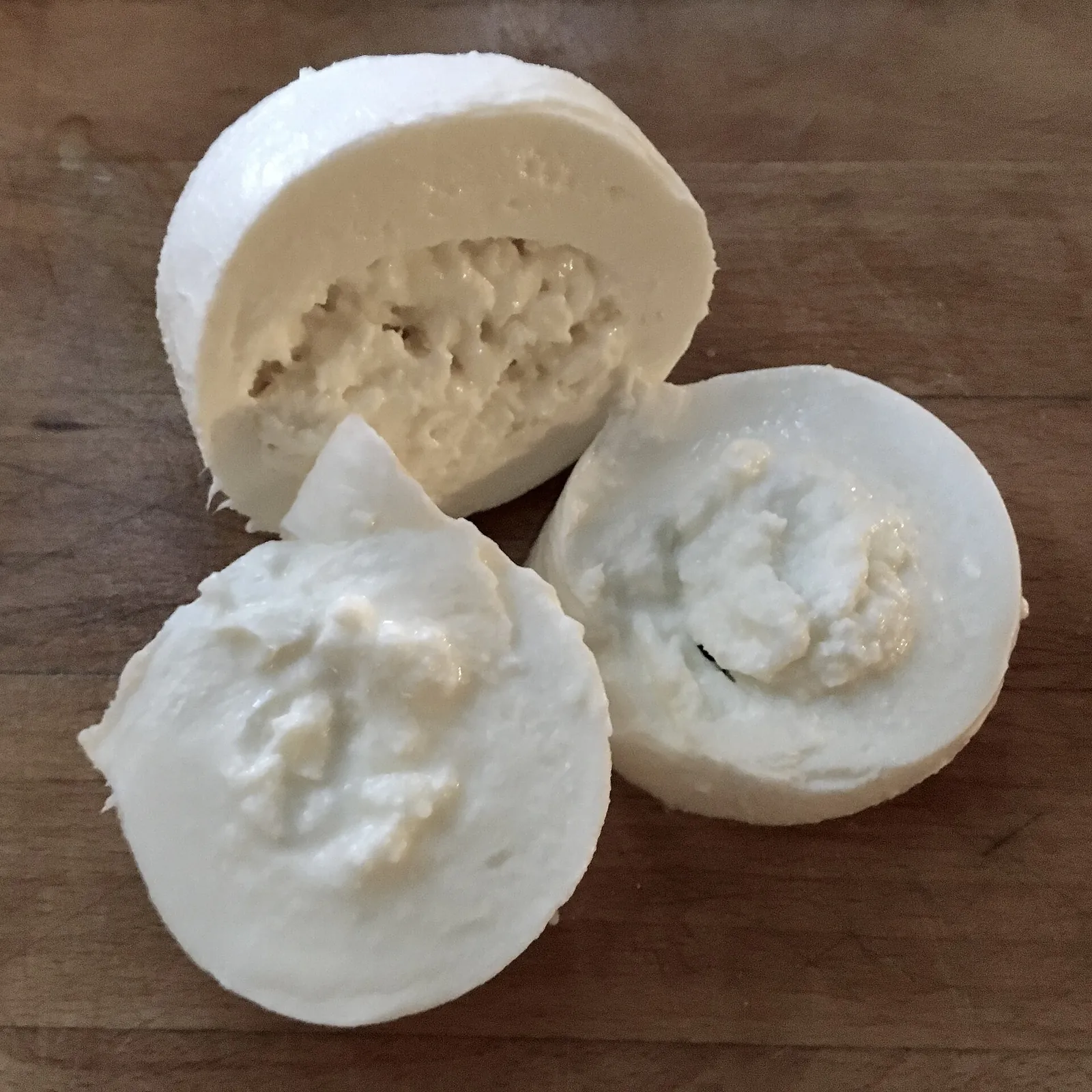
Only on the outside. Burrata's shell is the same stretched curd as fresh mozzarella, but it is shaped into a pouch and filled with stracciatella, a tangle of hand-torn curd soaked in cream. Mozzarella is that curd and nothing else, solid all the way through.
The cream changes everything else. It makes burrata softer and wetter, shortens its life, and turns it into a cheese for eating raw, while mozzarella, especially the low-moisture kind, is the one that goes in the oven.
Burrata vs mozzarella at a glance
This burrata vs mozzarella table sets a typical burrata beside fresh mozzarella, using EU rules, US standards and lab data.
| Burrata | Fresh mozzarella | |
|---|---|---|
| Construction | Pouch of stretched curd filled with stracciatella (curd shreds in cream) | Solid ball, braid or log of stretched curd |
| Milk | Cow's milk for Burrata di Andria PGI | Cow's milk (fior di latte) or water buffalo milk |
| Texture | Springy shell, loose and creamy inside | Springy and layered all the way through |
| Moisture | 50 to 70% (PGI rule); 70% average in lab tests | More than 52 and up to 60% (US standard) |
| Fat per 100 g | About 18 g (PGI lab tests) | 19.5 g (Italian, CREA); 22.1 g (US whole milk, USDA) |
| Protein per 100 g | About 10 g | 18.7 g (Italian); 22.2 g (US whole milk) |
| Shelf life | 3 to 5 days handmade, up to about 20 machine-made | Days; sold with a use-by date |
| Best uses | Raw, or torn over hot food after cooking | Salads, sandwiches, pizza, baking |
| Protected names | Burrata di Andria PGI | Mozzarella di Bufala Campana PDO, Mozzarella Tradizionale TSG |
Is burrata a type of mozzarella?
Burrata is less a type of mozzarella than mozzarella rebuilt: its shell is mozzarella curd, and its filling is more of that curd plus cream. The EU rules for Burrata di Andria, the protected version from Puglia, define it as a cow's milk cheese made by adding cream to stretched curd, with an outer layer made entirely of pasta filata (stretched curd) around a filling of cream and hand-shredded curd.
Factories make the link even plainer. In a 2023 University of Bari trial, curd was stretched in hot water into a mozzarella ball, which a machine then blew up into a pouch and filled with fresh mozzarella strands mixed half and half with UHT cream. Mozzarella itself is the curd alone: the US standard of identity describes curd kneaded and stretched in hot water until smooth, molded, then firmed in cold water, with more than 52 and no more than 60 percent moisture.
What's inside burrata
What's inside burrata is stracciatella: stretched curd torn by hand into strips and soaked in cream. The protected recipe says the shreds must be torn solely by hand and come in various lengths and widths, and that cream spills out when the cheese is cut. The cream can be skimmed from fresh milk or whey, or be fresh or UHT cream. Sold on its own in a tub, the filling is stracciatella, and the full burrata guide covers how burrata is made, bought and served.
Burrata vs mozzarella texture
The texture gap between burrata and mozzarella is widest at the center. Fresh mozzarella has a layered, fibrous body all the way through: the EU rules for Mozzarella Tradizionale describe matted fibers, a soft and slightly springy consistency, and a milky liquid that leaks when the cheese is cut or squeezed. Burrata has that texture only in its shell, which is about 2 mm thick; inside is a spongy, cream-soaked mass that slumps when the pouch is opened.
Flavor follows texture. Both taste of fresh milk, but mozzarella reads fresh and very slightly sour, while burrata carries the butter and cream aromas its rules list. Cold mutes both, so give either one 30 minutes out of the refrigerator before serving.
Burrata vs mozzarella fat and protein
Burrata and mozzarella carry similar fat by weight, and the real difference is protein. In lab tests of 21 Burrata di Andria cheeses, Italian researchers measured about 70 percent water, 17.9 grams of fat and 10.3 grams of protein per 100 grams. Italy's CREA food composition tables list cow's milk mozzarella at 58.8 percent water, 19.5 grams of fat and 18.7 grams of protein, and USDA data puts US whole-milk mozzarella at 50 percent water, 22.1 grams of fat and 22.2 grams of protein.
Per ounce, the gap looks like this.
| Per ounce (28 g) | Water | Fat | Protein |
|---|---|---|---|
| Burrata di Andria PGI (lab average) | 70% | 5.1 g | 2.9 g |
| Italian cow's milk mozzarella (CREA) | 59% | 5.5 g | 5.3 g |
| US whole-milk mozzarella (USDA) | 50% | 6.3 g | 6.3 g |
Burrata still tastes richer, because cream, not protein, dominates its solids. Fat makes up about 60 percent of burrata's dry matter by those figures, against about 47 percent for the Italian mozzarella and 44 percent for the US one. If protein is your goal, mozzarella gives you roughly twice as much per ounce; if you are watching fat, the two are closer than their reputations.
Burrata vs mozzarella shelf life
Shelf life is where burrata and mozzarella part ways. The researchers who studied Burrata di Andria put handmade burrata's shelf life at 3 to 5 days and machine-formed burrata's at up to 20, and advised eating it within 24 hours of production.
Fresh mozzarella is also counted in days. The Mozzarella Tradizionale rules call for storage at 32 to 39°F (0 to 4°C) and a use-by day and month on every pack, and the Mozzarella di Bufala Campana consortium says its cheese is best eaten the day you buy it. Low-moisture mozzarella is the keeper of the family: at more than 45 and no more than 52 percent water under its own US standard, it is drier and firmer and lasts far longer than either fresh cheese. The guide to fresh, low-moisture and buffalo mozzarella covers the whole family.
Once you open them, finish a burrata the same day, and keep fresh mozzarella in its liquid and use it within a day or two.
When to use burrata and when to use mozzarella
Use burrata when the cheese is the dish and mozzarella when the cheese is an ingredient.
- Caprese and tomato salads: either. Sliced mozzarella gives neat layers; burrata turns the plate into something to scoop up with bread.
- Pizza: mozzarella in the oven, low-moisture for a home oven and fresh for a very hot one, as the pizza cheese guide explains. Burrata goes on after baking.
- Baked pasta and lasagna: low-moisture mozzarella, which melts and stretches without flooding the dish; the best melting cheeses ranks it for that job. Burrata only as a topping once the pan leaves the oven.
- Sandwiches: fresh mozzarella for cold sandwiches, low-moisture for pressed panini, burrata on toast.
- A starter for guests: burrata, cut open at the table.
Can you substitute burrata for mozzarella?
You can substitute burrata for mozzarella, ounce for ounce, in anything served raw or finished after cooking, but not in anything baked. For a caprese, an 8-ounce burrata replaces an 8-ounce ball of mozzarella. Going the other way, fresh mozzarella torn into pieces and dressed with a spoonful of cream or stracciatella is a fair stand-in for burrata.
What most burrata vs mozzarella advice gets wrong
Most burrata vs mozzarella advice gets the fat wrong, and that is only the first mistake.
"Burrata is just fattier mozzarella." By weight it is not: the lab-tested burrata had less fat per 100 grams than Italian or US mozzarella. It has less protein and more water, with its fat concentrated in the cream.
"Burrata is made from leftover scraps." That is the origin story. The protected recipe now calls for curd shredded solely by hand, and the factory burrata in the 2023 study used freshly made mozzarella strands.
"They swap freely in the oven." Fresh mozzarella can bake on a pizza in a very hot oven. Burrata's cream turns greasy and its shell rubbery, so it goes on after the heat.
Questions about burrata and mozzarella
These are the questions about burrata and mozzarella that people ask most.
Is burrata a mozzarella ball?
Burrata is not a mozzarella ball but a mozzarella pouch, with stracciatella inside instead of more solid curd.
What is healthier, mozzarella or burrata?
Mozzarella is the healthier pick if protein is your measure: it has roughly twice burrata's protein per ounce for similar or slightly more fat.
Do you eat the whole ball of burrata?
Yes, you eat the whole ball of burrata, shell and filling together; only plastic ties or wrappers stay behind.
Is burrata made with buffalo milk?
Burrata is generally made with cow's milk, and Burrata di Andria, the protected version, may only use cow's milk. Buffalo milk is mozzarella's story, and buffalo mozzarella vs. fior di latte explains how the two milks change the cheese.
What's the difference between burrata and stracciatella?
The difference between burrata and stracciatella is the shell: stracciatella is burrata's filling sold on its own, curd shreds in cream with no pouch around them.
Choosing between burrata and mozzarella
Choosing between burrata and mozzarella comes down to heat and time. Buy burrata for a dish you will eat raw, and eat it today; buy fresh mozzarella for salads, sandwiches and very hot ovens, and a block of low-moisture mozzarella for lasagna and home-oven pizza. To taste the difference, set a 4-ounce burrata and a 4-ounce ball of fresh mozzarella side by side with the same tomatoes, olive oil and salt.
Sources
- Single document, Burrata di Andria PGI, standard amendment C/2024/1948, Official Journal of the European Union (EUR-Lex)
- Product specification, Mozzarella Tradizionale TSG (2020/C 424/12), Official Journal of the European Union (EUR-Lex)
- "Burrata di Andria" PGI Cheese: Physicochemical and Microbiological Features (Di Cerbo et al., 2020), Foods via PubMed Central
- Application of Commercial Biopreservation Starter in Combination with MAP for Shelf-Life Extension of Burrata Cheese (Natrella, Gambacorta and Faccia, 2023), Foods via PubMed Central
- Cheese, mozzarella, whole milk (FDC 170845), USDA FoodData Central, SR Legacy
- Mozzarella di vacca (code 164820), CREA food composition tables
- 21 CFR 133.155, Mozzarella cheese and 21 CFR 133.156, Low-moisture mozzarella, Electronic Code of Federal Regulations (FDA)
- Mozzarella di Bufala Campana DOP, Consorzio di Tutela Mozzarella di Bufala Campana