
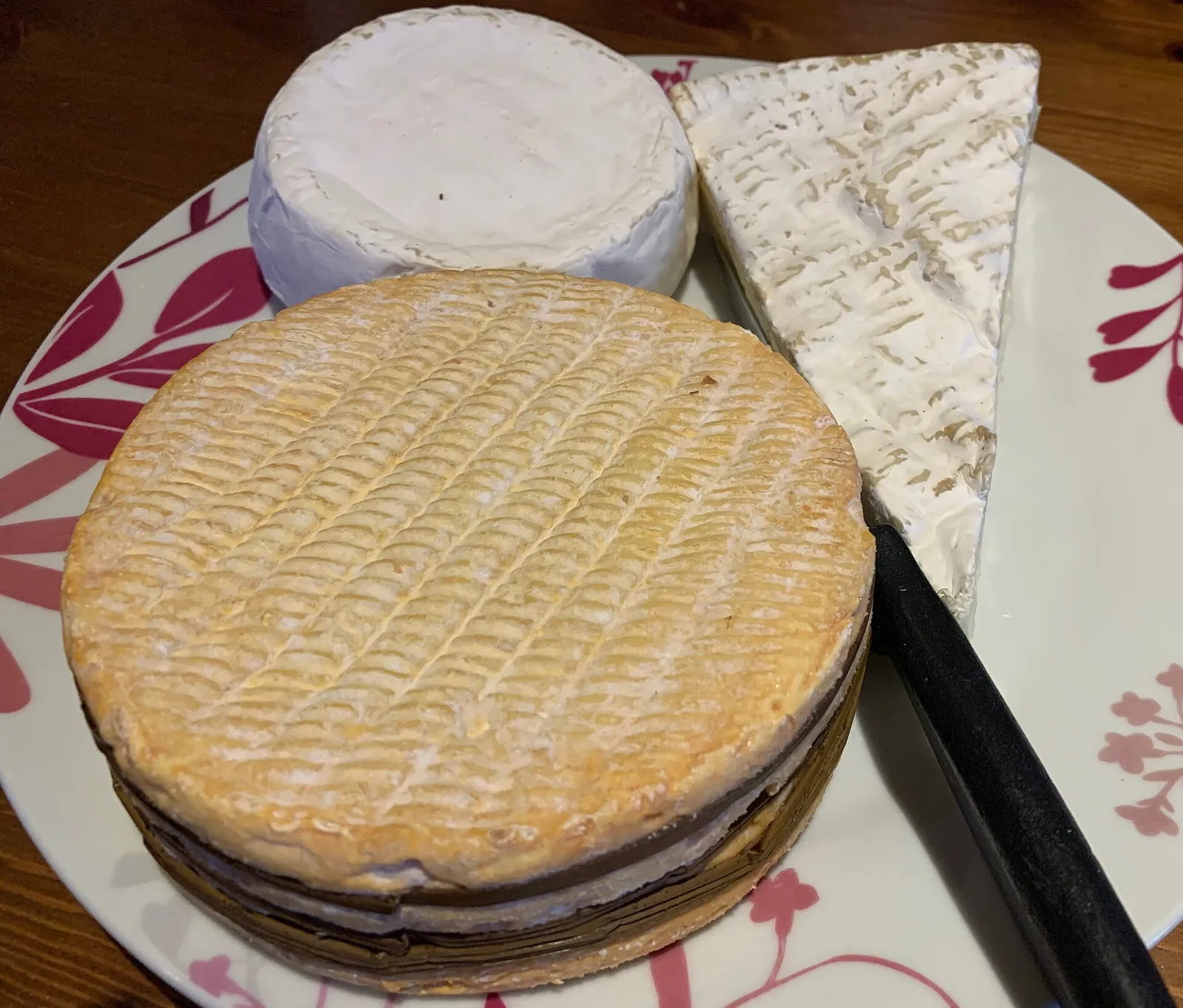
The names are looser than the cheeses. Only Brie de Meaux, Brie de Melun and Camembert de Normandie have protected recipes, and US rules file brie and camembert under one heading, so on an American shelf the maker's recipe and the ripeness matter more than the name.
Brie vs camembert at a glance
This brie vs camembert at a glance table compares the two best-known protected originals, with USDA figures for a typical ounce of each.
| Brie (de Meaux) | Camembert (de Normandie) | |
|---|---|---|
| Home | The Brie region east of Paris | Normandy |
| Size | Molded about 14 in (36 to 37 cm) across, 5.7 to 7.3 lb (2.6 to 3.3 kg) | 4.1 to 4.3 in (10.5 to 11 cm) across, at least 8.8 oz (250 g) |
| Sold as | Whole, or cut into halves or wedges after 4 weeks | A whole round in a wooden box |
| Milk | Raw cow's milk | Raw cow's milk |
| Molding | One uninterrupted pass, in thin layers | 5 or more ladlefuls, 40 minutes or more apart |
| Ripening | At least 4 weeks; ripe to the core at 6 to 8 weeks | Reaches customers at day 22 or later |
| Taste in the rules | Milky and a little bitter at 4 weeks; ripe, a subtle cream, butter and hazelnut aroma | Lightly salted; milky and mild, then frank and fruity |
| Per ounce (USDA) | 95 kcal, 7.8 g fat, 5.9 g protein, 178 mg sodium, 52 mg calcium | 85 kcal, 6.9 g fat, 5.6 g protein, 239 mg sodium, 110 mg calcium |
Brie vs camembert origin and size
Brie vs camembert starts with geography: brie takes its name from the Brie region east of Paris, between the Marne and Seine valleys, and camembert from a village in Normandy's Orne department. A Brie de Meaux weighs 5.7 to 7.3 pounds, roughly ten to thirteen times a 250-gram camembert, which is why brie is sold as wedges and camembert whole. Its specification allows it to be cut only into halves or wedges, from center to heel, and only after four weeks of ripening.
Each cheese has its own guide: brie covers the two protected Bries, and camembert covers Camembert de Normandie.
How brie and camembert are made
Brie and camembert are made almost the same way: warm milk is set with rennet, the curd is molded and drains on its own, the young cheeses are salted dry, and a white mold ripens them from the outside in. The mold species is shared too. A 2020 genome study in Current Biology found that Penicillium camemberti, the white fungus used on soft cheeses such as camembert and brie, is a recent domesticated lineage that grows faster and makes less toxin than its wild relatives.
What differs is how the curd reaches the mold. Brie de Meaux curd goes in during one uninterrupted pass, in thin layers laid by hand with a perforated skimmer about a foot across, the pelle à brie, the only tool the rules allow. Camembert de Normandie curd is ladled in at least five stages, each at least 40 minutes after the last, and then drains on its own for at least 18 hours, according to its specification.
Brie vs camembert taste and texture
Brie vs camembert taste differs mainly in how assertive each gets: the official description of ripe Brie de Meaux is a subtle aroma of cream, butter and hazelnut, while Camembert de Normandie is described as turning frank and fruity with age. Four weeks in, Brie de Meaux is milky with a hint of bitterness, and it is soft and ripe to the core at six to eight weeks.
A 2004 sniff test of 15 cheeses at Cranfield University, reported by the Associated Press, ranked camembert third smelliest and Brie de Meaux fifth. That is a small sample, but it fits camembert being the stronger of the two. Texture is closer: both ripen from the rind toward the center and end smooth and supple.
Brie vs camembert in the US
In the US, brie and camembert have no separate federal standards: both fall under the FDA's rules for soft ripened cheeses, which require a cheese made from unpasteurized milk to be cured at 35°F or warmer for at least 60 days. That rule is why most brie and camembert on American shelves is pasteurized.
Raw-milk versions carry more Listeria risk. The CDC advises people who are pregnant, 65 or older, or have a weakened immune system to skip any cheese made from raw milk unless it is heated to 165°F (74°C) or until steaming hot; see cheese during pregnancy for other cheeses.
Brie or camembert: which to buy
Buy brie when you want a milder, creamier cheese in wedges, and camembert when you want a stronger taste or a round to bake in its own box. For a board, a wedge of brie slices into neat pieces and a whole camembert makes a ready centerpiece. For baking, either works: camembert goes in its box, a brie wedge or small round goes in a dish, and the toppings in baked brie ideas suit both. Both go with crusty bread, tart apples, pears and walnuts, and the pairing guide has wine and beer matches. In recipes, swap them by weight.
Either way, press for ripeness before you pay; how to choose a ripe brie or camembert has the checklist.
What most brie vs camembert advice gets wrong
Most advice on brie vs camembert gets three things wrong, and all of them affect what you buy.
Small means faster. A small camembert does not ripen dramatically faster than a big brie. Brie de Meaux is ripe to the core at six to eight weeks under its rules, and in an Oregon State University study of camembert-style recipes the paste took 35 to 50 days to reach a neutral pH, the point at which the center has caught up with the rind. The ranges overlap.
Camembert is always the stronger one. In the same study, five camembert-style recipes ranged from 53 to 58 percent moisture, and after 50 days a cut lactic-curd cheese had flowed 27 mm (about 1 inch) while a stabilized-curd one had moved 4 mm (about 1/6 inch). The name does not fix the recipe, so a firm, mild factory camembert can be gentler than a ripe brie.
The French original tastes the same here. A raw-milk Brie de Meaux or Camembert de Normandie must be cured at least 60 days to be sold in the US. For Brie de Meaux that is just past the eight weeks at which the rules call it ripe to the core, and for camembert it is nearly three times the 22 days at which it reaches customers in France. Expect an older cheese than the one on a French counter.
Questions about brie vs camembert
These are the questions about brie vs camembert that come up most.
Is camembert stronger than brie?
Camembert is usually stronger than brie: the rules for Camembert de Normandie describe a frank, fruity taste, and it ranked third in the Cranfield sniff test against fifth for Brie de Meaux. A mild factory camembert can still be gentler than a ripe brie.
Can you substitute brie for camembert?
You can substitute brie for camembert in most recipes, by weight, whether you are baking, melting or building a board. Expect a milder, creamier result, and bake a brie wedge in a small dish since it has no box.
Is brie or camembert better for baking?
Neither brie nor camembert is better for baking: camembert bakes in its own wooden box, while brie needs a small round or a wedge in a dish. A younger, firmer round of either gives the best result, because the heat does the softening.
Does brie or camembert have more calories?
Brie has more calories than camembert, about 95 per ounce against 85, according to USDA FoodData Central, along with more fat (7.8 g against 6.9 g). Camembert has more sodium (about 239 mg against 178 mg) and more calcium (110 mg against 52 mg) per ounce.
Do brie and camembert have the same mold?
Brie and camembert are both ripened with the white mold species Penicillium camemberti, which cheesemakers also call Penicillium candidum, though the researchers found two varieties of it, apparently linked to different kinds of cheese. The bigger difference between the two cheeses is how the curd is handled.
Choosing between brie and camembert
For a first side-by-side, buy a wedge of brie and a round of camembert from the same shop in the same week, let both warm for 45 minutes and taste them plain. Buy again whichever you prefer, and if you want the raw-milk French originals, ask the counter how old they are.
Sources
- Cahier des charges de l'appellation d'origine Brie de Meaux, INAO (Institut national de l'origine et de la qualité)
- Cahier des charges de l'appellation d'origine protégée Camembert de Normandie, INAO
- 21 CFR 133.182, Soft ripened cheeses, Electronic Code of Federal Regulations
- Domestication of the emblematic white cheese-making fungus Penicillium camemberti and its diversification into two varieties (Ropars et al., 2020), Current Biology via PubMed
- Influence of cheese-making recipes on the composition and characteristics of Camembert-type cheese (Batty, Waite-Cusic and Meunier-Goddik, 2019), Journal of Dairy Science via PubMed
- French cheese called world's smelliest, Associated Press via NBC News
- Preventing Listeria Infection, Centers for Disease Control and Prevention
- Cheese, brie (FDC 172177) and Cheese, camembert (FDC 172178), USDA FoodData Central, SR Legacy