
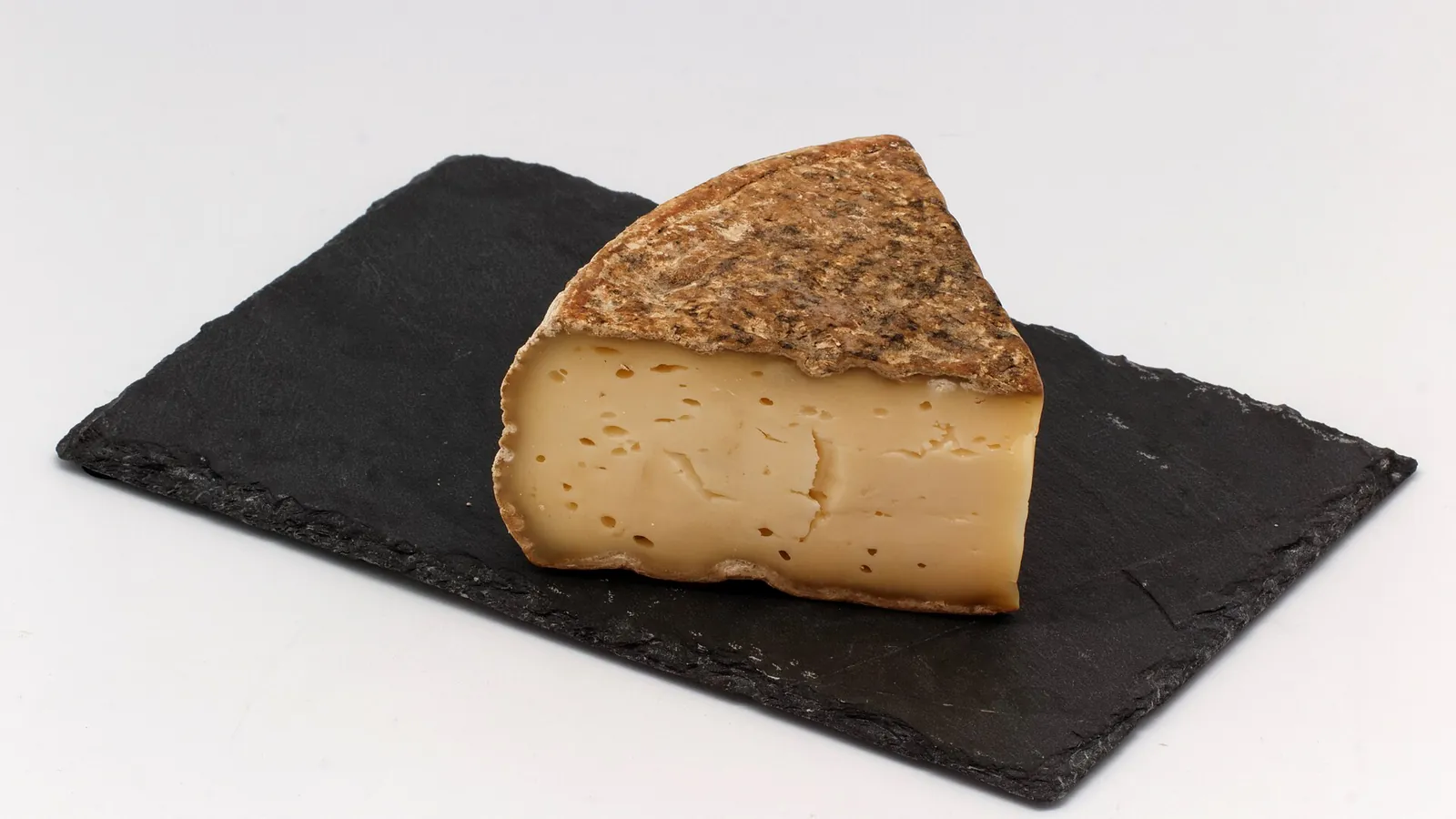
Its paste is semi-firm and mild, and it is the everyday cheese of the French Alps.
The rind is the part people ask about. It is a natural rind, dusted with secondary molds that grow while the wheels rest on wooden boards in a cool, humid cellar, and it is not washed or waxed. That difference is why Tomme de Savoie tastes earthy but not pungent, unlike the washed-rind Reblochon from the same mountains.
Tomme de Savoie at a glance
Here is Tomme de Savoie at a glance, from its product specification registered with INAO.
| Detail | Tomme de Savoie |
|---|---|
| Milk | Cow's milk, raw or thermized, never pasteurized |
| Made in | Savoie, Haute-Savoie and three communes of Ain, France |
| Protected name | PGI (protected geographical indication) |
| Type | Pressed, uncooked |
| Size | 18 to 21 cm across, 5 to 8 cm high, 1.2 to 2 kg (2.6 to 4.4 lb); a small format of 400 to 900 g exists |
| Aging | At least 30 days from renneting, on wooden boards |
| Rind | Smooth to slightly rough, gray to gray-white, with secondary molds |
| Paste | Semi-firm, white to yellow, small openings |
| Salt | 1.2 to 2 percent |
Tomme de Savoie PGI rules
Tomme de Savoie has been a PGI since 1996, registered under Regulation 1107/96 and amended in 2017, and the specification requires that the milk be produced and the cheese made and aged inside the delimited area. At least 75 percent of the dairy herd must be Abondance, Montbéliarde or Tarentaise cows, and fresh green forage must be fed for at least 150 days a year. The guide to PDO and PGI labels shows how a PGI differs from a PDO.
The milk may be raw or thermized, and pasteurization is forbidden. Thermization is a gentle heat treatment below pasteurization, and it keeps much of the milk's natural flora. Look for the word "Savoie" marked on the rind or the top.
How Tomme de Savoie is made
Tomme de Savoie is made by cutting the curd to grains between a corn kernel and a hazelnut, stirring it 20 to 60 minutes, and molding it. The maker may warm the curd while stirring, but no higher than 104°F (40°C), and may not wash the grains, which keeps some lactose for flavor. Pressing is mechanical or by stacking.
Acidification then runs at least 5 hours at 68°F (20°C) or warmer, followed by dry or brine salting; salting in the vat is forbidden. Cellars run 46 to 57°F (8 to 14°C) at 90 percent humidity or more, and the wheels are turned one to three times a week. The wooden boards matter: they feed the rind its flora.
The Tomme de Savoie rind
The Tomme de Savoie rind is a natural rind, and the specification describes it as smooth to slightly rough, gray to gray-white, with secondary molds that may grow on it. Yellow, brown or white patches are normal. The rind is the cheese's character, but most people cut it off, because the texture is dry and the taste is earthy and tough; and natural versus washed rinds explains the difference.
How Tomme de Savoie differs from other tommes
Tomme de Savoie differs from other tommes because "tomme" is only a style name, a round pressed mountain cheese, while Tomme de Savoie is a protected cheese with fixed rules. The sheep's milk tomme de brebis is a different cheese entirely. Next door in Savoie, Abondance is semi-cooked and fruitier. In central France, Cantal is another pressed uncooked cow's milk cheese.
The old story that Tomme de Savoie is made from skimmed milk has a basis: producers say it exists historically in a lean version because the cream went to butter. The specification today asks for a minimum of just 9 percent fat by total weight, so the cheese can be lean or richer. Do not buy it as a diet cheese without checking the label.
Tomme de Savoie flavor and texture
Tomme de Savoie tastes frank and slightly salty, the specification says, sometimes with a hint of acidity and a hint of piquancy. In practice that means milk, cellar and cut grass, with a mushroomy edge near the rind. The paste is semi-firm and a little springy, with small openings. Wheels aged one to three months are the standard range, and an older wheel turns stronger and drier.
How to use Tomme de Savoie
Tomme de Savoie is a good all-purpose table cheese. It melts well enough for gratins, croziflette-style pasta bakes and sandwiches, though it gives a softer, milder melt than Gruyère or Raclette. On a board it goes with cured ham, apples, pears and walnuts, and the pairing guide lists wines and beers.
Cut it into thin wedges rather than cubes, and take off the rind first for cooking. Serve it near room temperature, because cold mutes its milk and mushroom notes.
Tomme de Savoie substitutes
The best Tomme de Savoie substitutes are other mild pressed cheeses. Young Cantal is the closest in feel, Saint-Nectaire adds a more rustic, mushroomy rind, and a mild Gruyère works in gratins. The substitute finder lists more.
What most Tomme de Savoie advice gets wrong
Most Tomme de Savoie advice repeats two shortcuts.
Not every tomme is Tomme de Savoie
Tomme de Savoie is not just any tomme from the Alps. Only cheese made in the delimited area under the specification can use the name.
The gray rind is not spoilage
A gray, mold-dusted rind is normal here. A slimy, ammonia-smelling surface or pink or black spots on the cut paste are not. Trim it off and use the rest.
Questions about Tomme de Savoie
These are the questions about Tomme de Savoie that come up most.
What does Tomme de Savoie taste like?
Tomme de Savoie tastes frank and slightly salty, with a hint of acidity and sometimes a little piquancy, according to the specification.
Can you eat the rind of Tomme de Savoie?
The rind of Tomme de Savoie is natural and safe to eat for most people, but it is dry and earthy, so most cut it off. Skip it in cooked dishes.
Is Tomme de Savoie pasteurized?
Tomme de Savoie is made from raw or thermized milk, and pasteurization is forbidden. Pregnant people and others advised against raw-milk cheese should follow FDA and CDC guidance; see the raw-milk cheese guide.
How long is Tomme de Savoie aged?
Tomme de Savoie is aged at least 30 days from renneting, and Les Fromages de Savoie calls 30 days to three months the optimal window.
Does Tomme de Savoie melt?
Tomme de Savoie melts gently, so it works in gratins and sandwiches, but it will not stretch like Gruyère.
Your first Tomme de Savoie
For your first Tomme de Savoie, buy a wedge with the rind on and "Savoie" marked on it, cut it into thin pieces and serve it at room temperature with ham and a pear. Then bake the rest into a potato gratin.
Sources
- Cahier des charges de l'IGP Tomme de Savoie, INAO (Institut national de l'origine et de la qualité)
- IGP Tomme de Savoie, Les Fromages de Savoie
- Commission Implementing Regulation (EU) 2017/1223, legislation.gov.uk