
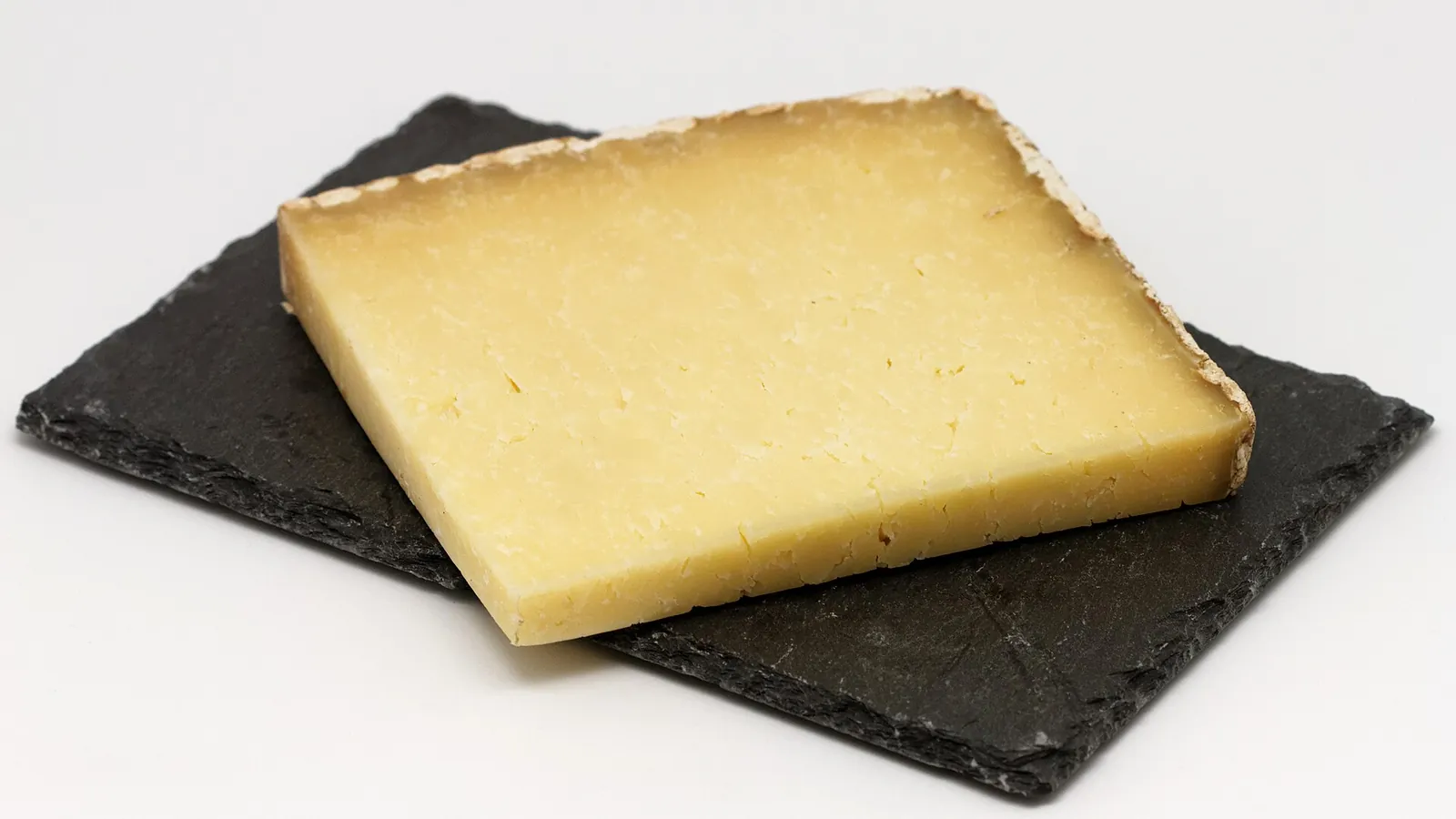
It is a pressed, uncooked cheese with a firm, ivory to deep yellow paste, and the age you buy decides almost everything about how it tastes and what to do with it.
Think of it as a French cousin of cheddar in feel, not a copy: the curd is pressed, rested, milled and pressed again, which gives a dense, slightly crumbly paste that is milky when young and sharp when old.
Cantal cheese at a glance
Here is Cantal cheese at a glance, from the INAO product sheet and Taste France.
| Detail | Cantal |
|---|---|
| Milk | Cow, raw or heat-treated |
| Made in | Most of the Cantal department, plus some communes of Puy-de-Dôme, Corrèze, Aveyron and Haute-Loire |
| Protected name | "Cantal" or "Fourme de Cantal"; AOC since 1956 |
| Style | Pressed, uncooked (pâte pressée non cuite) |
| Ages | Jeune: at least 30 days. Entre-deux: in between. Vieux: at least 8 months |
| Paste | Ivory to dark yellow, supple but firm, with a net-like texture |
| Flavor | Milky and slightly tart young; fruity and intense old |
What the Cantal AOP requires
The Cantal AOP requires that the cheese be made in a defined area of the Auvergne mountains, which the INAO describes as a cool, damp, rugged middle-mountain landscape. The name can be "Cantal" or "Fourme de Cantal." The INAO product sheet says the milk takes more than 30 hours to become cheese, and that the minimum aging is 30 days for the youngest and 8 months for vieux.
The 2019 revision of the specification, according to a 2022 report by the research group BASIC, put grass back at the center of the cows' diet: the cows must be born and raised in the area, and the rules limit herd size by land and ban indoor-only farming. GMOs are banned in feed, but silage is allowed, no breed is required, and both raw and heat-treated milk are permitted, on farms or in larger dairies. The PDO and PGI guide explains how these seals work.
How Cantal cheese is made
Cantal cheese is made by heating milk to about 90 F (32 C), adding rennet, cutting the curd into small grains and pressing it into a compact mass, per Taste France. That mass rests for 10 to 24 hours, then is ground in a mill and salted, which softens the paste. It is packed into molds, pressed a second time and aged at least 30 days.
The milling and second pressing are what give Cantal its dense but slightly crumbly body, and why it feels closer to a cheddar than to an Alpine cheese like Comté. The long rest lets the curd acidify before it is milled.
The three ages of Cantal cheese
The three ages of Cantal cheese differ more than most cheeses of one name, so buy by age, not just by name.
Cantal jeune
Cantal jeune is aged at least 30 days and is the mild one. Taste France describes an ivory to straw-yellow paste, firm yet supple, with buttery flavors; the INAO says the taste is milky and slightly tart early in aging. It melts the best.
Cantal entre-deux
Cantal entre-deux is the in-between age, sold after jeune and before vieux. Taste France describes a golden-brown rind and a soft, creamy paste with notes of hazelnut and fermented cream. It is the best all-rounder, because it still melts and already has depth.
Cantal vieux
Cantal vieux is aged at least 8 months, with a brown rind and brownish paste. Taste France calls the texture dry, almost crumbly and the character strong. The INAO says the flavor turns fruity and intense, and this is the age for a board or for grating, not for melting.
Sellers use looser age bands than the rules do (some give entre-deux as 2 to 6 months), so go by the word on the label.
How to use Cantal cheese
To use Cantal cheese, match the age to the job. Jeune and entre-deux melt for gratins, grilled sandwiches, omelets and potato dishes; the Auvergne's famous aligot, a dish of mashed potatoes with cheese and garlic, is the regional classic, and Taste France lists Cantal as its traditional cheese. Entre-deux also slices for sandwiches and a board. Vieux is for the board or for grating over soup, pasta or baked vegetables.
For a melt, shred the cheese, add it off a boil and stir; high heat makes pressed cheeses split. The best melting cheeses guide ranks the field.
What to drink and eat with Cantal cheese
Cantal cheese goes with the light reds and crisp whites of the region and beyond. Taste France suggests a Marcillac red, and cider works too. On the plate, add farmhouse bread, cured ham, apples and walnuts; vieux can stand up to a bigger red.
How to buy and store Cantal cheese in the US
Buying Cantal cheese in the US means checking the word "Cantal" or "Fourme de Cantal" and the age on the label. Ask a counter for a taste, and say what you plan to do with it: if it is for melting, say jeune or entre-deux.
Cantal may be raw milk, so check the label if you are pregnant or immunocompromised; the raw-milk cheese guide covers it. Store wedges in wax or parchment paper in the fridge, and bring them to room temperature for a board. The storing cheese guide has more on wraps; harder, older wedges keep longer.
What most Cantal cheese advice gets wrong
Most Cantal cheese advice repeats the "cheddar of France" label and a few other shortcuts.
Cantal is not simply a cheddar
Cantal is not simply a cheddar, because it is milder in its acid, fruitier when aged and made from a pressed, rested, milled and re-pressed curd.
The oldest-cheese claim is not provable
The claim that Cantal is among the oldest cheeses in France is repeated everywhere, but it rests on tradition and not on a dated record. The oldest cheeses guide weighs it.
Buying Cantal without an age wastes money
Buying Cantal without choosing an age wastes money, because a vieux does not melt well and a jeune has little sharpness for a board.
Substitutes for Cantal cheese
The best substitutes for Cantal cheese are other pressed, semi-firm cow's milk cheeses. For jeune, a mild cheddar or Saint-Nectaire comes close; for vieux, an aged cheddar or an aged Gruyère fills the gap. The substitute finder lists more.
Questions about Cantal cheese
These are the questions about Cantal cheese that come up most.
Is Cantal cheese like cheddar?
Cantal cheese is similar to cheddar in feel, with a dense, slightly crumbly paste and a milky tang that sharpens with age, but its curd is pressed, rested, milled and pressed again.
What are the three ages of Cantal cheese?
The three ages of Cantal cheese are jeune (at least 30 days), entre-deux (in between) and vieux (at least 8 months).
Does Cantal cheese melt?
Cantal cheese melts well when it is jeune or entre-deux, and poorly when it is vieux, which is drier and better for grating.
Is Cantal cheese raw milk?
Cantal cheese may be raw or heat-treated, because the specification allows both.
What does Cantal cheese taste like?
Cantal cheese tastes milky and slightly tart when young and fruity and intense when old, with hazelnut and cream notes in between.
Your first Cantal cheese
For your first Cantal cheese, buy a wedge of entre-deux, melt a little over potatoes and eat the rest with bread and an apple. Then taste a jeune and a vieux beside it to learn what age does.
Sources
- Cantal ou Fourme de Cantal product sheet, INAO (Institut national de l'origine et de la qualité)
- Cantal PDO, Taste France
- Fiche AOP, mise à jour 2022, BASIC (French research collective)