
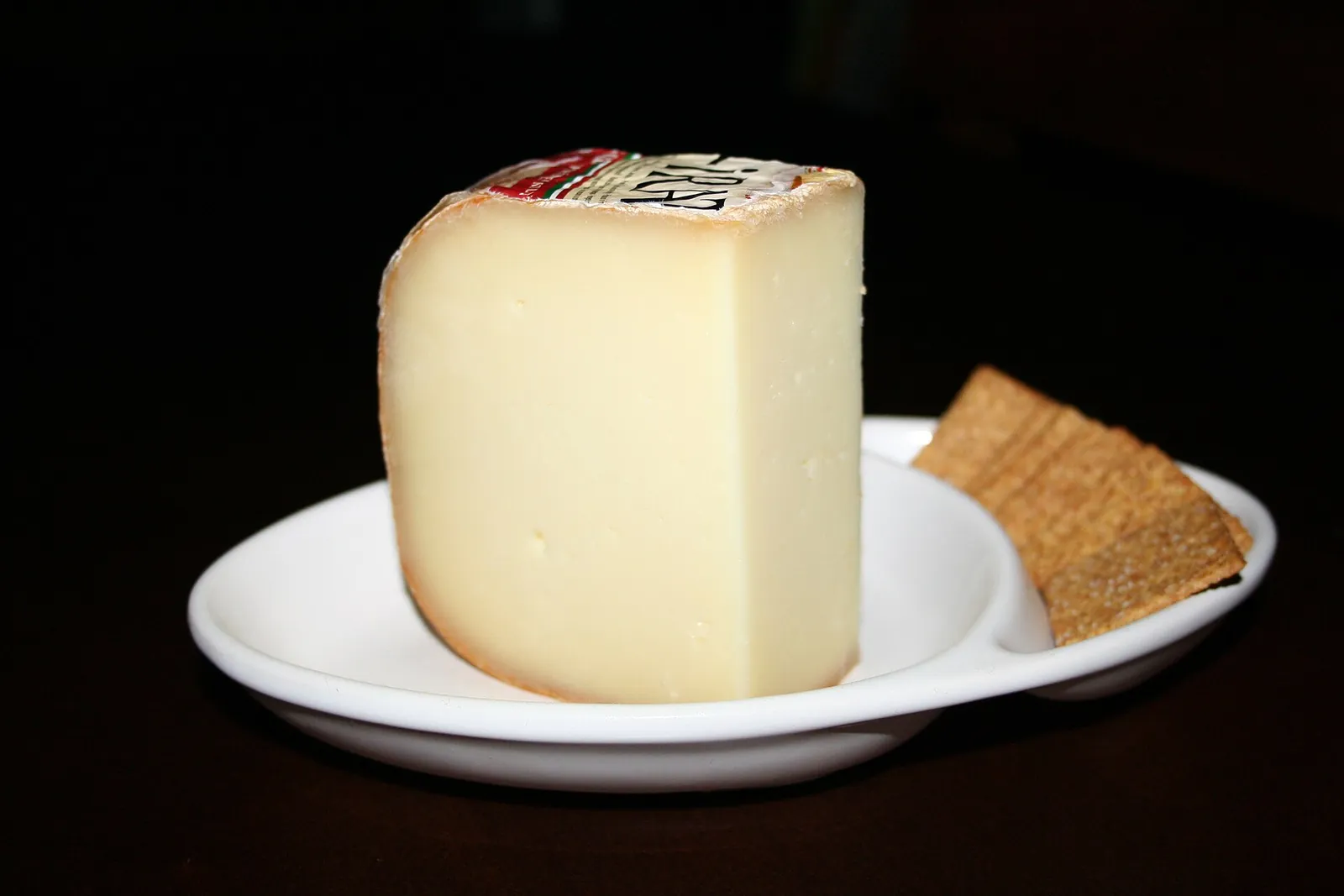
It is firm but supple, pale ivory, and always carries a slight hazelnut note.
The easiest way to place it: it is the protected, rule-bound version of a tomme de brebis. Where that name is only a style, Ossau-Iraty fixes the breeds, the feed, the area and the aging.
Ossau-Iraty at a glance
Here is Ossau-Iraty at a glance, drawn from the producers' press kit.
| Detail | Ossau-Iraty |
|---|---|
| Milk | Sheep, from Manech tête rousse, Manech tête noire or Basco-béarnaise ewes |
| Made in | Béarn and the Basque Country, Pyrénées-Atlantiques, France |
| Protected name | AOC since 1980, AOP since 1996 |
| Style | Pressed, uncooked tomme; raw or heat-treated (thermized) milk |
| Sizes | About 4.5 to 6.5 lb (2 to 3 kg) Basque wheels; about 9 to 11 lb (4 to 5 kg) Béarn wheels |
| Aging | At least 80 days for the smaller wheels, 120 for the larger |
| Flavor | Slight hazelnut, then hay, dried fruit and sheep's milk tang |
What the Ossau-Iraty AOP requires
The Ossau-Iraty AOP requires that every step, from raising the ewes to making and aging the cheese, happens in the Béarn and Basque mountain and hill area. Per the producers' press kit, the milk must come from the three breeds above, which suit the damp climate and steep land, and the ewes eat mainly pasture, plus local forage and non-GMO grain.
Two rules explain the cheese's character. The ewes are milked only part of the year, from December to August at most, to follow their natural lactation, and milking stops for at least 100 days before the next lambing. And about three quarters of the flocks go up the mountain in summer, a practice called transhumance; milk from ewes grazing at altitude can become fermier d'estive, a farmhouse version with its own marking and a flavor tied to high pasture. The PDO and PGI guide explains what such seals promise in general.
The name joins the Ossau valley in Béarn and the Irati forest in the Basque Country, according to the Cheese Atlas. The press kit says written traces of sheep cheeses from this region reach back to the first century, and notarial deeds from the early 1400s record cheesemaking near Oloron.
How Ossau-Iraty is made
Ossau-Iraty is made by warming the milk to 28 to 35 C (82 to 95 F), adding rennet, cutting the curd into small grains, then heating and stirring to separate curd from whey. The curd goes into perforated molds and is pressed and drained for 8 to 10 hours at about 68 F (20 C), per the press kit. Then it is stamped with a mark guaranteeing its origin and left in salt for 24 hours.
Aging does the rest. The wheels rest in humid cellars above 75 percent humidity, are turned and rubbed regularly, and form a natural rind. The 80-day and 120-day minimums are set by size, and the press kit says aging can run from two and a half months to a year or more. The kit counts about 30 ewes to make one 11 lb (5 kg) wheel, which is part of why a farmhouse wheel costs more than a supermarket tomme.
Ossau-Iraty flavor and texture
Ossau-Iraty flavor is light and balanced, always edged with hazelnut, and it varies by who made it and how long it aged. The paste is white to ivory and smooth, with few or no holes. Per the press kit, the Basque wheels have a dry ocher to ashen gray rind, a firm paste and an aroma of dry grass or straw, with notes of dried fruit, hay or fern; the larger Béarn wheels have a thin, sticky red-orange to brown rind and a smellier, creamier, more floral and animal taste.
Young wheels are milky and supple. Long-aged ones firm up and deepen toward roasted nuts, without turning hard or sharp. Serve it at about 60 F (16 C): the press kit says that is when it opens up, so take it out of the fridge before the meal.
Ossau-Iraty and black cherry jam
Ossau-Iraty and black cherry jam are the standard Basque pairing, traditionally made with cherries from Itxassou, a village in the Basque Country, according to the Cheese Atlas. The jam's sweet-tart fruit cuts the cheese's rich, nutty fat, and a thin slice with a spoonful and a piece of bread is the whole idea. Honey or fig jam also work; the cheese and jam guide covers the family of pairings.
Southwest French wines such as Jurançon and Irouléguy are the traditional drinks, with a light red as the easy alternative.
How to cook with Ossau-Iraty
To cook with Ossau-Iraty, treat it as a mellow melter and a grating cheese. Slice it over toast or into a gratin, shave it over roasted vegetables or fold it into omelets. Basque chefs quoted in the press kit build restaurant dishes around it, so it is not only a board cheese.
It melts smoothly because it is a pressed cheese with moderate moisture; keep the heat low so the fat does not separate. For a broader melting comparison, see the best melting cheeses.
How to buy and store Ossau-Iraty in the US
Buying Ossau-Iraty in the US means asking for the AOP name and, if you can, fermier (farmhouse) or laitier (made in a dairy from collected milk). The press kit says about 150 farm producers make fermier wheels, while the rest comes from more than twenty dairies and agers. Farmhouse wheels run more characterful; dairy wheels are steadier.
The milk may be raw. Raw-milk cheese sold in the US must be aged at least 60 days, and this one is aged 80 or more; see the raw-milk cheese guide for who should avoid it. Store it in wax or parchment paper in the fridge, away from strong foods; the storing cheese guide has more on wraps.
What most Ossau-Iraty advice gets wrong
Most Ossau-Iraty advice repeats a few habits that cost you flavor.
Ossau-Iraty is not just one cheese
Ossau-Iraty is not one flavor, because the AOP covers Basque 2 to 3 kg wheels, Béarn 4 to 5 kg wheels and farmhouse, dairy and summer-pasture versions. If you did not like one, try another before you write it off.
Ossau-Iraty tastes flat served cold
Ossau-Iraty tastes flat straight from the fridge. Warm it for about an hour and the hazelnut comes forward.
The jam is a pairing, not a requirement
The jam is a pairing, not a rule. If you cannot find black cherry jam, a good cherry or fig preserve gets you most of the way there.
Substitutes for Ossau-Iraty
The best substitutes for Ossau-Iraty are other firm sheep's milk cheeses. Manchego at 3 to 6 months is the closest widely sold choice, Idiazabal is a smoky Spanish Basque relative, and a young pecorino is saltier and sharper. The substitute finder lists more.
Questions about Ossau-Iraty
These are the questions about Ossau-Iraty that come up most.
What milk is Ossau-Iraty made from?
Ossau-Iraty is made from sheep's milk, from Manech tête rousse, Manech tête noire or Basco-béarnaise ewes in the Béarn and Basque Country area.
How long is Ossau-Iraty aged?
Ossau-Iraty is aged at least 80 days for the smaller wheels of about 4.5 to 6.5 lb and 120 days for the larger ones, and some wheels age a year or more.
What does Ossau-Iraty taste like?
Ossau-Iraty tastes mild, balanced and nutty, always with a slight hazelnut note, and the paste is smooth and firm.
What do you pair with Ossau-Iraty?
Black cherry jam is the classic pairing with Ossau-Iraty, along with crusty bread, nuts and southwest French wines such as Jurançon.
Is Ossau-Iraty raw milk?
Ossau-Iraty can be raw or heat-treated: farmhouse wheels are raw milk, and dairies may use either.
Your first Ossau-Iraty
For your first Ossau-Iraty, buy a wedge of the AOP cheese, let it warm for an hour, and eat it with black cherry jam and bread. If you like it, taste a farmhouse wheel against a dairy one to find your style.
Sources
- Dossier de presse Ossau-Iraty AOP, June 2018, Syndicat de défense de l'AOP Ossau-Iraty
- Ossau-Iraty, Syndicat de défense de l'AOP Ossau-Iraty
- Ossau-Iraty: Pride of the French Pays Basque, The Cheese Atlas