
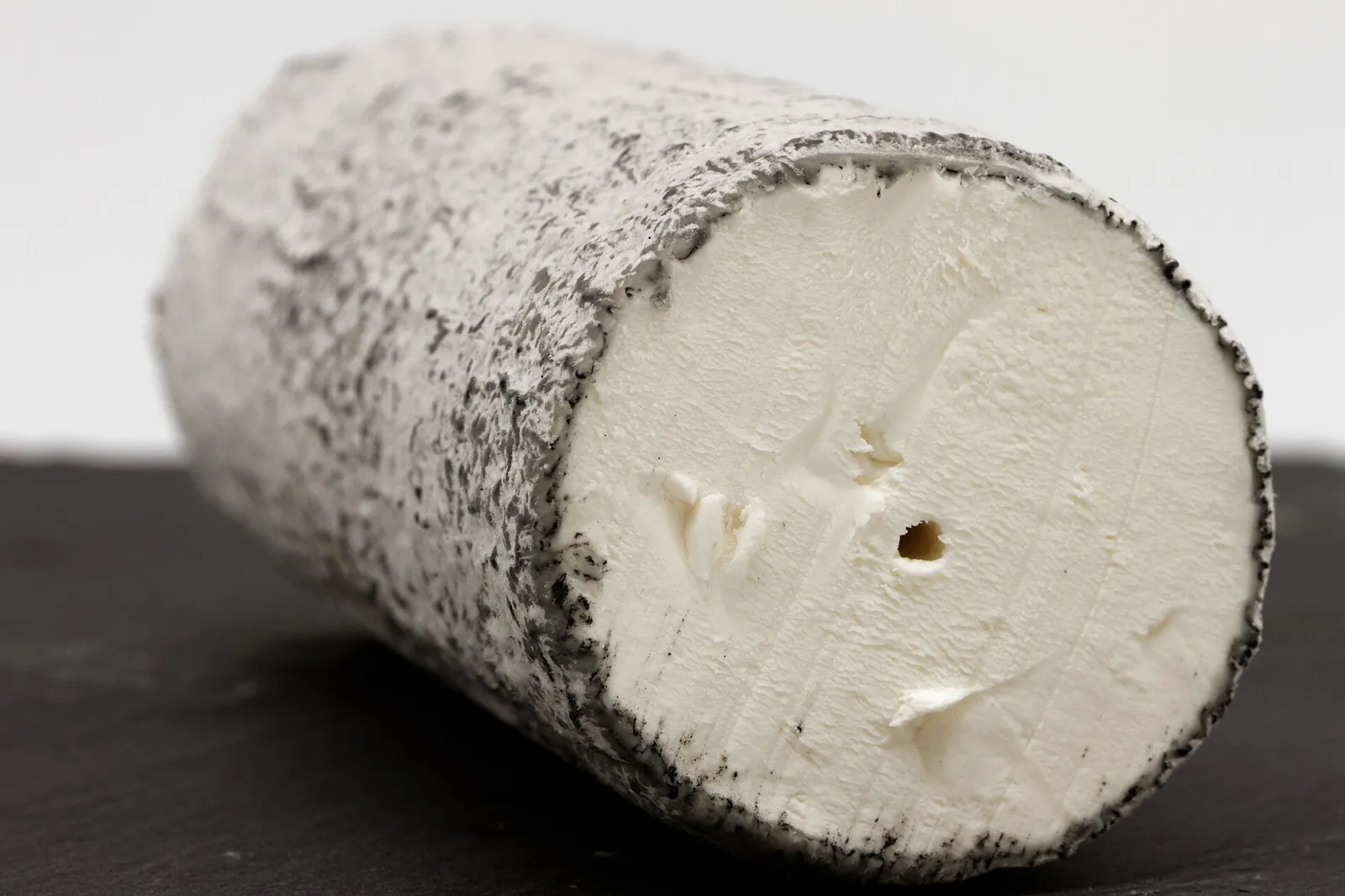
In US stores the word usually means the fresh log: tangy, creamy and ready to spread the day you open it.
Chèvre is simply French for goat, so the word names the milk, not the style. What sets one chevre apart from another is what happens after the curd is drained: a fresh log is packed and sold unripened, while a ripened goat cheese spends 10 days or more growing a rind. France gives the AOP label to 14 of the ripened ones.
Chevre cheese at a glance
Chevre cheese at a glance comes down to two styles, the fresh log and the ripened round, compared below.
| Detail | Fresh chevre | Ripened goat cheese |
|---|---|---|
| Ripening | None, sold unripened | 10 days or more for several AOP names |
| Rind | None | Natural, ash, bloomy mold, leaf or straw |
| Texture | Soft, creamy, spreadable | Creamy under the rind when young, firmer and drier with age |
| Flavor | Tangy, lemony, mild | Nuttier and earthier, stronger with age |
| Water (USDA) | About 61 percent in the soft type | 46 percent (semisoft) down to 29 percent (hard) |
| Best for | Spreading, crumbling, tarts, warm salads | Cheese boards, toast, a slice with fruit |
Why chevre tastes tangy
Chevre tastes tangy because acid does most of the work of setting the curd. The Cheese Science Toolkit, created by Purdue food scientist Pat Polowsky, lists chèvre with cottage cheese and quark among the acid-coagulated cheeses and explains that acid dissolves the calcium that glues casein proteins together, which is why acid-set cheese is usually softer.
The goaty edge is a separate matter. Lipase enzymes snip fatty acids such as caproic and caprylic acid off the milk fat, and once free they are volatile enough to reach your nose. The toolkit adds that the note is easier to spot in fresh cheeses like chèvre.
Fresh chevre vs aged goat cheese
Fresh chevre is eaten unripened, while aged goat cheese spends days or weeks drying and growing a rind, and that ripening changes both texture and flavor. CNIEL, the French dairy trade association, gives first eating ages on its cheese pages: Valençay can be tasted from its 11th day of ripening, Mâconnais is ripened at least 10 days, and Pouligny-Saint-Pierre and Rigotte de Condrieu take about 10.
Drying does the rest. USDA's goat cheese entries run from about 61 percent water in the soft type to 46 percent in semisoft and 29 percent in hard, so an ounce of hard goat cheese carries 128 calories against 75 for soft. Flavor follows the same path: ripened rounds trade lemony tang for nuttier, earthier notes, and CNIEL describes Valençay with forest floor and hazelnut, and Rocamadour with a light goat flavor over cream and hazelnut.
The 14 French AOP chevre cheeses
France gives 14 chevre cheeses the AOP label, the French name for the EU's PDO, and both INAO's 2017 dairy figures and CNIEL's cheese directory list the same 14. The guide to PDO and PGI labels explains what the seal promises, and the table sums up what CNIEL's cheese pages say about each.
| Cheese | Where it comes from | What to look for |
|---|---|---|
| Banon | Haute-Provence | Wrapped in brown chestnut leaves tied with raffia |
| Chabichou du Poitou | Limestone Haut-Poitou | Small, with the traditional "bonde" (bung) shape |
| Charolais | Within 60 km (37 mi) of Charolles | Cylinder of about 9 to 11 oz (250 to 310 g), about 2.8 in (7 cm) tall |
| Crottin de Chavignol (listed as Chavignol) | Loire Valley, the same terroir as white Sancerre | Small round whose rind grows Penicillium mold after about a month |
| Chevrotin | Savoie | Made on farms only, by hand, from one herd's milk (Alpine and Savoie goats); unusually creamy |
| Mâconnais | Beside the vineyards of the Mâconnais | Small truncated cone with a bloomy rind in ivory, beige or bluish tones |
| Pélardon | Cévennes and the Languedoc scrubland | Disk about 2.4 to 2.8 in (6 to 7 cm) wide with a thin cream rind |
| Picodon | Ardèche and Drôme | Small round patty |
| Pouligny-Saint-Pierre | Brenne Regional Nature Park, the smallest cheese AOP area | Pyramid with a marbled ivory-white rind that can look slightly blue |
| Rigotte de Condrieu | Slopes of the Pilat massif | Ivory rind, ready after about 10 days |
| Rocamadour | Around the village of Rocamadour | Disk of 1.2 oz (35 g), 2.4 in (6 cm) wide and 0.6 in (1.6 cm) tall, with a velvety white rind; also called cabécou |
| Sainte-Maure de Touraine | Loire Valley | Log with a rye straw through the center, dusted with charcoal ash and salt |
| Selles-sur-Cher | Where Touraine, Berry and Sologne meet | Truncated "pebble" with a natural gray, ashy rind |
| Valençay | Loire Valley | Truncated pyramid, salted and dusted with charcoal ash |
CNIEL's pages describe most of the 14 as raw-milk cheeses, and Chevrotin can be made only on farms. Scale varies enormously: Sainte-Maure de Touraine sold 1,825 metric tons in 2020 on CNIEL's count and Chevrotin 68, so the big names, Rocamadour (1,296), Selles-sur-Cher (1,066) and Crottin de Chavignol (897) among them, are the ones you are most likely to meet.
How to buy chevre cheese in the US
Buying chevre cheese in the US starts with the label, because a plain goat cheese or a "chevre-style" one is not the same as a French AOP name from the list above. For a fresh log, pick a plain one with a short ingredient list (goat milk, salt, cultures, enzymes), a date well ahead and a clean, moist white surface, and skip any log that looks yellowed, gray or wet. Flavored logs save time but limit what you can cook with them; Laura Chenel, Vermont Creamery and Montchevre all sell fresh logs.
For ripened French goat cheese, ask a cheese counter for an AOP name and check whether the milk is raw or pasteurized. The FDA standard for soft ripened cheeses says cheese made from unpasteurized milk must be cured at 35°F (2°C) or warmer for at least 60 days, far longer than these cheeses need in France. A raw-milk Valençay on a US counter is therefore older and drier, with a stronger flavor, than the one sold in France, and a younger one has to be made from pasteurized milk.
How to serve and cook chevre cheese
Serve chevre cheese cool, not ice cold: cut a fresh log while it is cold, let it warm for about 15 minutes before spreading, and give a ripened round 30 minutes out of the fridge. Unflavored dental floss or a thin wire cuts a soft log into clean rounds where a knife smears it.
Honey, figs, beets and strawberries suit it, and crisp, high-acid whites such as Sancerre, Sauvignon Blanc and Chenin Blanc cut through the richness; a saison or gose works for beer drinkers. CNIEL says Chavignol and white Sancerre come from the same terroir and make the perfect pairing.
Cooking with chevre is mostly heat control. For salade de chèvre chaud, the French bistro classic, set rounds of log on toasted baguette slices and broil until the tops brown; for a baked version, roll rounds in breadcrumbs and bake at 400°F (200°C) for 8 to 10 minutes. Stir it into hot pasta or risotto off the heat so it loosens into a creamy sauce, and crumble it over pizza or tarts near the end.
What most chevre advice gets wrong
Most chevre advice gets a few basics wrong, and three of them change how you buy and cook it.
Chevre is not always fresh
Chevre is not always fresh: in France the word covers every goat cheese, and the 14 protected names are ripened cheeses with rinds, not the unripened logs sold as chevre in US stores. A Selles-sur-Cher or Valençay is a different product from the log in the dairy case, with a rind, more flavor and a firmer paste.
Mold and ash on ripened chevre are normal
Mold and ash on ripened chevre are normal: CNIEL describes Pélardon with a thin cream rind sometimes spotted with molds, Pouligny-Saint-Pierre with a marbled ivory rind that can turn slightly bluish, and Selles-sur-Cher with a gray ash rind. On a fresh log, though, fuzzy mold or pink slime means it has spoiled, so throw it out.
Warm chevre does not melt like mozzarella
Warm chevre softens but does not melt like mozzarella, because the acid that set the curd makes casein cling together. The Cheese Science Toolkit says acid-set cheese will not melt or get gooey and stretchy, so a warm round holds its shape on toast and crumbles keep their edges on pizza.
Questions about chevre cheese
These are the questions about chevre cheese that come up most.
Is chevre the same as goat cheese?
Chevre is the same as goat cheese in France, where the word simply means goat, but on a US label it usually names the fresh, spreadable log rather than every goat cheese. Feta is a separate cheese, covered in the feta vs goat cheese guide.
What does chevre cheese taste and look like?
Chevre cheese tastes tangy, lemony and mildly earthy, with a creamy texture when fresh and a nuttier flavor once ripened. It looks bone white because goats break beta-carotene down into colorless vitamin A, the Cheese Science Toolkit explains.
Is chevre safe to eat during pregnancy?
Chevre is safe to eat during pregnancy when it is made with pasteurized milk: FDA guidance says to avoid cheese made with unpasteurized milk and treats pasteurized cheese as fine, with queso fresco-type cheeses as the exception. The FDA's page for moms-to-be has the full list, and the pregnancy cheese guide covers more cheeses.
How long does chevre cheese last?
Chevre cheese lasts until the date on the package while it is sealed and refrigerated, and about a week once opened. Rewrap it tightly, and throw it out if it turns slimy, pink or sour.
What is a good substitute for chevre?
A good substitute for chevre is cream cheese loosened with a squeeze of lemon juice, which gives similar tang and spreadability, or a mild feta for crumbling, which is saltier. The substitute finder lists more swaps.
What wine goes with chevre?
Crisp, high-acid white wine goes best with chevre, and white Sancerre, a Sauvignon Blanc from the Loire, is the classic match, though Chenin Blanc also works. The wine's acidity echoes the cheese's tang and cuts through its richness.
Your first chevre cheese
For your first chevre cheese, buy a plain fresh log and spread it on toasted baguette with honey and a sliced fig. Next, ask a cheese counter for a Selles-sur-Cher or a Valençay, and taste how the rind changes the cheese.
Sources
- French AOP cheeses: directory and the 14 goat's-milk cheese pages, CNIEL (French dairy trade association)
- Chiffres clés laitiers 2017, rectifié 2019, INAO and CNAOL
- Cheese Science Toolkit: acid vs rennet coagulation, goaty, melt and stretch, and cheese color pages, created by Patrick J. Polowsky, Purdue University
- 21 CFR 133.182, Soft ripened cheeses, Legal Information Institute, Cornell Law School
- Listeria (Food Safety for Moms-to-Be), U.S. Food and Drug Administration
- Cheese, goat, soft type (FDC 173435), with the semisoft (173433) and hard (172197) entries, USDA FoodData Central