
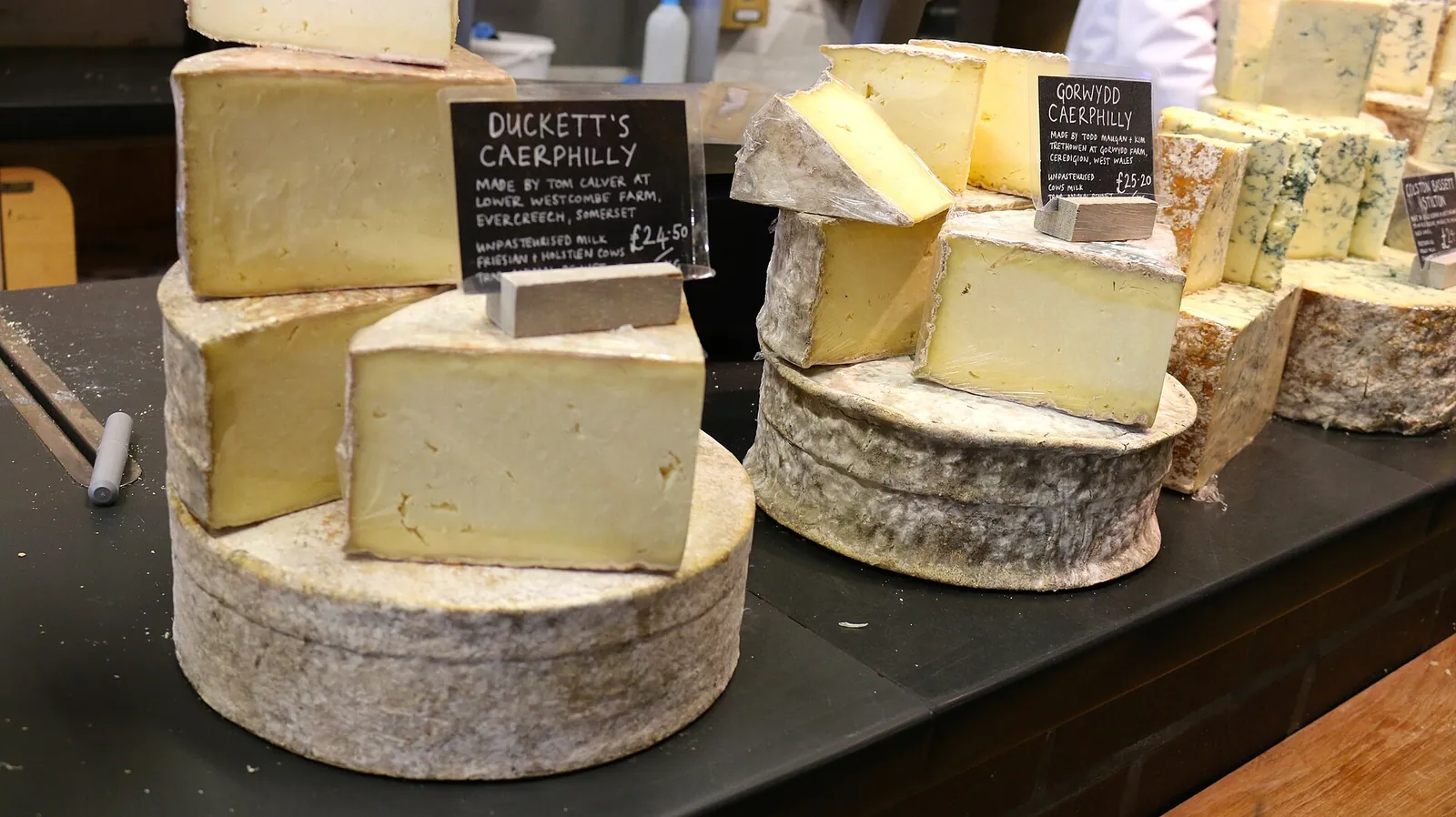
Eaten young, it is moist, white and mild; given a few weeks, the best farmhouse versions grow a mushroomy rind layer and a deeper flavor.
The thing to know before you buy is that two traditions share one name. The Welsh farmhouse cheese is moist and sometimes aged; the Somerset version, made with Cheddar-style equipment, ends up drier. Both crumble, but they do not taste the same.
Caerphilly cheese at a glance
Here is Caerphilly cheese at a glance, with the figures taken from the Welsh PGI specification and from the makers and cheese references listed below.
| Detail | Caerphilly |
|---|---|
| Milk | Cow |
| Made in | Wales (farmhouse), Somerset and Wiltshire (mostly larger dairies) |
| Protected name | "Traditional Welsh Caerphilly" and "Traditional Welsh Caerffili", PGI protected in 2018 |
| Age | Eaten from 10 days old; the Welsh specification allows up to 6 months |
| Shape | Flat round; PGI cheeses are about 2 to 4 kg (4.4 to 8.8 lb) |
| Fat | 45 to 55 percent of the dry matter under the Welsh specification |
| Texture | Crumbly and moist when young; creamier near the rind with age |
| Flavor | Mild, lemony and fresh when young; fuller and earthier when aged |
Where Caerphilly cheese comes from
Caerphilly cheese takes its name from the town in South Wales, and Slow Food UK dates farm production there to the early 1830s. The name probably comes either from the town itself or from the cheese's popularity with the mining communities around it.
The miners' story is the part everyone repeats. The cheese was said to replace the salt lost to sweat on a long shift, and its thick, firm rind gave a clean place to hold it with dirty hands, so the inside stayed clean. Slow Food UK adds the claim that it absorbed "toxic fumes" underground, which is lore rather than something to rely on.
Then the cheese moved. Cheddar makers in Somerset took it up in the late 19th century, partly because southern demand was growing, and used Cheddar equipment and larger-scale methods that gave a drier cheese. The cheese ripens quickly, which suited a dairy that wanted cash flow. By the early 20th century much of the production had left Wales, and wartime rationing ended farmhouse making. After the war, factory production resumed in Somerset and Wiltshire, which still make most of the mass-produced Caerphilly, according to Wikipedia's summary of the cheese's history.
The Welsh revival started with a surplus. In 1987, when milk quotas left farms with milk to spare, Gwynfor and Thelma Adams of Caws Cenarth began making Caerphilly again, as the Welsh Government's announcement recalls. Gorwydd Caerphilly from the Trethowan family in Ceredigion followed, launched in 1996.
The Traditional Welsh Caerphilly name
Traditional Welsh Caerphilly is a protected geographical indication (PGI), registered by the EU on January 30, 2018, and it covers only cheese made in Wales. The UK specification requires cow's milk from Welsh farms with a mainly forage-based diet, and it allows raw or pasteurized milk, organic or not.
The rest of the specification is a useful checklist for what the Welsh cheese should be. It is a flat round of 2 to 4 kg (about 4.4 to 8.8 lb), 20 to 25 cm (8 to 10 inches) across, hand-molded, with milk making up about 97.5 percent of the recipe and salt 1 to 2 percent. The paste is creamy white, and the rind may carry a thin, slightly molded coat that was traditionally dusted with fine oatmeal or flour when the cheese was sold. The UK register also lists it from December 31, 2020. For what PGI and PDO seals actually promise, see the guide to PDO and PGI cheeses.
Plain "Caerphilly" without those words is not covered. A Somerset Caerphilly is a real cheese, but the PGI name is the one that guarantees Welsh milk and Welsh making.
How Caerphilly cheese tastes at different ages
Caerphilly cheese tastes mild, fresh and lemony when young, and the specification calls for a "fresh lingering after taste" that becomes fuller but stays mild with age. At 10 days to a few weeks the paste is moist, white and crumbly, with a clean tang like buttermilk or lemon peel.
Aging changes the structure, not just the volume. Culture magazine describes Gorwydd as having three distinct textures: a dense, gray-brown molded rind with earthy flavors, a mushroomy layer about an inch deep under it, and a slightly chalky, open center with hints of milk and citrus. That layer forms because the mold works inward from the rind, softening the paste as it goes, so older wheels are creamier at the edge and crumblier at the heart. Cut a wedge so everyone gets some of each.
How to buy Caerphilly cheese in the US
Buying Caerphilly cheese in the US starts with the label: look for "Traditional Welsh Caerphilly" for the protected Welsh cheese, and expect a plain "Caerphilly" to come from either Wales or England. A cheese shop that cuts from a whole wheel is the best bet, because a good farmhouse wheel is only a couple of weeks to a few months old and does not travel well in plastic.
Ask which version you are getting and how old it is, and ask for a taste that includes the rind layer. A younger piece is the safe first purchase; an older farmhouse piece is the one to hunt for. If the cut face looks wet, glassy or sweaty, skip it.
How to cook with Caerphilly cheese
Caerphilly cheese is at its best cold or just warmed, because a young, moist, crumbly cheese softens and browns rather than stretching. Crumble it over salads, beets or roasted vegetables, serve it with apples, chutney and crusty bread, or set it on oatcakes.
Heat is where it gets interesting. It browns well under a broiler, so it suits cheese on toast and, for the full method, a Welsh rarebit. Its clean acidity is the reason it works with leeks, the Welsh vegetable: fold crumbled Caerphilly into a leek tart or a savory bake near the end, so it keeps some texture instead of melting out. Skip it for a smooth, glossy sauce; it will not melt that way.
For drinks, Culture magazine suggests Chardonnay or Chenin Blanc with Gorwydd. Cider and a light ale suit a young cheese. The pairing guide has more options.
Caerphilly cheese substitutes
Caerphilly cheese substitutes should be crumbly, mild and a little tangy, and the closest are other British crumbly cheeses. Lancashire and Wensleydale are the easiest to find, and both sit in the same moist, crumbly range. Reference sources also name Cheshire and Yarg, a Cornish cheese, as relatives; Cheshire is the nearest in texture.
For a salad, a mild feta gives a similar crumble, though it is wetter and saltier; rinse it and skip extra salt in the dish. For a melted topping, young white cheddar browns well but is sharper. The substitute finder covers more swaps.
What most Caerphilly advice gets wrong
Most Caerphilly advice treats it as one cheese with one flavor, and that is the first thing it gets wrong.
Caerphilly cheese is not one style
Caerphilly cheese is two traditions with one name. The Somerset method, using Cheddar-type equipment, produced a drier cheese; the Welsh farmhouse cheese is moister and can be aged. If a recipe or a review calls it "dry and crumbly" and another calls it "creamy under the rind," both may be right.
Aged Caerphilly is not a mistake
Aged Caerphilly is not a cheese that went wrong: Slow Food UK calls aged versions a rare find, because factory cheese is sold young. If the rind layer is soft and earthy and the center is chalky, that is how a farmhouse wheel is meant to look.
The miners' story is partly lore
The miners' story of Caerphilly cheese is partly lore. The salt and the rind make practical sense, but the "toxic fumes" detail comes from folklore, and nothing in the specification or maker sources backs it.
Questions about Caerphilly cheese
These are the questions about Caerphilly cheese that come up most.
What does Caerphilly cheese taste like?
Caerphilly cheese tastes mild, fresh and slightly lemony when young, with a crumbly texture. Aged farmhouse wheels turn earthier and mushroomy near the rind.
Is Caerphilly cheese Welsh?
Caerphilly cheese is Welsh in origin, and the protected "Traditional Welsh Caerphilly" must be made in Wales from Welsh milk. Much of the mass-produced Caerphilly today comes from Somerset and Wiltshire.
Is Caerphilly cheese the same as Cheshire?
Caerphilly cheese is not the same as Cheshire, though both are crumbly cow's milk cheeses from the British Isles. Caerphilly is typically younger, whiter and more lemony; Cheshire comes in white, red and blue versions.
Can you melt Caerphilly cheese?
Caerphilly cheese melts only gently. It softens and browns on toast, which is why it works in rarebit and savory bakes, but it will not give a smooth, stretchy melt.
Is Caerphilly cheese made with raw milk?
Caerphilly cheese can be made with raw or pasteurized milk: the Welsh PGI specification allows both. Check the label or ask the cheesemonger for the specific cheese.
How long does Caerphilly cheese keep?
Caerphilly cheese is best eaten fresh, within a week or two of cutting. Wrap it in parchment or wax paper, keep it in a container in the fridge, and see the guide to storing cheese for wraps.
Your first Caerphilly cheese
For your first Caerphilly cheese, buy a small cut of Traditional Welsh Caerphilly, serve it with an apple and some chutney, and taste a piece with the rind layer on the side. If you like it, try an older farmhouse wheel next, or a Somerset one for comparison. For other English choices, the British and Irish cheeses page is a good next stop, and Cheddar shows the neighboring Somerset tradition.
Sources
- Traditional Welsh Caerphilly / Traditional Welsh Caerffili product specification, UK Government (GOV.UK) protected food names
- Grate result: Wales' iconic Caerphilly cheese gains European protection, Welsh Government
- Artisan Caerphilly, Slow Food UK
- Caerphilly (Gorwydd Farm), Culture magazine
- Caerphilly cheese, Wikipedia