
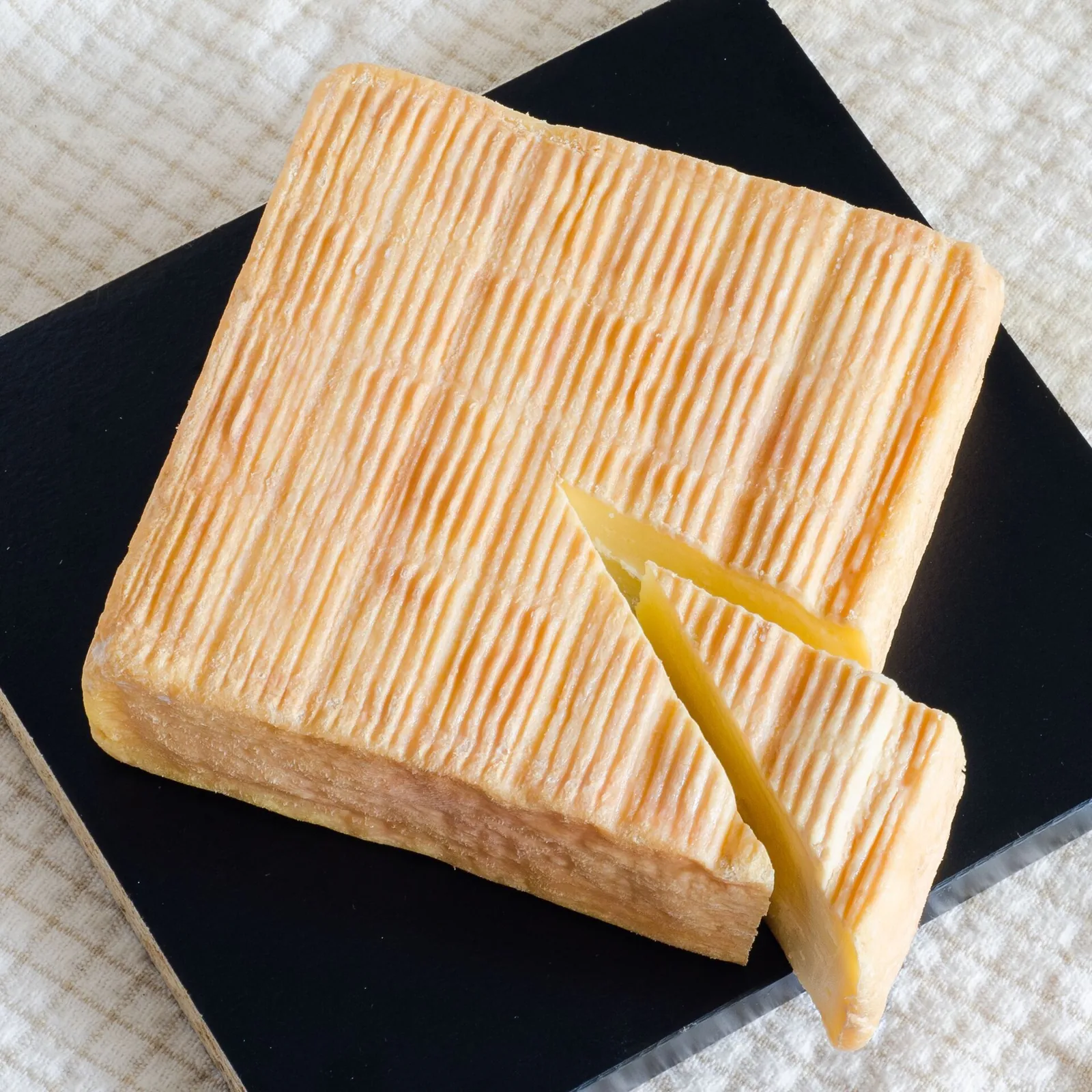
Its smell is strong and slightly ammoniated, its paste is supple, and its home dish is the flamiche, a tart in which the cheese melts.
The cheese took its name from the abbey of Maroilles, founded in the 7th century, and it still carries the look of its monastic origins: a square, a damp cellar and a rind that is washed again and again.
Maroilles cheese at a glance
Here is Maroilles cheese at a glance, taken from the EU single document in the INAO's file.
| Detail | Maroilles |
|---|---|
| Milk | Cow |
| Made in | Thiérache, in the Nord and Aisne departments of northern France |
| Protected name | AOC decree of May 24, 1976; now an AOP (PDO) |
| Rind | Washed, red-orange, with visible marks from the draining racks |
| Shape | Square, 12.5 to 13 cm per side inside the mold |
| Texture | Soft, supple to the touch |
| Smell | Strong, frank, slightly ammoniated |
| Fat | At least 45 g per 100 g of dry matter |
Where Maroilles cheese comes from
Maroilles cheese comes from Thiérache, a region the document calls the "pays vert," a hedged, wet grassland with more than 900 mm (about 35 inches) of rain a year. All milk production, cheesemaking and ripening must happen inside the zone, and the cows must graze at least 170 days a year.
The link to the Abbey of Saint-Humbert at Maroilles is old, but the source is careful about it. Benedictine monks encouraged cheesemaking early, and medieval texts from 1174 and 1245 record cheese deliveries, yet the document calls it conjectural to say that these were already today's soft washed-rind cheese. The name "Maroilles" appears as a distinct product in 1723, in a dictionary of commerce. So "made by monks for a thousand years" is the legend; the paper trail is shorter but still centuries long.
The cheese was first protected by a syndicate in the early 20th century and recognized as an AOC by decree on May 24, 1976. For what the AOP seal means today, see the PDO and PGI guide.
How Maroilles cheese is made and washed
Maroilles cheese is made in two stages: first a fresh, unripened cheese called Maroilles blanc, then ripening in a damp cellar. The syndicate settled on that two-step method in 1932, and from the late 19th century specialist ripeners (affineurs) bought the young cheeses and brought them to maturity in their own cellars.
The wash is what gives Maroilles its color and smell. Farm cellars were traditionally damp brick or blue stone, which suited the "red ferment" that colors the rind orange-red. During ripening the cheeses are brushed with water that is more or less salted, with or without added cultures; the brushing speeds up the spread of those microbes and keeps unwanted molds off the surface. That is the same mechanism behind every washed-rind cheese.
Maroilles cheese sizes and flavor
Maroilles cheese comes in four sizes: the standard square, then Sorbais, Mignon and Quart, which are smaller. The standard is 12.5 to 13 cm per side, Sorbais 12 to 12.5 cm, Mignon 11 to 11.5 cm and Quart 8 to 8.5 cm. The smaller ones contain less cheese, set by the amount of dry matter: 360 g for the standard, 270 g, 180 g and 90 g for the others.
The official description is of a frank, characteristic smell that is slightly ammoniated, a soft paste with small openings, and a rind with a firm, even orange-red color. Taste is rounder than the nose suggests: salty, meaty and savory, with a creamy softness that grows as it ripens. If you like Époisses or Livarot, whose own description stresses powerful, long-lasting aromas, this is in the same range of strength, with a more rustic feel.
How to buy Maroilles cheese in the US
Buying Maroilles cheese in the US means asking a cheese counter, since it is a specialty import. Look for the name Maroilles or Marolles with the AOP seal, a rind that is evenly orange-red, and a square that gives slightly under your thumb. Skip a cheese with a dry, cracked rind, a chalky center or a sharp ammonia smell.
The smaller sizes, Mignon and Quart, are easiest to finish while the cheese is at its best, so choose one of those when you are cooking for a few people.
How to serve and cook with Maroilles cheese
Serve Maroilles cheese at room temperature, about an hour out of the fridge, so the paste softens and the smell opens. Keep it covered until guests sit down and give it its own board.
The drink is local beer. Dark, malty northern French and Belgian beers, such as a bière de garde or a dubbel, handle its salt and pungency better than most wines; the beer and cheese guide has more. A full red also works. On the board, dark rye or crusty bread and something sharp, like mustard or pickles, work well.
Cooked, it is the star of the flamiche (or tarte au Maroilles): a tart with a bread-like or pastry base, topped with sliced Maroilles, cream and sometimes leeks or onions, baked until the cheese melts. The village holds a festival devoted to it, the Fête de la Flamiche et du Maroilles, created in 1997. For more tart ideas, see savory cheese tarts.
Maroilles cheese mistakes that cost you flavor
Most Maroilles cheese mistakes come down to temperature, wrapping and nerves.
Serving Maroilles cheese cold
Serving Maroilles cheese cold mutes its flavor and leaves the paste stiff. Give it the hour.
Sealing Maroilles cheese in plastic
Sealing Maroilles cheese in plastic traps its smell and moisture, so the rind turns slick. Use wax paper or parchment in a lidded container, as the storing guide describes.
Judging Maroilles cheese by its smell
Judging Maroilles cheese by smell alone makes people give up too soon. The aroma is the loudest part, and the paste is rounder. Taste before you decide.
Using too much in a flamiche
Using too much Maroilles cheese in a flamiche overwhelms the tart. Thin slices over cream and onions give a savory, melting layer; thick slabs go bitter and greasy.
Maroilles cheese substitutes
Maroilles cheese is closest to other strong, soft washed rinds. Livarot is similar in power, Époisses is creamier, Munster is the easiest to find in the US, and Pont-l'Évêque is the milder square. For a flamiche, Reblochon or Taleggio also melt well. The Substitute Finder lists others, and the stinky cheese ranking shows where Maroilles falls on the scale.
Questions about Maroilles cheese
These are the questions about Maroilles cheese that come up most.
Why does Maroilles cheese smell so strong?
Maroilles cheese smells strong because its rind is brushed with salted water during ripening, which encourages the orange surface microbes behind the aroma. The official description calls the smell frank and slightly ammoniated.
Does Maroilles cheese taste as strong as it smells?
Maroilles cheese tastes rounder than it smells: the paste is soft, salty and savory, with the strength mostly in the aroma.
What is flamiche made with Maroilles cheese?
Flamiche made with Maroilles cheese is a northern French tart in which sliced Maroilles melts over a bread or pastry base, often with cream and onions or leeks.
How big is Maroilles cheese?
Maroilles cheese is a square about 12.5 to 13 cm (5 inches) on a side in its standard size, with smaller Sorbais, Mignon and Quart versions.
Can you eat the rind on Maroilles cheese?
You can eat the rind on Maroilles cheese, which is brushed with salted water as it ripens, though its salt and strength lead some people to trim it. The rind guide explains the options.
Your first Maroilles cheese
For your first Maroilles cheese, buy a small Mignon or Quart square, let it warm up for an hour and serve it with dark bread and a malty beer. If you like it, bake a flamiche with thin slices over cream and onions.
Sources
- Maroilles or Marolles, single document (Regulation (EC) 510/2006), Institut national de l'origine et de la qualité (INAO)
- Livarot, product page, Institut national de l'origine et de la qualité (INAO)
- Pont-l'Évêque, product page, Institut national de l'origine et de la qualité (INAO)