
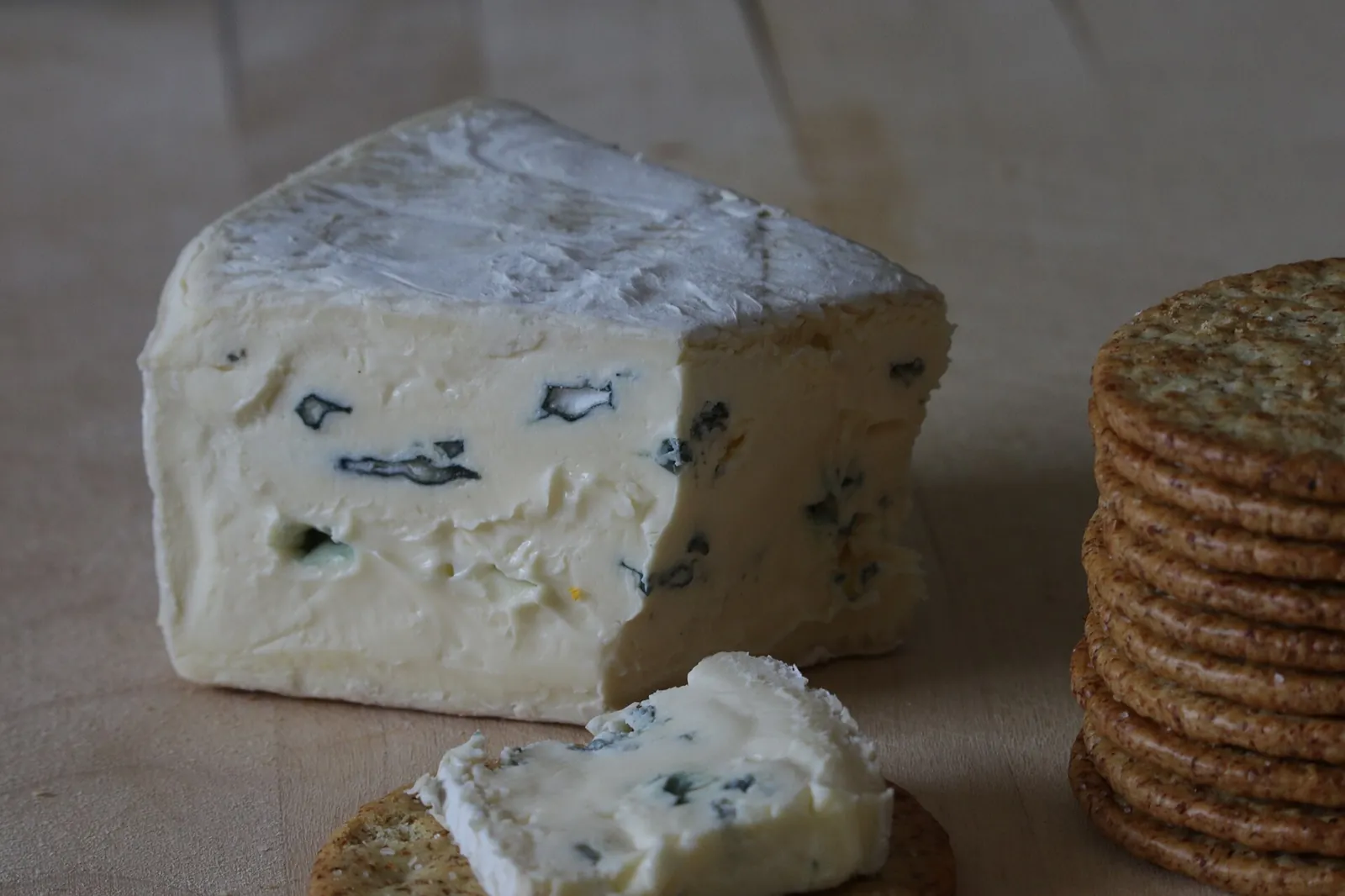
It is one of the mildest blue cheeses sold in the US, which is exactly why people buy it.
The mildness has a cause. Extra cream goes into the milk, so the fat softens the sharp, salty edge of the blue mold, and a second mold on the outside adds a mushroomy, buttery note instead of tang.
Cambozola cheese at a glance
Here is Cambozola cheese at a glance, from the maker's history and the European Court of Justice record.
| Detail | Cambozola |
|---|---|
| Milk | Pasteurized cow's milk with added cream |
| Made by | Champignon (Hofmeister-Champignon), Allgäu, Germany |
| Style | Soft-ripened triple cream with blue veins |
| Rind | Edible, white and bloomy, like Camembert |
| Molds | Penicillium camemberti outside, Penicillium roqueforti inside |
| Flavor | Buttery and mild, with a gentle blue tang |
| Protected name | None: Cambozola is a brand name, not a PDO |
| On sale since | 1983 in Austria, per the court record |
What Cambozola cheese is and where the name comes from
Cambozola cheese was developed in the early 1970s by the Champignon dairy in the Allgäu, and the name is a blend of Camembert and Gorgonzola. Wikipedia's entry adds that it also nods to Cambodunum, the Roman name of Kempten, the city where Champignon sits.
The name caused a real legal fight. In a 1999 case over cheese sold in Austria since 1983, the EU's top court ruled that "Cambozola" evokes the protected name "Gorgonzola". It left the national court to decide whether the trademark, registered before Gorgonzola's EU protection, could stay in use. The cheese is still sold under the name today.
How Cambozola cheese is made
Cambozola cheese starts with pasteurized cow's milk enriched with extra cream, then carries two molds. Penicillium camemberti grows on the surface and makes the white rind, while Penicillium roqueforti, the same blue mold used in Gorgonzola, Roquefort and Stilton, forms the veins inside.
The rind softens the paste from the outside in, much as it does in a ripe Brie, so a ripe wedge is creamiest just under the rind and a little firmer at the center. The blue stays scattered rather than heavy, which is why it never reaches the intensity of an aged blue. The guide to blue cheese explains how the veins form.
What Cambozola cheese tastes like
Cambozola cheese tastes buttery and mild, with a mushroomy hint from the rind and a gentle, savory blue tang that never turns sharp. The texture is soft and spreadable, and the rind is edible and thin.
Next to a Gorgonzola dolce, it is creamier and less spicy. Next to a Brie, it has more savor and a slight blue bite. If a blue cheese has ever tasted like soap or pennies to you, this is the one to retry first.
Cambozola Classic and Black Label
Cambozola comes in two versions, Classic and Black Label, and The Cheese Atlas describes the Black Label as the longer-matured one. The Classic is the creamy, mild wedge most people mean. The Black Label is firmer, with a grayer natural rind and more assertive blue veining, so buy it only if you want more bite.
Cambozola vs Gorgonzola
Cambozola vs Gorgonzola comes down to rind, fat and strength. Gorgonzola is an Italian PDO blue with no white rind, and its piccante style is firm and sharp, while Cambozola is a brand with a bloomy rind and a triple-cream paste. English-speaking markets often sell it as a "blue brie," which describes it well, though it is not a Brie and carries no Brie rules.
Against Roquefort, the gap is wide: raw sheep's milk, a firm and salty paste, and a strong aroma on one side, a spreadable cow's milk cheese on the other. The Saint Agur guide covers its closest French rival, which has no rind and a slightly firmer bite.
How to buy and serve Cambozola cheese
Buy Cambozola cheese as a wedge cut from the wheel or a sealed wedge with a firm white rind and veins that look blue-green rather than gray. Skip a piece that smells of ammonia or has a slimy, sunken rind.
Take it out of the fridge 30 to 60 minutes before serving, because cold mutes the butter and leaves the paste stiff. Eat the rind with it. Honey, pears, grapes, figs and walnuts suit it, and so do crusty bread and plain crackers. For drinks, lean sweet or sparkling: Riesling, Champagne or a light fruity red. It is gentler than most blues, so a big tawny port can bully it; the port and blue cheese guide fits stronger blues better, and the pairing guide lists more options.
For cooking, melt it into a pan sauce for steak or stir it into pasta cream off the heat, so it stays smooth instead of splitting. Skim the rind off for a perfectly smooth sauce, or leave it in for a little extra flavor.
What to use instead of Cambozola cheese
The best swap for Cambozola cheese is another mild, creamy blue. Saint Agur is the closest in richness, Gorgonzola dolce is nearly as soft, and a ripe Brie topped with a small spoon of blue crumbles imitates the rind and the veins together. A creamy, mild Danablu works in sauces, though it is saltier. The substitute finder lists more.
What most Cambozola advice gets wrong
Most Cambozola advice repeats a few mistakes that cost you flavor.
Serving Cambozola cold
Serving Cambozola cold hides what makes it good, because chilled fat tastes flat and the paste feels waxy. Give it an hour on the counter.
Cutting off the Cambozola rind
Cutting off the Cambozola rind throws away the part that gives it a mushroomy depth, and it is safe to eat. Trim it only if the texture bothers you.
Calling Cambozola a Gorgonzola
Calling Cambozola a Gorgonzola is wrong in law and in the cheese: Gorgonzola is a protected Italian name, and Cambozola is a German brand with a different rind, milk handling and character.
Questions about Cambozola cheese
These questions about Cambozola cheese come up most.
Is Cambozola cheese mild?
Cambozola cheese is among the mildest blues, because its extra cream and soft rind soften the blue flavor.
Can you eat the rind on Cambozola cheese?
You can eat the rind on Cambozola cheese; it is a thin, edible white mold rind like the one on Camembert.
Is Cambozola cheese pasteurized?
Cambozola cheese is made from pasteurized cow's milk. People who are pregnant should still follow CDC and FDA guidance on soft cheeses.
What does Cambozola cheese go with?
Cambozola cheese goes with honey, pears, figs, grapes and walnuts, plus Riesling, sparkling wine or a light fruity red.
Where is Cambozola cheese from?
Cambozola cheese is from Germany, made by the Champignon dairy in the Allgäu region of Bavaria.
Your first Cambozola cheese
For your first Cambozola cheese, buy a small wedge, let it warm up for an hour and eat it, rind and all, on a cracker with a spoon of honey. Taste a piece of Gorgonzola dolce beside it to hear the difference.
Sources
- Cambozola, Wikipedia
- Court of Justice press release on the Gorgonzola v Cambozola ruling of March 4, 1999, Court of Justice of the European Union
- Cambozola: Germany's Camembert and Gorgonzola hybrid, The Cheese Atlas