
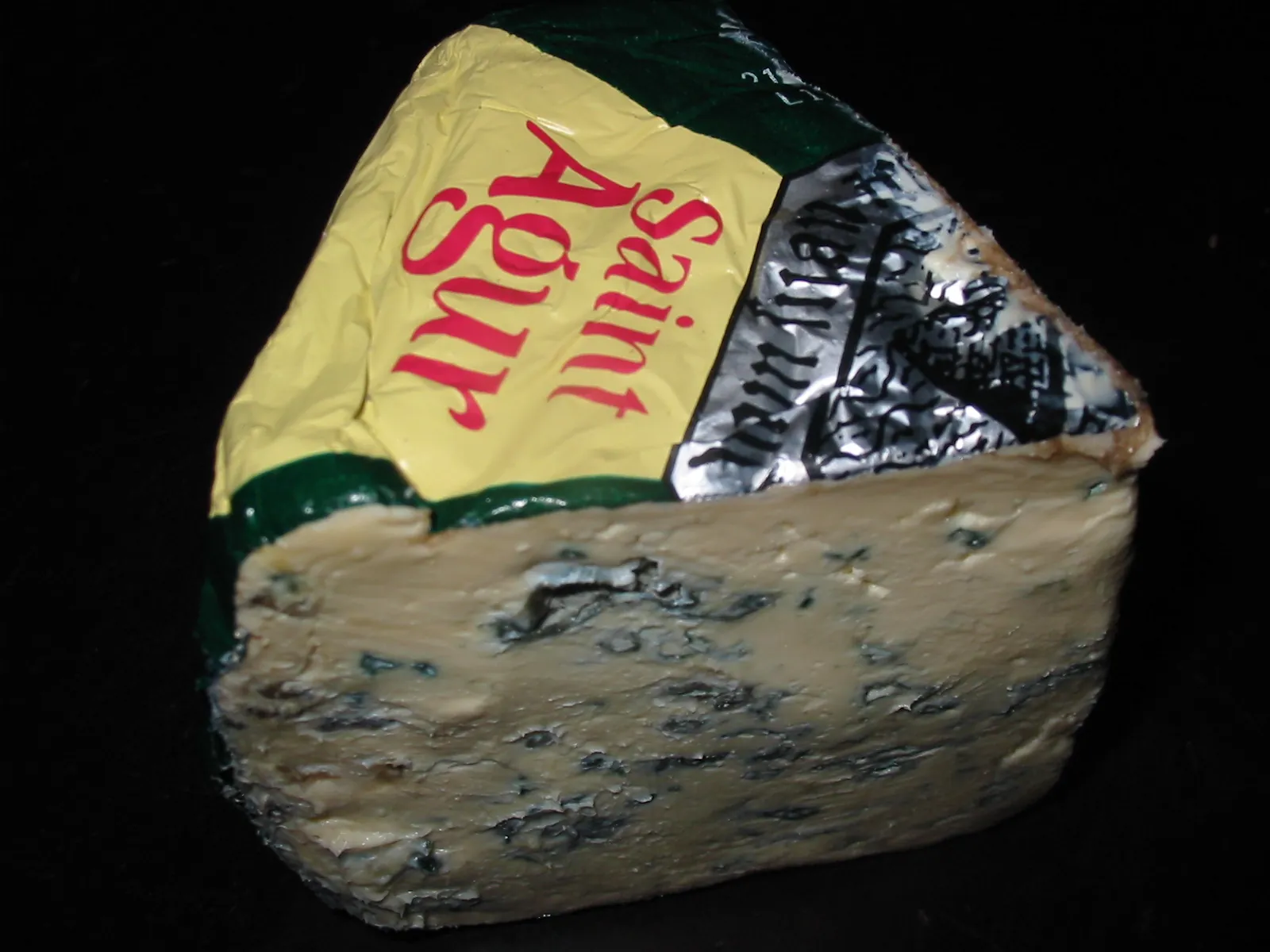
It is made from pasteurized cow's milk at a plant in Beauzac, in the mountains of Haute-Loire in the Auvergne.
Its softness comes from fat. Cream is added to the milk, so the paste is rich and buttery, and the blue mold reads as a gentle tang instead of a salty jolt.
Saint Agur cheese at a glance
Here is Saint Agur cheese at a glance, from its maker's brand page and cheese reference sites.
| Detail | Saint Agur |
|---|---|
| Milk | Pasteurized cow's milk with added cream |
| Made in | Beauzac, Velay mountains, Haute-Loire, Auvergne, France |
| Maker | Savencia Fromage & Dairy (formerly Bongrain), since 1988 |
| Fat | About 60 percent, which is why it counts as a double cream |
| Ripening | Roughly 60 days up to nearly three months, per sources |
| Shape | Octagonal wheel, about 8 in wide and 5 in high, 4 to 5 lb |
| Texture | Soft, creamy, spreadable, melts easily |
| Flavor | Sharp but mellow, fruity, with a mild blue spice |
| Protected name | None: Saint Agur is a brand, not a PDO |
Where Saint Agur cheese comes from
Saint Agur cheese comes from Beauzac, where Savencia says it is still made in the Velay mountains of Haute-Loire. Bongrain, now Savencia, began producing it in 1988, according to cheese.com. It is a modern brand rather than a farmhouse tradition, so no consortium or protected name sets its rules.
Savencia says "nearly three months" in its cellars are needed before the cheese is melting, in controlled temperature and humidity; cheese.com puts ripening at 60 days. Treat it as a cheese that spends two to three months in the cellar. It is wrapped in foil, and Culture magazine lists vegetable rennet, which matters if you shop for vegetarian cheese.
Old guides call the shape hexagonal. Savencia describes it as octagonal, and the wheel really does have eight sides.
What Saint Agur cheese tastes like
Saint Agur cheese tastes buttery and savory, with a mellow, slightly fruity blue spice and only a little salt. The paste is pale cream with blue-green veins, moist and dense but yielding, and it spreads on a cracker without crumbling.
Cheese.com calls the flavor sharp, fruity and mellow, and sure enough the tang shows up late, after the cream. Keep it at room temperature for 30 to 60 minutes before serving so the butter comes forward.
How Saint Agur cheese compares with other blues
Saint Agur cheese compares with other blues mostly on softness and salt. It has no white rind, which sets it apart from Cambozola, and it is richer and less crumbly than a Stilton.
| Blue | Milk | Character |
|---|---|---|
| Saint Agur | Pasteurized cow | Creamy, mellow, mild spice |
| Gorgonzola dolce | Pasteurized cow | Soft, mild, slightly spicy; aged at least 50 days |
| Cambozola | Pasteurized cow | Triple cream with a white rind, the mildest |
| Danablu | Cow, homogenized | Sharper and saltier, sliceable |
| Roquefort | Raw sheep | Firm, salty, strongest |
The Gorgonzola guide explains dolce, Roquefort is the salty classic at the other end, and the Danablu guide covers the sharper Danish blue. For the whole family, see Blue Cheese 101.
How to buy Saint Agur cheese
Buy Saint Agur cheese as a wedge cut from the foil-wrapped wheel, or as the sealed wedges sold in many US supermarkets. Look for a pale, moist paste with blue-green veins spread fairly evenly, and pass on a piece that has dried at the edges, turned gray or smells of ammonia.
Because the paste is so soft, a cut wedge dries out fast. Rewrap it tightly in foil or wax paper after each use, and finish it within a week or two.
How to use Saint Agur cheese
Use Saint Agur cheese wherever a blue should melt or spread. Stir it into a hot pan with a splash of cream for a steak sauce, fold it into pasta off the heat, or whisk it into a dressing. Crumble it, still cold, over a salad of pears, walnuts and bitter greens.
On a board it is the easy blue: pair it with honey, figs, pears and walnuts. Port, Sauternes and fruity reds suit it; Culture lists Chardonnay, Syrah and port, and the port and blue cheese guide explains why sweet wine tames blue. Savencia also sells a spreadable Saint Agur Crème and a ready sauce under the same brand.
What to use instead of Saint Agur cheese
The closest swap for Saint Agur cheese is Gorgonzola dolce, which is just as soft and spoonable. Cambozola is milder and adds a rind, and a mild Danablu is a bit saltier and more crumbly. For a salad you can use almost any blue; for sauces, stay with creamy ones, because dry crumbly blues turn grainy. The substitute finder has more options.
What most Saint Agur advice gets wrong
Most Saint Agur advice repeats a few habits that cost you flavor.
Saint Agur is not a protected cheese
Saint Agur is not a PDO cheese, so the name guarantees a brand, not an area or a rulebook. The PDO and PGI guide explains the difference.
Saint Agur cheese is mild, not bland
Saint Agur cheese is mild, but it is not bland: the tang builds late, so judge it after a few seconds, not at the first bite. Eaten ice cold, it tastes flat and waxy, and that is when people decide they do not like it.
Do not boil a Saint Agur sauce
A Saint Agur sauce should never boil, because high heat can make the cream split. Warm it gently and stir it off the heat.
Questions about Saint Agur cheese
These questions about Saint Agur cheese come up most.
Is Saint Agur cheese a mild blue?
Saint Agur cheese is one of the milder blues, thanks to its added cream.
Can you cook with Saint Agur cheese?
You can cook with Saint Agur cheese: it melts easily into sauces, pasta and dressings.
Is Saint Agur cheese pasteurized?
Saint Agur cheese is made from pasteurized cow's milk, according to Savencia's brand listings on cheese.com and Culture.
Is Saint Agur cheese vegetarian?
Saint Agur cheese is listed with vegetable rennet by Culture magazine, but check the label of the exact wedge you buy.
How should you store Saint Agur cheese?
Store Saint Agur cheese wrapped in foil or wax paper in the fridge and eat it within a week or two of opening; the storing cheese guide covers wraps.
Your first Saint Agur cheese
For your first Saint Agur cheese, buy a small wedge, warm it for 30 to 60 minutes and eat it with a pear and a few walnuts. Then melt the rest into a steak sauce.
Sources
- Saint Agur brand page, Savencia Fromage & Dairy
- Saint Agur, cheese.com
- Saint Agur cheese profile, culture: the word on cheese