
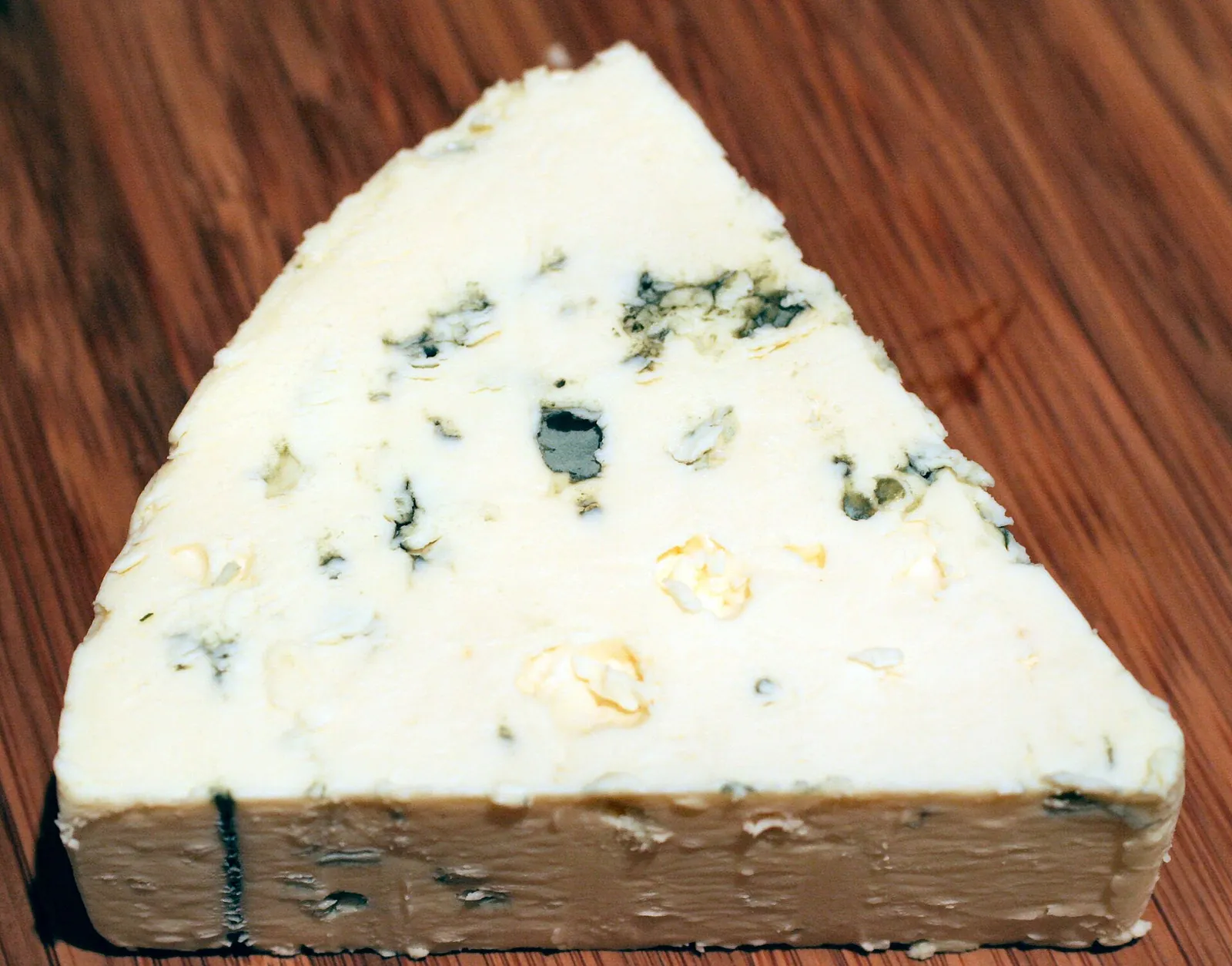
By law it comes only from Danish cow's milk and is aged at least five weeks.
What shapes it is the milk treatment. Danish cheesemakers homogenize the milk, which spreads the fat evenly and gives a whiter, richer paste with a more piquant blue bite than the same mold gives in other cheeses.
Danablu cheese at a glance
Here is Danablu cheese at a glance, from its official product specification.
| Detail | Danablu |
|---|---|
| Milk | Danish cow's milk, homogenized and pasteurized or thermized |
| Made in | Denmark, with every production step inside the country |
| Protected name | PGI (EU register, 1996); specification amended in 2013 |
| Fat | At least 50 or 60 percent in the dry matter, in two versions |
| Aging | At least 5 weeks |
| Shape | Flat cylinder, about 20 cm across and 3 kg, or a block about 30 by 12 cm and 4 kg |
| Paste | White to slightly yellow, marbled with blue-green veins |
| Flavor | Clean and piquant, sharp, salty and a little sour |
What the Danablu PGI requires
The Danablu PGI requires that the cheese be made only in Denmark, from Danish cow's milk, with every stage of production in the country. The Danish Food Administration's specification, the document the EU register refers to, sets out the rest. Two fat levels are allowed: at least 50 percent fat in the dry matter with at least 52 percent dry matter, or at least 60 percent with at least 56 percent. The rind may not carry a paraffin or plastic coating, and the cheese must age at least five weeks.
A PGI protects the name and the link to a country, not a farm, and the PDO and PGI guide explains the difference. The EU approved changes to the Danablu specification in a 2013 regulation, and the label may add "Danish Blue Cheese" beside the registered name.
How Danablu cheese is made
Danablu cheese begins with Danish cow's milk that is fat-standardized, homogenized and then pasteurized or thermized. Starter culture and blue mold culture go in, and after the milk has started to acidify, rennet. The curd is cut, ladled into molds, drained, salted, pierced and aged.
Piercing opens channels so air can reach the blue mold, the same step that makes every blue cheese. Unlike a Stilton, the paste is meant to be loose but not crumbly: the specification asks for a soft, sliceable and spreadable body, a bit firmer toward the outside, with no gas holes.
The history of Danablu cheese
Danablu cheese was developed by the Danish cheesemaker Marius Boel, who bought Marslev dairy in 1914 and began making blue cheese in 1915. By the 1920s he was making around 1,000 cheeses a day, according to the specification. In 1927 he tried homogenized milk, an idea taken from 9 percent coffee cream, and the cheese came out richer, whiter and more piquant. A producers' association formed on June 23, 1934, and the Ministry of Agriculture fixed the name Danablu in 1952.
There is a good side story. During World War II, a US university patented homogenizing cheese milk and tried to charge a levy on Danish cheese made that way, and the claim was dropped once it was shown that Boel had used the method 20 years earlier.
What Danablu cheese tastes like
Danablu cheese tastes sharp, salty and a little sour, with a clean, piquant blue flavor that can turn slightly bitter. The specification describes the taste as strongly marked by the blue mold, and it is stronger than a Cambozola or a Saint Agur.
Compared with Roquefort, it is less complex, and compared with Stilton it is softer and less crumbly. That mix of punch and creaminess is why it ends up in dressings. Many US shoppers meet it first as a supermarket crumble.
How to buy and use Danablu cheese
Buy Danablu cheese by looking for "Danablu" or "Danish Blue Cheese" on the label with Denmark as the origin. Choose a piece with even blue marbling and a white to pale yellow paste, with no gray, no sliminess and no sharp ammonia smell. A wedge keeps better than a bag of crumbles.
Use it where salt and punch help. Crumble it over a salad with pear and walnuts, whisk it into blue cheese dressing, melt it into a steak or burger sauce, or fold it into pasta cream. Because it is salty, taste before adding salt to anything built on it. Serve it on a board with honey, figs, pears and crusty bread, and pour a sweet wine. The port and blue cheese guide explains why that pairing works.
Store it wrapped in foil or wax paper in the fridge and use it within a week or two of opening. The storing cheese guide covers wraps.
What to use instead of Danablu cheese
The nearest swap for Danablu cheese is a firm, salty blue: Gorgonzola piccante or a young Stilton. Maytag Blue is a good American option, and Roquefort is saltier and more complex. In a dressing, any of them works; on a board, taste first. The substitute finder lists more.
What most Danablu advice gets wrong
Most Danablu advice repeats a few habits that cost you flavor.
Danablu is not just a cheap blue
Danablu is not just a cheap Roquefort copy: Boel's homogenized-milk method produced a distinct, whiter, more piquant cheese, and the PGI protects that style.
Danablu is not meant to crumble
Danablu is not meant to crumble like Stilton, and the specification calls for a body that slices and spreads.
Salt the dressing last
When you make Danablu dressing, season only after tasting, because the cheese carries plenty of salt.
Questions about Danablu cheese
These questions about Danablu cheese come up most.
What is Danablu cheese?
Danablu cheese is a Danish blue cheese from cow's milk with a protected geographical indication (PGI).
Is Danablu the same as Danish Blue?
Danablu is the same cheese as Danish Blue: the specification lets the label add "Danish Blue Cheese" beside the registered name.
How strong is Danablu cheese?
Danablu cheese is stronger and saltier than Cambozola or Saint Agur, but less complex than Roquefort.
Is Danablu cheese pasteurized?
Danablu cheese is made from milk that is pasteurized or thermized, according to its specification, so check the label if you need a fully pasteurized cheese.
What is Danablu cheese good for?
Danablu cheese is good in salads, dressings and steak sauces, and on a board with sweet fruit.
Your first Danablu cheese
For your first Danablu cheese, buy a small wedge marked "Danablu" and taste it plain, then crumble the rest into a salad with pear and walnuts. Try it beside a Saint Agur to hear the difference.
Sources
- Produktspecifikation for DANABLU, September 2025, Danish Veterinary and Food Administration
- Enhedsdokument "Danablu", Danish Veterinary and Food Administration
- Commission Implementing Regulation (EU) No 269/2013 on Danablu, European Commission
- Commission Regulation (EC) No 1107/96, European Commission