
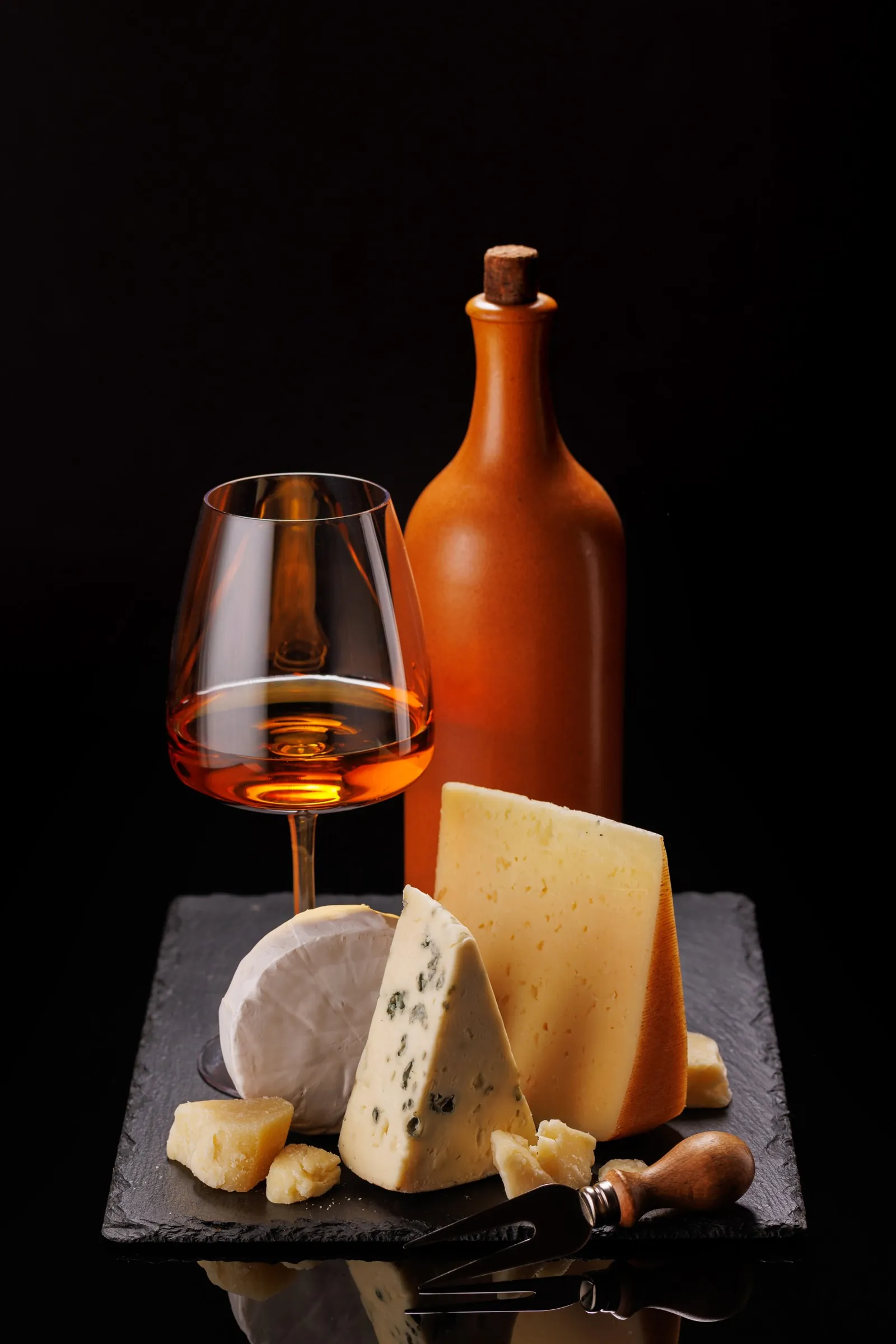
For a first try, pour a tawny with Stilton, which is the traditional pairing in England.
The match sounds odd until you taste it. Blue cheese is salty and sharp because the mold breaks down fat into strong-tasting compounds, and salt is added generously. A review of salt in cheese puts blue-veined cheeses at 3 to 5 percent salt, often applied dry. Port is both sweet and strong, so it can stand up to that intensity without being flattened. That is guidance, and it explains why other sweet wines work too.
Port and blue cheese at a glance
This port and blue cheese table shows which style of port to try first with each blue, and why.
| Blue cheese | Milk and style | Port to try | Why |
|---|---|---|---|
| Stilton | Pasteurized cow's milk, crumbly, mellow | Tawny or ruby | Nutty tawny echoes the savory depth; ruby adds fruit |
| Gorgonzola dolce | Pasteurized cow's milk, soft, creamy | Late bottled vintage or ruby | Fruit and sweetness suit a milder, creamy blue |
| Roquefort | Raw sheep's milk, salty, sharp | Aged tawny or a sweeter wine such as Sauternes | The saltiest of the common blues needs the most sweetness |
| Danablu | Danish cow's milk, sharp | Ruby | Fruity and simple holds up |
Port and Stilton: the classic
Port and Stilton is an English tradition: Wikipedia notes that a barley wine or port is traditionally paired with Blue Stilton, and that the cheese is traditionally eaten at Christmas. Stilton is made in Derbyshire, Leicestershire and Nottinghamshire from pasteurized cow's milk, and it carries a protected designation of origin (PDO) from June 21, 1996, as the Stilton page details. Blue Stilton is a mellow, crumbly blue, so it works with most styles of port, and a tawny is the usual first choice.
One kitchen tip repeats online and is worth skipping: scooping out the center of a Stilton and pouring port in. It exposes the paste to air and drowns the cheese. Cut wedges and pour the port into a glass.
Styles of port with blue cheese
The styles of port come from how the wine is aged, and each one changes the match. According to the IVDP, Port is made in the Douro region by stopping fermentation with grape brandy, which leaves a high alcohol content, usually between 19 and 22 percent by volume. It divides into two aging styles.
Ruby styles (Ruby, Reserve, Late Bottled Vintage and Vintage) are aged to keep a deep red color and youthful fruit. They are the easy, fruity choice with a creamy blue. Tawny styles are blends of wines aged for different lengths of time in casks, and come with age statements of 10, 20, 30 and 40 years, plus single-year Colheita. Their nutty, dried-fruit character suits a mature blue. Vintage port is made to age in the bottle, so save it for a special evening and a cheese that will not bury it.
White Port and rosé also exist, with white offered in several degrees of sweetness, and a sweeter white can be a lighter option with a milder blue.
Port with Gorgonzola, Roquefort and other blues
Port with Gorgonzola, Roquefort and other blues follows one rule: the saltier and stronger the cheese, the sweeter and richer the wine. Gorgonzola in its creamy dolce form is gentle and takes a fruity ruby or LBV. Roquefort is made from raw sheep's milk and is the saltier, sharper cheese, so it welcomes an aged tawny or the classic French match, Sauternes.
The Blue Cheese 101 guide covers the whole family and how they differ. If you are choosing for a guest who is pregnant, note that Roquefort is raw-milk while Stilton and Gorgonzola are pasteurized, as that page explains; ask the guest's doctor and read the label.
How to serve port with blue cheese
To serve port with blue cheese, take the cheese out of the fridge about an hour ahead so the paste softens, and pour the port at cool room temperature (a tawny is nice slightly chilled). A small glass is enough, since port is strong. Put out walnuts, a pear or a few figs, and honey if you like extra sweetness: cheese and nuts and cheese and honey have more.
Plan about 1 to 2 ounces of blue per person on a board and a splash of port, in line with the cheese per person guide. Please serve alcohol to adults only, and offer a non-alcoholic option such as the drinks in non-alcoholic pairings.
Port and blue cheese mistakes
The common port and blue cheese mistakes are a cheese that is too cold, a port that is too dry, and a wine that drowns a delicate cheese. A very dry red wine fights the salt and can taste bitter beside blue cheese, which is why sweet wines work better. Likewise, a young, mild blue next to a very old vintage port wastes the port.
Do not serve a huge pour. After dinner, one small glass beside a wedge is the whole experience.
Questions about port and blue cheese
These questions about port and blue cheese come up most often.
Why does port go with blue cheese?
Port goes with blue cheese because its sweetness and ripe fruit balance the cheese's salt and sharp, funky flavor, and the salt makes the port taste richer.
What port goes best with Stilton?
The port that goes best with Stilton is a tawny, whose nutty notes echo the cheese, though a ruby or LBV also works.
Can you use something other than port with blue cheese?
Something other than port with blue cheese works if it is sweet: Sauternes with Roquefort is a famous French match, and late harvest wines and sweet sherry follow the same logic.
Is vintage port worth it with blue cheese?
Vintage port with blue cheese is a treat, not a requirement. A tawny or LBV costs less and works just as well for most people.
Is Stilton always pasteurized?
Stilton is always made from pasteurized cow's milk, per the PDO, so it differs from raw-milk Roquefort.
Try port and blue cheese tonight
For your first port and blue cheese tasting, buy a small wedge of Blue Stilton and a bottle of tawny, let the cheese warm for an hour, and taste with a pear and a few walnuts. Then switch to a ruby and notice what changes.
Sources
- Port Wines: Introduction, Instituto dos Vinhos do Douro e do Porto (IVDP)
- The Reduction of Salt in Different Cheese Categories, Frontiers in Nutrition
- Stilton cheese, Wikipedia