
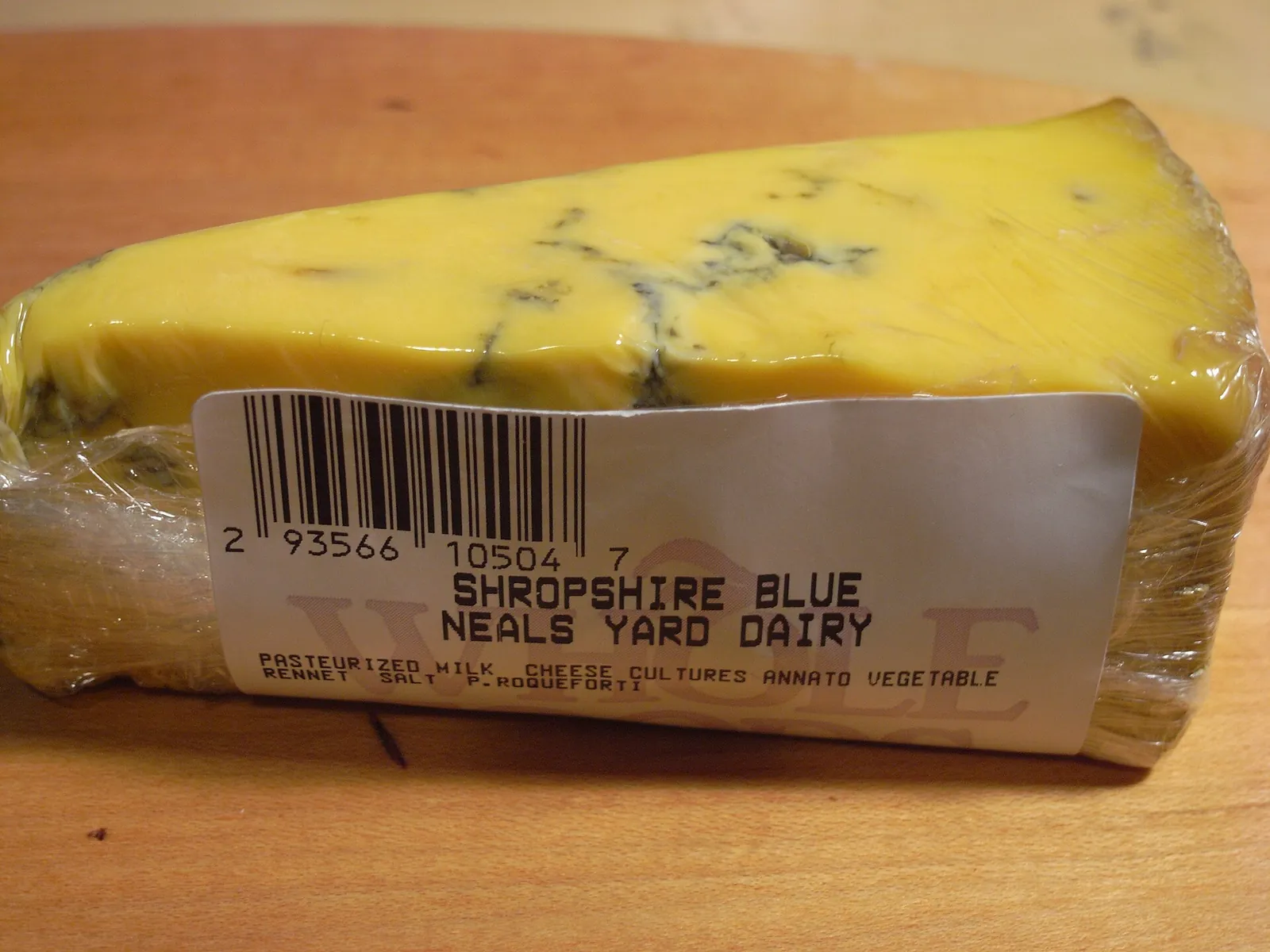
Cheesemaker Andy Williamson created it in Scotland in the 1970s, and it is now made in Nottinghamshire.
The orange is annatto, a plant dye, and it does little to the taste. What you taste is a smooth, creamy blue that sits between a mild blue and a Stilton, with the sweetness or the sharpness depending on who is describing it.
Shropshire Blue at a glance
Here is Shropshire Blue at a glance, from reference summaries of the cheese.
| Detail | Shropshire Blue |
|---|---|
| Milk | Pasteurized cow's milk, vegetable rennet |
| Made in | Nottinghamshire, England (Colston Bassett dairy is named as a current maker) |
| First made | 1970s, at Castle Stuart dairy near Inverness, Scotland |
| Color | Orange paste from annatto, with blue veins from Penicillium roqueforti |
| Age | About 10 to 12 weeks |
| Fat | About 48 percent |
| Texture | Smooth, semi-soft and creamy |
| Flavor | Described as sharp and tangy by some sources and delicately sweet by others |
Why Shropshire Blue is not made in Shropshire
Shropshire Blue was first made around Inverness, Scotland, so the name is a marketing choice and not a place. According to Wikipedia, Andy Williamson, who had trained in making Stilton, produced it in the 1970s at Castle Stuart dairy. The Cheese Atlas adds that he first called it Inverness-shire Blue and changed the name to help sales.
A rival account credits a Shropshire dairyman, Dennis Biggins of Whitchurch, with a similar cheese in the 1930s, with the recipe later rediscovered by Williamson. CooksInfo adds that when the Scottish creamery closed in 1980, two Nottinghamshire dairies, Clawson and Colston Bassett, picked up the recipe, and it describes the taste as somewhat like cheddar with a blue tang, milder and sweeter than Stilton. Either way, a separate cheese called Ludlow Blue, made in Shropshire with carotene instead of annatto, is a different product.
Why Shropshire Blue is orange
Shropshire Blue is orange because the maker adds annatto, a natural food coloring from a tropical plant, to the milk. The same dye colors red Cheshire and Red Leicester, and the Cheshire page covers how annatto is used there. Annatto adds color, not flavor: the taste comes from the cheese and its mold.
The orange does one useful thing. The blue-green veins show up sharply against it, so a Shropshire Blue wedge looks dramatic on a board, especially at a holiday table.
How Shropshire Blue is made
Shropshire Blue is made much like Stilton: pasteurized cow's milk is set with culture and vegetable rennet, with Penicillium roqueforti producing the veins, and the cheese matures for about 10 to 12 weeks. The Cheese Atlas says the recipe borrows from both Stilton and Cheshire, and that at 6 to 8 weeks the cheese develops a rusty natural rind.
For how the veins form in general, see Blue Cheese 101. The short version: piercing lets air reach the mold, and the mold grows along the channels.
What Shropshire Blue tastes like
Shropshire Blue tastes creamy and savory with a clear but balanced blue bite, and descriptions differ on how sharp it is. Wikipedia calls it sharper than Stilton and generally creamier, while The Cheese Atlas calls it delicately sweet with no sharpness or bitterness. Both can be true, because blue cheese from different batches and ages varies.
Expect a smooth, semi-soft paste that is less crumbly than Stilton. Younger pieces are milder and sweeter; older pieces get tangier. If you want a first blue that is bold but not harsh, this is a good pick.
Buying Shropshire Blue in the US
Buying Shropshire Blue in the US means buying an import from a cheese shop, so ask for a wedge cut from a wheel. Look for a bright, even orange paste with veining spread through it and a creamy, not dry or chalky, face. The guide to choosing blue cheese covers what to check on any blue.
Do not confuse it with Stilton. Stilton is a protected name that only three counties can use, and Shropshire Blue is a separate cheese, sold under its own name.
How to serve Shropshire Blue
Shropshire Blue is best served at room temperature, so take it out of the fridge about an hour ahead. The Cheese Atlas suggests honey and walnuts and a drink of English brown ale or a fortified wine such as port. Port and blue cheese explains why the sweetness works against the salt.
On the plate, pears, figs, celery and oatcakes all work. Crumble it over a salad of bitter leaves and walnuts, or stir a small amount into a warm cream sauce for steak off the heat. It melts into sauces more smoothly than a drier blue. For board ideas, see the cheese board guide.
Shropshire Blue substitutes
The nearest substitute for Shropshire Blue is a mild Stilton, which is crumblier and has no orange. For the color, a colored Cheshire is similar in hue but is not blue. For a creamy blue with the same smoothness, try a young, creamy Gorgonzola-style blue. The substitute finder has more.
Storing Shropshire Blue
Store Shropshire Blue wrapped in wax paper or foil in the fridge, in a lidded container to keep its smell in, and eat a cut wedge within about two weeks. The storing cheese guide has more on wraps.
What most Shropshire Blue advice gets wrong
Most advice on Shropshire Blue repeats three habits that mislead.
Shropshire Blue is not a Stilton variety
Shropshire Blue is not a type of Stilton, because Stilton is a protected name tied to three counties and one specification, and Shropshire Blue is its own cheese. They share a method and a mold, not a name.
The orange is not a flavor
The orange in Shropshire Blue is annatto, and it does not make the cheese sharper or sweeter. Judge the cheese by its smell and paste.
The Shropshire Blue origin story is partly true
The Shropshire Blue origin story is not entirely invented, because a rival account places a similar cheese in Shropshire in the 1930s. The Scottish origin is the better documented.
Questions about Shropshire Blue
These are the questions about Shropshire Blue that come up most.
Is Shropshire Blue from Shropshire?
Shropshire Blue is not from Shropshire: it was first made in Scotland in the 1970s and is now made in Nottinghamshire.
Why is Shropshire Blue orange?
Shropshire Blue is orange because annatto, a natural plant dye, is added to the cheese.
How does Shropshire Blue compare to Stilton?
Shropshire Blue compares to Stilton as a smoother, orange cousin made in a similar way, and some describe it as sharper while others call it sweeter.
Is Shropshire Blue pasteurized and vegetarian?
Shropshire Blue is made from pasteurized cow's milk with vegetable rennet, according to the reference summaries, but check the label of the piece you buy.
Your first Shropshire Blue
For your first Shropshire Blue, buy a small wedge cut to order, serve it after an hour on the counter with walnuts, honey and a pear, and compare it with a mild Stilton.
Sources
- Shropshire Blue, Wikipedia
- Shropshire Blue: The Orange Stilton, The Cheese Atlas
- Shropshire Blue, CooksInfo