
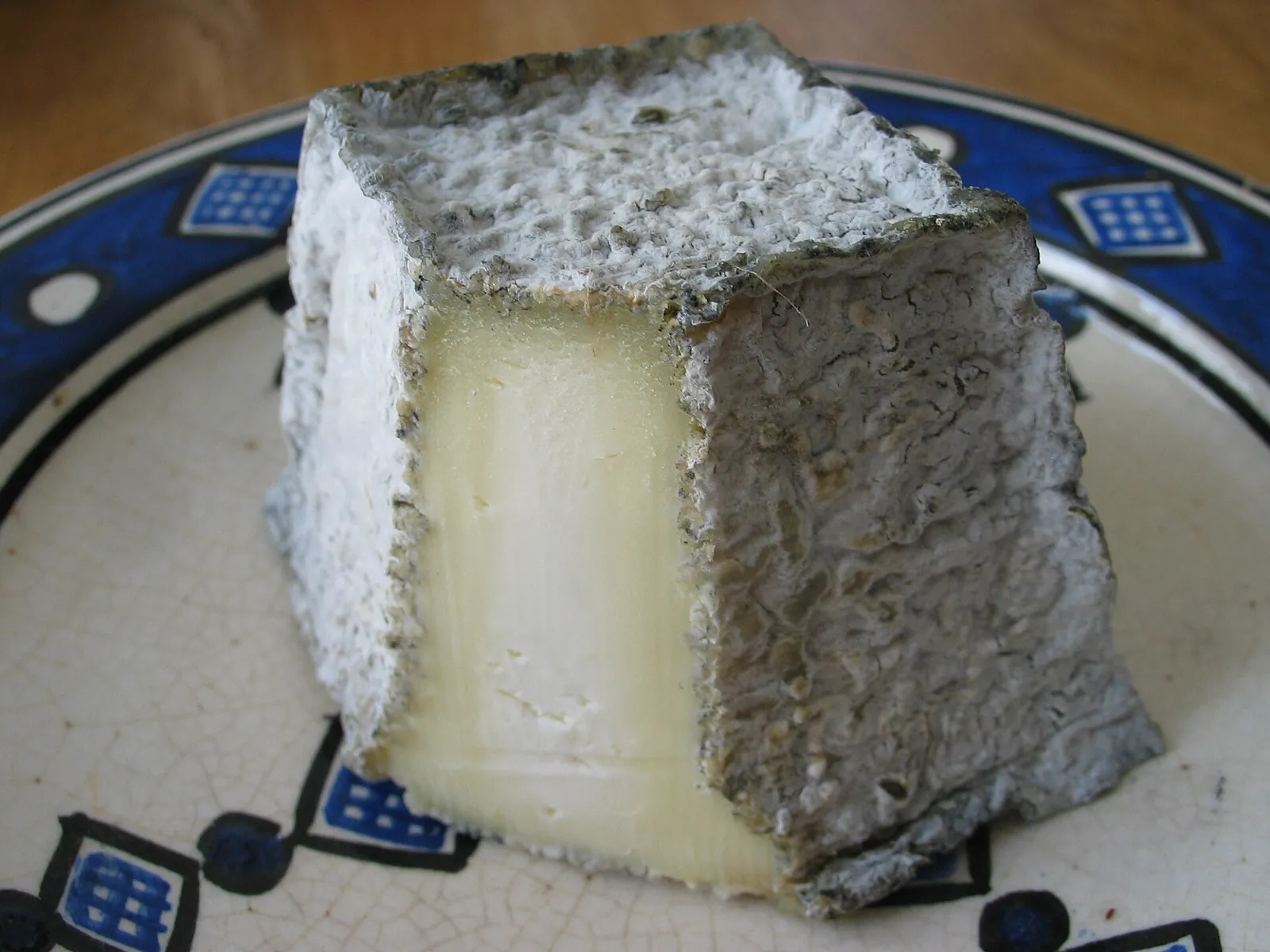
It is made from raw milk in Berry, in the Loire region of central France, and sold from the 11th day of ripening.
The shape is the first thing anyone notices, and the story behind it is the second. The cheese itself is lactic and clean, a fresh goat tang that deepens into hazelnut as the rind ripens.
Valençay cheese at a glance
Here is Valençay cheese at a glance, taken from the AOP specification at INAO, the French body that sets the rules for protected names.
| Detail | Valençay |
|---|---|
| Milk | Raw, whole, unhomogenized goat's milk from Alpine or Saanen goats and their crosses |
| Made in | Berry and the neighboring Loire area, around the town of Valençay |
| Protected name | AOP (the French form of the EU's PDO) |
| Shape | Truncated pyramid with a square base, in a large or a small ("petit") size |
| Aging | Sold only from the 11th day after renneting, when the rind is fully formed |
| Rind | Light gray to blue-gray from vegetable charcoal and surface molds |
| Paste | Porcelain white, smooth, fine, homogeneous |
| Dry matter | At least 40 percent of the weight |
Where Valençay cheese comes from
Valençay cheese comes from Berry and nearby parts of the Loire, a region of clay-limestone soils and a mild ocean climate where goats have been kept for centuries. The spec traces goat keeping to Charlemagne's capitularies and to 16th century archives of La Châtre, and notes writers from Talleyrand, who was lord of the Château de Valençay, to George Sand praising the cheese.
The cheese took its present name in the 20th century and found a wider market then. It is the only goat cheese of the region shaped as a truncated pyramid that is ashed and ripened under a bloomy rind, the spec says. CNIEL, the French dairy trade body, counts 298 tonnes marketed in 2020. The guide to French chevre covers the other goat AOPs, and the PDO and PGI labels guide covers the seal.
The Napoleon legend behind the Valençay shape
The Valençay shape has a legend, though not one the spec confirms. CNIEL tells it with Talleyrand at the castle: after Napoleon's defeat in Egypt, Talleyrand had the pyramid-shaped cheeses beheaded so they would not remind the emperor of it. Some versions have Napoleon himself striking the top off with a sword.
Treat it as a good story. The spec explains the shape the practical way: the cheese is molded in truncated pyramid molds with set dimensions, 50 to 55 mm across the base for the large size and 40 to 44 mm for the small one.
How Valençay cheese is made
Valençay cheese is made from raw, whole, unhomogenized goat's milk from no more than the last four milkings. Rennet is added in small doses, the curd sets for at least 18 hours and then drains by its own weight, with no pressing, for at least 20 hours from the start of molding.
After unmolding, the cheese is salted and coated on every face with vegetable charcoal. It then dries and ripens until a rind has formed over the whole surface and molds show to the naked eye. It can leave the ripening room only from the 11th day after renneting. A "petit" Valençay, from the small mold, must carry that word on the label, but it cannot sit right above the name.
The ash is part of the technique. The spec says salting and ashing together with slow ripening and the surface molds form a complex that regulates moisture exchange and builds taste and aroma.
Valençay cheese flavor by age
Valençay cheese flavor runs from fresh and lemony when young to nutty and more complex as it ages. The spec describes goat, forest floor, mushroom and floral notes, and CNIEL says forest floor and hazelnut, with a soft, creamy paste when young that develops with ripening.
A young Valençay around 11 to 20 days is moist, dense and tangy, with a pale gray rind. Later the rind turns blue-gray, the paste firms and the flavor becomes nuttier and more pungent. The rind is thin and edible, and the ash is mild.
How to buy Valençay cheese in the US
Buying Valençay cheese in the US depends on the FDA's raw-milk rule. The standard for soft ripened cheeses says cheese from unpasteurized milk must be cured at 35°F (2°C) or warmer for at least 60 days, against 11 in France. A raw-milk Valençay on a US counter is therefore at least 60 days old, and drier and stronger than one eaten in Berry.
Look for the pyramid shape and an even ash coat with no wet spots, and ask whether it is raw milk and how old. A pasteurized-milk pyramid is a different cheese, because the AOP requires raw milk. The raw-milk cheese guide explains the safety side.
How to serve Valençay cheese
Serve Valençay cheese at room temperature after about 30 minutes out of the fridge, cut in wedges from the top down so everyone gets rind and paste. A whole pyramid is a good board centerpiece, and the cheese board guide shows how to place it.
Crisp Loire whites suit it: CNIEL lists Valençay AOC wines in red, white or rosé, and Sancerre or other Sauvignon Blanc also work. Honey, figs, walnuts, seeded baguette and fruit bread go with it, and the goat cheese pairing guide and the Pairing Guide list more. It can also be crumbled over salads.
Valençay cheese substitutes
A Valençay cheese substitute is another ash-coated ripened goat cheese. Selles-sur-Cher is milder and flat, while a young Sainte-Maure log is close in flavor. The Substitute Finder lists more swaps.
What most Valençay cheese advice gets wrong
Most Valençay cheese advice gets a few details wrong.
The Napoleon story is a legend
The Napoleon story about Valençay cheese is a legend, and versions differ on who wielded the sword. The spec explains the shape by the mold.
Valençay is not the same as Selles-sur-Cher
Valençay is not the same as Selles-sur-Cher, because the shapes differ: a flat-topped pyramid against a flat disc. Both are ashed raw goat cheeses from the Loire area.
The ash is not soot
The ash on Valençay cheese is vegetable charcoal salted into the surface, not soot, and you can eat it. Wet slime or a sour smell is the sign to discard it.
Questions about Valençay cheese
These questions about Valençay cheese come up most often.
Why does Valençay have a flat top?
Valençay has a flat top because it is molded in truncated pyramid molds, and by legend Talleyrand beheaded the cheeses so they would not remind Napoleon of Egypt.
Is Valençay made from raw milk?
Valençay is always made from raw milk, because the AOP requires it. In the US it must be aged at least 60 days.
How long is Valençay aged?
Valençay is aged at least 11 days after renneting before it can be sold, once a rind has formed on its whole surface.
Can you eat the rind on Valençay?
You can eat the rind on Valençay, because it is a thin ash and mold coat that is part of the cheese.
What wine goes with Valençay?
Crisp Loire whites such as Sauvignon Blanc or Sancerre go with Valençay, and CNIEL lists local Valençay AOC wines.
Your first Valençay cheese
For your first Valençay cheese, buy a small pyramid, let it warm for 30 minutes and cut wedges to serve with honey and a Loire white. Eat it within a few days of cutting.
Sources
- Cahier des charges de l'appellation d'origine Valençay, INAO (Institut national de l'origine et de la qualité)
- Valençay, AOP goat cheese, CNIEL (Interprofession laitière)
- 21 CFR 133.182, Soft ripened cheeses, Legal Information Institute, Cornell Law School