
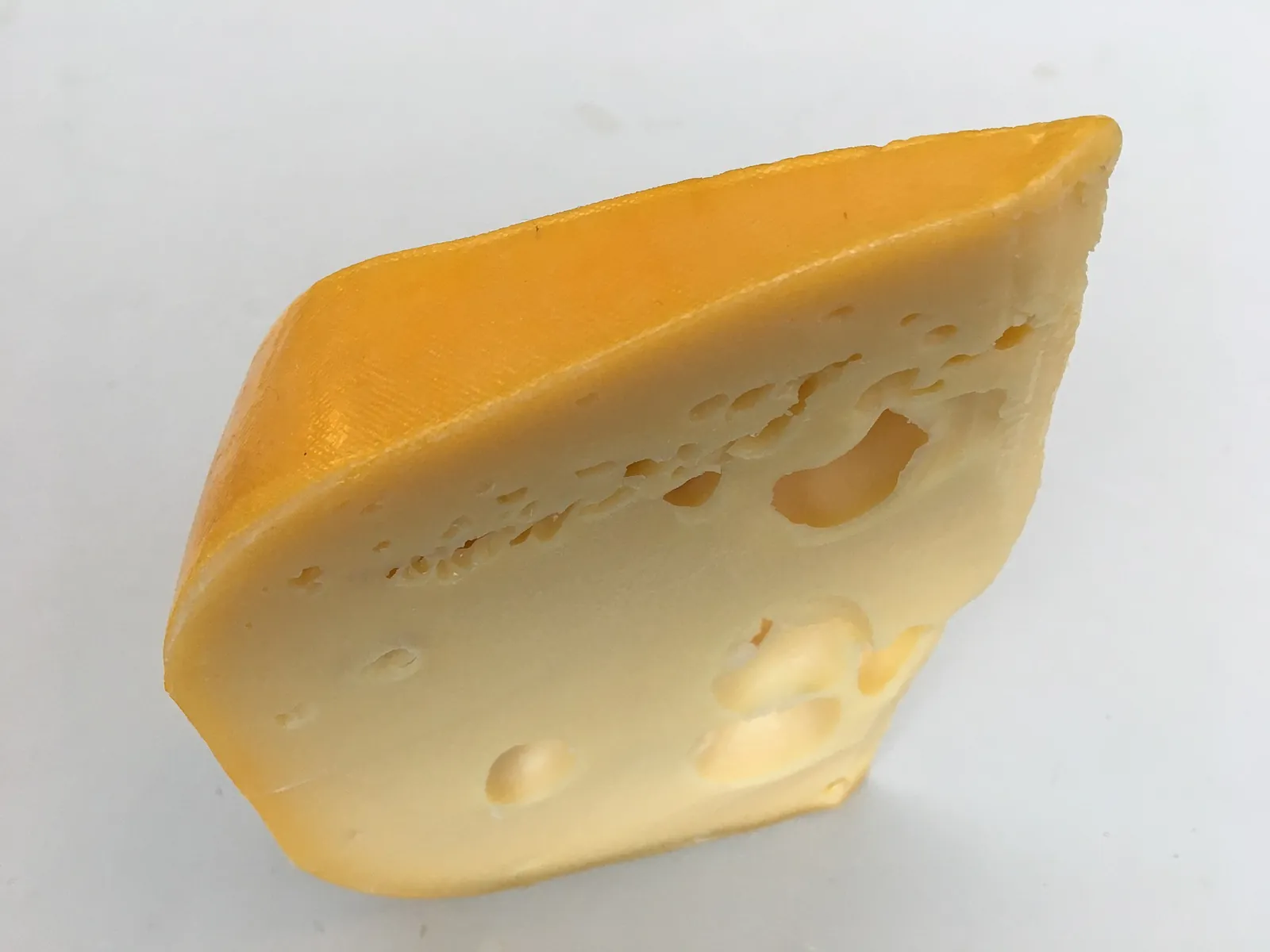
Leerdammer was launched in the Netherlands in 1974 and is now owned by the French dairy group Lactalis, which sells it in the US as Président Leerdammer. Maasdam is the general name for the kind of cheese Leerdammer pioneered, mild and supple like a young Gouda but with the big round holes of Emmental. NIZO, the Dutch dairy research institute that helped create it, lists the cheese as "Maasdam (e.g. Leerdammer)."
The maker frames it the other way around. Leerdammer's Dutch website says that when the cheese was developed it could not be filed under any existing type, such as Gouda or Emmentaler, so it became a new type with its own name. Both accounts hold up. Leerdammer came first, and Maasdam is what the style is called when anyone else makes it.
Leerdammer vs Maasdam at a glance
Here is Leerdammer vs Maasdam at a glance, alongside Emmental and Jarlsberg.
| Leerdammer | Maasdam | Emmentaler AOP | Jarlsberg | |
|---|---|---|---|---|
| What the name is | A registered trademark | A cheese style | A protected Swiss name | A registered trademark |
| Who makes it | Lactalis, in the Netherlands | Any dairy | Almost 100 Swiss village dairies | Its brand owner, in Norway, Ireland and the US |
| Milk | Pasteurized cow's milk (US label) | Cow's milk | Raw cow's milk | Pasteurized cow's milk |
| Youngest age sold | 6 weeks | Up to each maker | 4 months | Not published |
| Taste | Mild, nutty | Slightly sweet | Slightly sweet young; tart to intense at 8 to 12 months | Mild, sweet, nutty |
| Calories per 100 g | 352 | Varies by maker | 395 | 351 |
| Salt or sodium | 1.5 g salt per 100 g; 170 mg sodium per ounce (US label) | Varies by maker | 0.5 g salt per 100 g | 440 mg sodium per 100 g |
Leerdammer is a brand, Maasdam is a style
Leerdammer is a brand and Maasdam is a style, and the history shows how the two names split. According to the Dutch farm newspaper Boerenbusiness, the cheese was developed at NIZO in Ede and brought to market in 1974 by the cheese company Baars Kaas, which set out at once to make it a branded product. The food group Wessanen took over the brand and its factory, De Vijfheerenlanden in Schoonrewoerd, in 1976. Leerdammer later passed to France's Bel group and then to Lactalis, growing into one of the largest cheese brands in Europe.
The maker credits two founders, dairy owner Cees Boterkooper and Bastiaan Baars, who wanted to combine the mild taste of Gouda with the holes of Emmental, and says the name honors the town of Leerdam. NIZO, founded by the Dutch dairy industry in 1948, credits itself with helping create "Maasdam (e.g. Leerdammer)" and "Proosdij (e.g. Parrano)," pairing each cheese type with a brand that sells it.
The two names have different legal standing too. Neither Maasdam nor Leerdammer appears in the European Union's register of protected food names, which does list Dutch cheeses such as Gouda Holland, Edam Holland and Noord-Hollandse Gouda. Leerdammer is protected as a registered trademark instead, so any dairy may make Maasdam, but only the brand owner can sell Leerdammer. The Maasdam profile covers the style on its own.
Why Leerdammer and Maasdam have big holes
Leerdammer and Maasdam have big holes because of propionic acid bacteria, the same microbes that open the eyes in Emmental. A European Commission research project on these bacteria, CORDIS project FAIR961024, lays out the chemistry. Starter bacteria produce lactate, and the propionic bacteria convert that lactate into propionate, acetate and carbon dioxide. The gas collects in weak spots in the curd and inflates them into eyes, while the propionic acid adds much of the flavor. Leerdammer's own FAQ puts it more simply: the bacteria make gas that cannot escape the cheese.
Size gives the style away. Typical Dutch cheese has eyes 3 to 10 millimeters across, about 1/8 to 3/8 inch, according to a 2009 article in the Dutch cheesemaking magazine De Zelfkazer, while Emmentaler, Maasdammer and Leerdammer grow round, glossy eyes up to 2 or 3 centimeters, close to an inch. The same article credits the propionic bacteria with the faint sweetness, since propionic acid tastes a little sharp and sweet.
The bacteria need warmth. Emmentaler AOP spends its first six to nine weeks at about 72°F (22°C) before moving to a cellar at about 54°F (12°C). Leerdammer's makers say the culture that forms its holes has not changed since the 1970s; after pressing, the wheels sit in brine for more than two days, ripen for at least six weeks and are coated in wax.
Leerdammer vs Emmental and Jarlsberg
Leerdammer vs Emmental and Jarlsberg is a contest among three cheeses built around the same holes, and age and milk explain most of the difference.
Leerdammer vs Emmental
Leerdammer vs Emmental comes down to age and milk. Emmentaler AOP is made from raw milk in almost 100 Swiss village dairies, and its youngest wheels are aged four months, when the Emmentaler consortium calls the cheese mild and slightly sweet, with notes of dried grass and milky caramel. At 8 months it turns fine and tart, and at 12 months intense. Leerdammer, sold from six weeks, stays softer and milder, with what its maker calls a creamy texture similar to Gouda.
Use Emmental when you want depth, as in fondue, and Leerdammer when you want easy slicing and a gentle melt. The guide to Emmental, Swiss and Gruyère covers the Swiss side in detail.
Leerdammer vs Jarlsberg
Leerdammer vs Jarlsberg is the closest match, since both were invented to cross Gouda with Emmental. Jarlsberg came first. Its makers trace it to Professor Ystgaard and his students at the Agricultural University of Norway, who used a new culture in the 1950s to put more holes into Gouda-style cheese, and the brand was born in 1956. Jarlsberg is now made in Norway, Ireland and the US, and the slices and blocks sold in America use US milk.
On the label the two are near twins. Per 100 grams, Jarlsberg lists 351 calories and 27 grams of fat, and Leerdammer's Dutch slices 352 calories and 27.5 grams. Swap one for the other freely; the Jarlsberg profile has more on the Norwegian side.
How to use Leerdammer and Maasdam
Use Leerdammer and Maasdam wherever you would use a young Swiss or a mild Gouda.
- Cold sandwiches: thin slices on rye with ham and mustard.
- Hot sandwiches: a toastie, patty melt or croque monsieur, where the young cheese melts quickly.
- Breakfast: Dutch style on buttered bread, or folded into an omelet.
- Baking: quiche and gratins, with a sharper cheese added if you want more flavor.
- Boards: with apples, pears, walnuts and a crisp white wine or a lager.
For fondue, make it half the cheese and let Gruyère bring the depth that a six-week cheese lacks. For the rest of the Dutch cheese counter, see the guide to Dutch cheeses.
Substitutes for Leerdammer
Good substitutes for Leerdammer are any Maasdam, Jarlsberg, baby Swiss or a young Emmental. For melting, buy the full-fat version. Jarlsberg's makers say their lower-fat Lite will not melt like the original, and the same logic applies to Leerdammer Light, which cuts fat from 27.5 to 16 grams per 100 grams. The substitute finder has more swaps.
What most Leerdammer guides get wrong
Most Leerdammer guides repeat the origin story and skip the label details that matter in a US store.
Fat in dry matter is not the fat content. European labels often state fat as a share of the cheese's dry matter, the part left if all the water were gone. Leerdammer's FAQ says to multiply by about 0.6 for semi-hard cheese, and Jarlsberg's label shows the result: 45 percent fat in dry matter, 27 percent fat in the cheese. Leerdammer's UK slices list 27.5 grams of fat per 100 grams.
It is saltier than Emmental. Per 100 grams, Leerdammer's European label lists 1.5 grams of salt, three times the 0.5 grams the Emmentaler consortium lists for its Classic. In US terms, Leerdammer has 170 mg of sodium per ounce, against about 125 mg for Jarlsberg.
The US version is made a little differently. The Dutch slices list only milk, salt, starter culture and a vegetarian coagulant, and promise no added preservatives. The US wedges add annatto extract for color and natamycin, a natural mold inhibitor, and name the coagulant only as "enzymes," so vegetarians should ask the maker.
There is more than one Leerdammer. In the Netherlands the brand sells longer-ripened Caractère slices with a fuller, more savory taste, plus a Light line. US shoppers mostly meet the Original, as a 7-ounce wedge or cut from a wheel.
Questions about Leerdammer
Here are quick answers to common questions about Leerdammer.
What type of cheese is Leerdammer?
Leerdammer is a Dutch cow's-milk cheese of the Maasdam type, supple like a young Gouda with big holes made by propionic acid bacteria.
Is Leerdammer the same as Maasdam?
Leerdammer is the original brand of Maasdam-style cheese. Every Leerdammer is Maasdam in style, but another dairy's Maasdam is not Leerdammer.
Is Leerdammer the same as Jarlsberg?
Leerdammer is not the same as Jarlsberg, though both cross Gouda with Emmental. Jarlsberg is Norwegian and dates to 1956, while Leerdammer is Dutch and dates to 1974.
Is Leerdammer highly processed?
Leerdammer is not highly processed. It is a natural cheese of milk, salt, cultures and a coagulant that is pressed, brined and aged, not a process cheese like American slices, though the US version adds a mold inhibitor and annatto.
Is Leerdammer lactose free?
Leerdammer says independent lab tests found less than 0.01 grams of lactose per 100 grams in most of its products. If you are lactose intolerant, the NIDDK notes that hard cheeses such as Swiss are lower in lactose than other dairy foods and that most people can handle some lactose.
Where can you buy Leerdammer in the US?
You can buy Leerdammer in the US as Président Leerdammer, which arrived for the brand's 50th anniversary in 7-ounce wedges and as wedges cut from whole wheels at specialty cheese counters.
Buying Leerdammer or Maasdam
Buying Leerdammer or Maasdam comes down to whether you want the original brand or simply the style. In the US, ask the cheese counter for Président Leerdammer, and when it is missing, any Maasdam, Jarlsberg or baby Swiss will do the same jobs.
Start with a toasted ham-and-Leerdammer sandwich. Then taste a cold slice beside a young Emmentaler, and the extra months of aging will show.
Sources
- Our history, NIZO
- Leerdammer: Veelgestelde vragen (FAQ), Over Leerdammer, Jong Original and Jong Belegen Caractère (Dutch), Our brand, Original slices and Light slices (UK), Our brand and Président Leerdammer 7oz wedge (US), Lactalis
- Top cheese brand in the Netherlands celebrates its anniversary in private, Boerenbusiness, June 7, 2024
- European Commission: Project FAIR961024 on propionic acid bacteria in cheese (CORDIS) and eAmbrosia, the EU geographical indications register
- Kaas met een knipoog, De Zelfkazer, October 2009, Wageningen University & Research eDepot
- Emmentaler Switzerland: Product range, Emmentaler AOP Mild/Classic and Craftsmanship, Emmentaler AOP consortium
- Jarlsberg: Our Story and Products, Jarlsberg
- Eating, Diet, & Nutrition for Lactose Intolerance, National Institute of Diabetes and Digestive and Kidney Diseases