
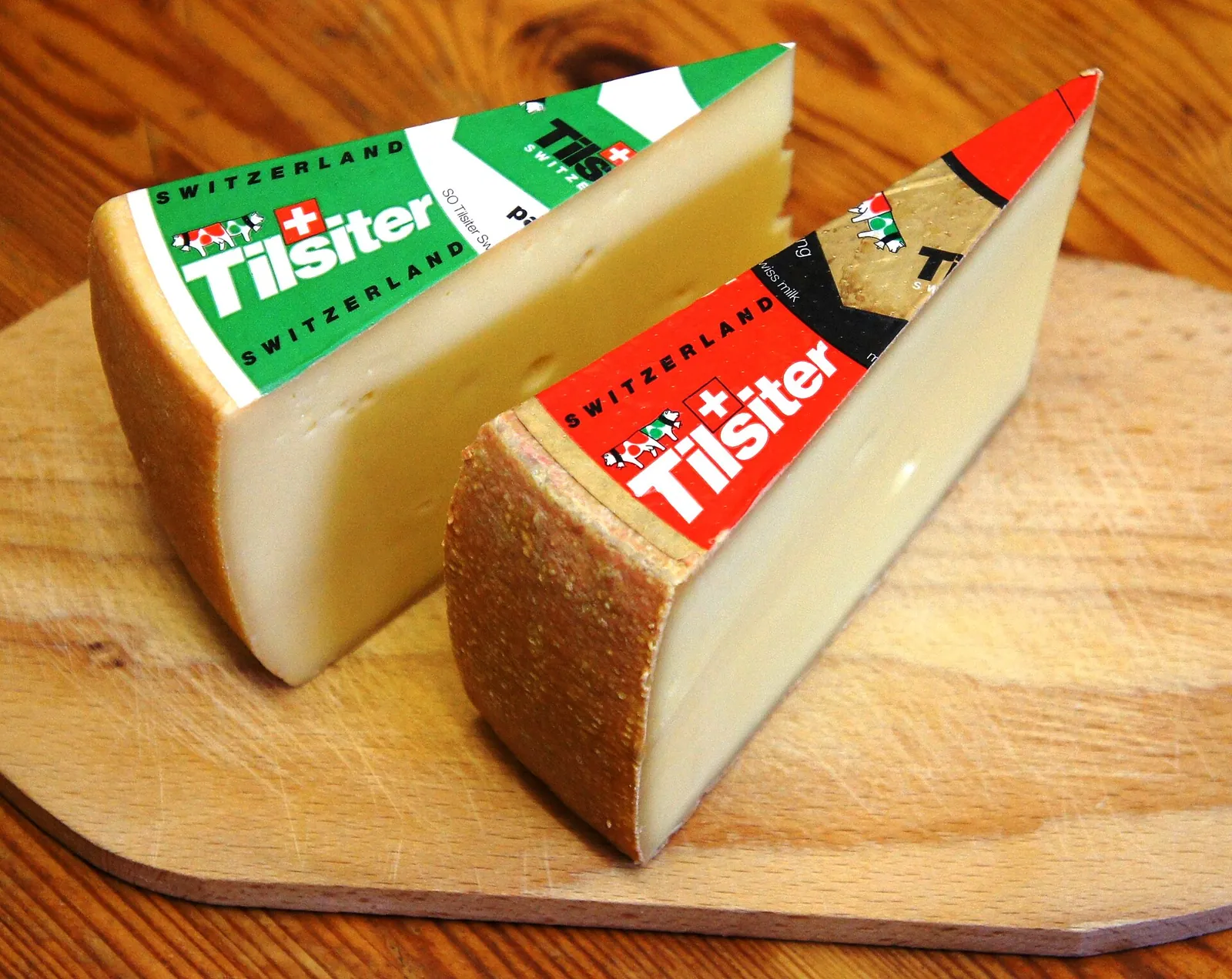
It is tangy and savory, firm enough to slice cleanly and soft enough to melt, which makes it an everyday sandwich cheese rather than a showpiece.
The name has outlived the town. After 1945 the German-speaking cheesemakers were expelled and the town became Sovetsk, so the cheese carried on elsewhere, and what you buy today is a Swiss or German version with its own rules.
Tilsit cheese at a glance
Here is Tilsit cheese at a glance, using the Swiss Red Label as the example because its maker publishes the figures.
| Detail | Swiss Tilsiter, Red Label |
|---|---|
| Milk | Cow's milk, raw or partially thermised |
| Made in | Cantons Thurgau and St. Gallen and the Zurich Oberland, Switzerland |
| Type | Semi-hard, smear-ripened |
| Ripening | At least 3 months |
| Fat | Full-fat, at least 45 percent |
| Rind | Brown-red, from regular brine washing on wooden boards |
| Texture | Firm to easy-to-cut, fine |
| Flavor | Full-bodied and tangy |
| Rennet | Animal |
| Per 100 g | 365 kcal, 26 g protein, 29.5 g fat |
Where Tilsit cheese comes from
Tilsit cheese takes its name from Tilsit in former East Prussia, and the modern Swiss version dates to 1893. That year, Otto Wartmann returned to Thurgau from the town of Tilsit with a cheese recipe and refined it at Bissegg. The family's farm, the Holzhof, is where the maker says the first Swiss Tilsiter was made in 1893.
Wartmann changed the cheese on the way. According to swissinfo, he made the holes round instead of slits and the paste smooth where the original was crumbly. In 2007 the Holzhof farmstead was officially renamed Tilsit, after an importer announced Russian Tilsiter and EU agricultural duties fell on June 1 of that year, so there is now a place called Tilsit again.
Swiss Tilsiter and its label colors
Swiss Tilsiter is sold in six styles that the producers separate by label color, according to the Tilsiter Switzerland site. The Red label is the mild, aromatic classic, with a surchoix version of it; the Black is the extra; the Green and the Yellow (creamy) are two more styles; and the Blue is the light one. The Red, the maker says, develops its tang over its three-month ripening and is naturally lactose-free. Its factsheet lists the milk as raw or partially thermised.
Use the color as a guide to the style, not as a quality ladder: pick Red or Yellow for mild sandwiches and cooking, and Black or Green when you want more flavor.
German Tilsiter and the PGI
German Tilsiter has its own protection: Holsteiner Tilsiter received EU protected geographical indication (PGI) status on December 9, 2013, reported by Lebensmittel Zeitung. To carry the name, the cheese must be made and ripened in Schleswig-Holstein, though the milk does not have to come from there.
A PGI is looser than a PDO because only one stage has to happen in the region. The PDO and PGI guide lays out the difference, and the Swiss and German cheeses are separate products that share a name.
What Tilsit cheese tastes like
Tilsit cheese tastes tangy, savory and a little spicy, with a smooth, supple paste, and the Swiss Red Label is described by its maker as full-bodied and tangy. The tang comes from the washed rind: brine washing encourages the surface bacteria that give the rind its brown-red color and some of its savor. That sets it between a plain mild cheese and a strong one, well short of Limburger.
The rind types guide explains how washed rinds differ from natural and bloomy ones.
How to use Tilsit cheese
Tilsit cheese is at its best sliced thin on dark bread, melted over potatoes or into a toastie, and set on a board with pickles and mustard. Slice it cold and let it warm for 20 minutes if you are serving it on a board, and grate it fresh for cooking so it melts evenly.
For drinks, a lager or wheat beer matches its tang, and the beer and cheese guide has more. A dry white or a light red also works.
How to buy and store Tilsit cheese
To buy Tilsit cheese, look for "Tilsiter" with a country named: Swiss Tilsiter for the Swiss cheese, Holsteiner Tilsiter for the protected German one. The Swiss Red Label is a good first pick. Because the Swiss version is raw or partly thermised milk and aged at least three months, check the label for the age and see the raw-milk cheese guide if you have a reason to avoid it.
Store it wrapped in the fridge and use it within a couple of weeks. The storing cheese guide covers wraps.
Tilsit substitutes
For a Tilsit cheese substitute, the closest are mild washed-rind semi-hards. Port Salut is the nearest in texture and softness. Appenzeller is tangier with an herb-washed rind. For a smooth melting stand-in without the washed tang, Gouda or Havarti will do. The substitute finder has more options.
What most Tilsit advice gets wrong
Most Tilsit advice treats Tilsit as one cheese, when it is two protected traditions and a family of Swiss styles. The Swiss Tilsiter has round holes and a smooth paste because of changes made in 1893; a German Holsteiner Tilsiter is made under a different rule. A recipe written for one will still work with the other, but expect a different tang.
The other mistake is expecting a strong smell. Tilsit is washed-rind, but it is the mild end of that group, so it will not clear a room the way a stronger washed-rind cheese does.
Questions about Tilsit cheese
These are the Tilsit cheese questions that come up most.
What does Tilsit cheese taste like?
Tilsit cheese tastes tangy and savory with a smooth, firm paste, and the Swiss Red Label is described as full-bodied and tangy.
Is Tilsit cheese Swiss or German?
Tilsit cheese began in East Prussia and is made today in both countries: Swiss Tilsiter since 1893 and Holsteiner Tilsiter in Schleswig-Holstein, which has been protected as a PGI since December 2013.
Is Tilsit cheese good for melting?
Tilsit cheese is good for melting because it is a semi-hard cheese with a supple paste, so use it in toasties and gratins.
Does Tilsit cheese have holes?
Tilsit cheese has small round holes in the Swiss style, which Otto Wartmann made round instead of slits, according to swissinfo.
What is a good Tilsit cheese substitute?
A good Tilsit cheese substitute is Port Salut for a mild washed-rind cheese or Appenzeller for a tangier one.
Your first Tilsit cheese
For your first Tilsit cheese, buy a small wedge of Swiss Red Label Tilsiter, slice it onto dark rye with mustard and pickles, and pour a lager. If you want a milder or tangier cheese afterward, compare it with Havarti next.
Sources
- Tilsiter Red Label factsheet, Tilsiter Switzerland
- Cheese smells of international incident, swissinfo.ch
- Tilsiter Switzerland: origin and history, Switzerland Tourism
- Tilsiter varieties, SO Tilsiter Switzerland GmbH
- Holsteiner Tilsiter muss aus Schleswig-Holstein kommen, Lebensmittel Zeitung